Showing posts with label Gone with the Wind. Show all posts
Showing posts with label Gone with the Wind. Show all posts
Tuesday, December 15, 2009
A Kid in the Choir
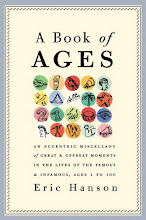
Gone with the Wind had its premiere on this day in 1939, at the Leow's Grand Theatre in Atlanta. The theatre front was turned into a plantation mansion for the three-day gala, complete with white pillars. Searchlights filled the sky. Crowds filled the intersection of Peachtree and Pryor. Newsreel cameras caught everything. Clark Gable chatted with the mayor, Vivien Leigh chatted with Margaret Mitchell. And somewhere in the commotion there was a boy's choir with a ten year-old member named Martin Luther King Jr. who probably thought this was the biggest day of his life, the most famous he would ever be. Martin Luther King Jr. appears four times in A Book of Ages. (Margaret Mitchell appears once, and Clark Gable and Vivien Leigh don't appear at all.)

Saturday, May 23, 2009
Inventor of Dreams
Americans adore their own mythology. Maybe it's because we're still young enough as a country. The biggest manufacturer of that mythology is and was the movie business, which was a far more energetic and prolific creative force earlier on, during the Studio Era. The era, to take two examples, of Gone with the Wind and The Wizard of Oz. Both pictures are fundamental to how America imagines itself. Both were made in one year, 1939, by one film director who hardly anybody remembers today: Victor Fleming.
Fleming gets his desserts (or is it deserts?) on page 211 of A Book of Ages, and is one of only a handful of unfamous people in the whole book. But his imprint is so indelible our forgetfulness ought to be a crime. The half of us who don't dream about Oz dream of Tara.
Fleming also gets a well-deserved treatment in this week's New Yorker magazine, in the capable hands of David Denby. The occasion is a new biography of Fleming by Michael Sragow. Biographers are like entrepreneurs in one important sense. They devote years of toil based on a hope that people will give a damn, if I may quote Rhett Butler. In this case, the subject is fascinating and important but virtually unknown, less famous, for instance, than Chelsea and her vodka.
Fleming gets his desserts (or is it deserts?) on page 211 of A Book of Ages, and is one of only a handful of unfamous people in the whole book. But his imprint is so indelible our forgetfulness ought to be a crime. The half of us who don't dream about Oz dream of Tara.
Fleming also gets a well-deserved treatment in this week's New Yorker magazine, in the capable hands of David Denby. The occasion is a new biography of Fleming by Michael Sragow. Biographers are like entrepreneurs in one important sense. They devote years of toil based on a hope that people will give a damn, if I may quote Rhett Butler. In this case, the subject is fascinating and important but virtually unknown, less famous, for instance, than Chelsea and her vodka.
Subscribe to:
Posts (Atom)

 Posts
Posts


