Showing posts with label Henry Luce. Show all posts
Showing posts with label Henry Luce. Show all posts
Thursday, July 30, 2009
Very Early Television
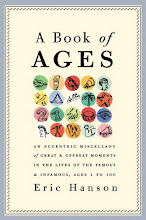
In July 1932, 29 year-old Clare Boothe was having an affair with married Wall Street moneybags Bernard Baruch and was invited over to his place to watch something his friend David Sarnoff called television. Not yet a playwright or married to Henry Luce of Time magazine, Boothe was an editor at Vanity Fair. She appears three times in A Book of Ages. Understudying Mary Pickford on Broadway, letting boyfriend Henry Luce "go all the way", and being nervous as her play "The Women" opens on Broadway in 1936. (Henry Luce appears twice.)

Sunday, April 19, 2009
Bicycle Day & Paul Revere
On this day in 1943 in Basel, Switzerland, a 37 year-old research scientist named Albert Hofmann ingested an experimental alkaloid called lycergic acid and went for a ride on his bicycle, thus experiencing the very first acid trip. April 19 has been remembered as "bicycle day" by druggies ever since.
Lycergic acid, better known as LSD, became the plaything of an adventurous elite for several decades before becoming illegal. Henry Luce and his Republican congresswoman wife enjoyed it in the privacy of their Republican home. Cary Grant tried it for the first time when he was filming Houseboat; he was 54. Aldous Huxley wrapped it in philosophy. Dr. Timothy Leary, age 46, wrote a slogan for it. Albert Hofmann, its inventor, lived to a ripe old age. His is the last entry in A Book of Ages, at age 100, fit as a fiddle, in full command of his faculties and making no mention at all of flashbacks.
On the night of April 19, 1775 Paul Revere, age 40, took a very different trip, on horseback, from Boston to Lexington. Henry Wadsworth Longfellow wrote a famous poem about the event in 1863 when he was 56. Myth is more memorable when it rhymes. Revere appears four times in A Book of Ages, most memorably at age 38 when he dresses up like an Indian and helps dump East India Company tea into Boston harbor. That was more of a consumer protest over prices than a tax rebellion, but again mythology is what people remember.
Lycergic acid, better known as LSD, became the plaything of an adventurous elite for several decades before becoming illegal. Henry Luce and his Republican congresswoman wife enjoyed it in the privacy of their Republican home. Cary Grant tried it for the first time when he was filming Houseboat; he was 54. Aldous Huxley wrapped it in philosophy. Dr. Timothy Leary, age 46, wrote a slogan for it. Albert Hofmann, its inventor, lived to a ripe old age. His is the last entry in A Book of Ages, at age 100, fit as a fiddle, in full command of his faculties and making no mention at all of flashbacks.
On the night of April 19, 1775 Paul Revere, age 40, took a very different trip, on horseback, from Boston to Lexington. Henry Wadsworth Longfellow wrote a famous poem about the event in 1863 when he was 56. Myth is more memorable when it rhymes. Revere appears four times in A Book of Ages, most memorably at age 38 when he dresses up like an Indian and helps dump East India Company tea into Boston harbor. That was more of a consumer protest over prices than a tax rebellion, but again mythology is what people remember.
Subscribe to:
Posts (Atom)

 Posts
Posts


