Today is Guy Fawkes Day, celebrated in England with bonfires and with stuffed effigies that children use to extort money and sweets.
On November 5th 1605 Guy Fawkes was caught leaving a rented cellar adjacent to the Houses of Parliament where a subsequent search discovered 36 barrels of gunpowder, enough explosives to break all the windows within a kilometer's radius and exterminate the Mother of Parliaments and King James I during the State Opening scheduled for that day. The Catholic conspirators also planned to kidnap the royal children. They expected a popular uprising to follow that would restore the kingdom to the Catholic faith. If they had succeeded the King James Bible would, like the breed of spaniels, have been named after James's son Charles instead. Unless, of course, the kidnapping had succeeded as well; in that event, who knows. History is a mare's nest of causes and effects.
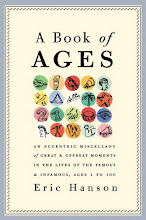
James I appears once in A Book of Ages. Charles I also appears once. Fawkes doesn't appear at all, but does feature prominently in the film "V for Vendetta." Some consider Guy Fawkes the patron saint of anarchists and pyromaniacs. What the anarchists couldn't achieve, Parliament achieved, at least partly, by legal means, when they beheaded Charles I in 1649.
Showing posts with label London. Show all posts
Showing posts with label London. Show all posts
Thursday, November 5, 2009

Wednesday, October 28, 2009
The Satirist's Satirist
Evelyn Waugh was born on this day in 1903. He was the second son of a prominent London publisher whom he cordially loathed. It was a childhood of mutual disappointment. In true English lower-upper-middle-class fashion Evelyn worked very hard at appearing not to try or to care and unsurprisingly failed at everything. He scorned everything valued by the society he grew up in while secretly coveting it all. He was sent down from Oxford after two years, considered becoming an illustrator, learned fancy cabinet-making, failed as a schoolteacher, attended parties with the Bright Young Things of the time. When he was 24 he attempted suicide by swimming out to sea. He turned back after being stung by a jellyfish.
At age 26, on a madcap impulse, he married the daughter of a Lord. She was also named Evelyn, and they became known as She Evelyn and He Evelyn, a matched set of semi-androgynous wits. He was 27 when they divorced. It was a cruel blow to his ego, but by this time he'd become a bestselling novelist, turning his disappointments into fiction.
His style is one of joyful malice, but reading about his life it's hard to tell whether he or the world was guilty of the first cruelty. Was he unloved or unlovable? Judging by his letters and books he seems thoroughly misanthropic, but he was much loved and had many friends. He climbed into the fashionable Country House set he admired but dressed and behaved in an aggressively unfashionable manner, which outraged everyone––but amused them privately. His most successful novel was probably his worst, a soppy, sentimental hymn to a rapidly declining aristocracy. His best novels are his earliest, funniest, bitterest ones, Decline and Fall, Vile Bodies and Scoop. Evelyn Waugh appears six times in A Book of Ages, and could have appeared a half dozen more.
It's worth noting that he passed his gifts along to his children. One son, Auberon, became an even more cynical, amusing, pitiless scold than his father.
At age 26, on a madcap impulse, he married the daughter of a Lord. She was also named Evelyn, and they became known as She Evelyn and He Evelyn, a matched set of semi-androgynous wits. He was 27 when they divorced. It was a cruel blow to his ego, but by this time he'd become a bestselling novelist, turning his disappointments into fiction.
His style is one of joyful malice, but reading about his life it's hard to tell whether he or the world was guilty of the first cruelty. Was he unloved or unlovable? Judging by his letters and books he seems thoroughly misanthropic, but he was much loved and had many friends. He climbed into the fashionable Country House set he admired but dressed and behaved in an aggressively unfashionable manner, which outraged everyone––but amused them privately. His most successful novel was probably his worst, a soppy, sentimental hymn to a rapidly declining aristocracy. His best novels are his earliest, funniest, bitterest ones, Decline and Fall, Vile Bodies and Scoop. Evelyn Waugh appears six times in A Book of Ages, and could have appeared a half dozen more.
It's worth noting that he passed his gifts along to his children. One son, Auberon, became an even more cynical, amusing, pitiless scold than his father.
Monday, October 19, 2009
Burning the Husband's Erotica
On October 19, 1890, explorer, Orientalist, and translator of erotica, Richard Francis Burton died in Trieste. He was the first non-Muslim to visit the holy city of Mecca, completing the trek in mufti, speaking the native tongues. Burton also spent years searching for the source of the Nile (it was ultimately discovered by his erstwhile exploring partner, John Hanning Speke) but he died in more mundane circumstances. Hoping to save his reputation, his wife lit a bonfire in the backyard of their house in Mortlake outside London. Among the things she burned were his unpublished translation of the erotic classic The Scented Garden, which he’d been working on for 14 years. She was offered the astounding sum of £6,000 to publish it. Burton was 69. Burton appears four times in A Book of Ages.
Monday, October 5, 2009
A Letter to 84 Charing Cross Road
Sixty years ago today, on October 5, 1949, Helene Hanff wrote a letter to a bookstore in London. Marks & Co. was located at 84 Charing Cross Road; Miss Hanff was located on East 95th Street in New York City. She'd read their ad in the Saturday Review (a magazine once influential and now dead) and asked if they could send her "clean secondhand copies" of books on a list she enclosed. Hazlitt, Stevenson, Leigh Hunt––she loved books of essays. Also English authors, mostly 19th century. (In the letter she disparages the "grimy, marked-up schoolboy copies" available at Barnes & Noble, which was where NYU students flogged their books.) This initial note began a twenty-year friendship.
Helene Hanff was a 33 year-old writer of radio and television scripts and unproduced stage plays. She never visited Marks & Co. Friends of hers who visited London stopped by the shop and described its details and its people to her; that's the closest she came. By the time she could afford the fare to London the store had closed and her book-dealer correspondent, Frank Doel, had died. Hanff didn't particularly like travel anyway. She traveled through books, and the books traveled to her. Despite her love of cigarettes and martinis, she lived to be 80. Helene Hanff appears once in A Book of Ages, writing that first of many letters. In 1970 the two-way correspondence was collected into a book of its own, which I still reread occasionally. It remains in print.
I remember reading 84 Charing Cross Road when it was first published. I was a 14 year-old book collector, and obtained most of my books not by catalog but by bicycle. I rode the ten or so miles from suburban Minneapolis to Nelson's Book Shop and Oudal's Used and Rare located downtown, bringing the books home in a backpack. Hanff and I had similar tastes, though I preferred Charles Lamb to Hazlitt and Hunt. I still have the books I bought then, the prices I paid remain unerased inside the endpapers. The 1900 Dent edition of The Last Essays of Elia (with illustrations by C. E. Brock) cost $2.
Helene Hanff was a 33 year-old writer of radio and television scripts and unproduced stage plays. She never visited Marks & Co. Friends of hers who visited London stopped by the shop and described its details and its people to her; that's the closest she came. By the time she could afford the fare to London the store had closed and her book-dealer correspondent, Frank Doel, had died. Hanff didn't particularly like travel anyway. She traveled through books, and the books traveled to her. Despite her love of cigarettes and martinis, she lived to be 80. Helene Hanff appears once in A Book of Ages, writing that first of many letters. In 1970 the two-way correspondence was collected into a book of its own, which I still reread occasionally. It remains in print.
I remember reading 84 Charing Cross Road when it was first published. I was a 14 year-old book collector, and obtained most of my books not by catalog but by bicycle. I rode the ten or so miles from suburban Minneapolis to Nelson's Book Shop and Oudal's Used and Rare located downtown, bringing the books home in a backpack. Hanff and I had similar tastes, though I preferred Charles Lamb to Hazlitt and Hunt. I still have the books I bought then, the prices I paid remain unerased inside the endpapers. The 1900 Dent edition of The Last Essays of Elia (with illustrations by C. E. Brock) cost $2.
Monday, September 28, 2009
Tom and Viv
In September 1932, T. S. Eliot moved out of the London apartment he shared with his wife, Vivien. The poet was 43. They'd been married for almost twenty years, but her mental illness had made her increasingly difficult to live with. She had begun biting visitors. The poet (who was never married to the novelist George Eliot) appears seven times in A Book of Ages.
Friday, September 4, 2009
Buried Treasure
On September 4, 1666, diarist Samuel Pepys dug a hole in his back garden to bury his wine and his best cheese in, and hopefully save it from the Great Fire Of London, which was burning closer by the day. He was 33.
Tuesday, August 18, 2009
Pepys, Unexpurgated
On August 18, 1667, Samuel Pepys wrote in his diary “… being weary, turned into St Dunstan's church, where I hear an able sermon of the minister of the place. And stood by a pretty, modest maid, whom I did labour to take by the hand and the body; but she would not, but got further and further from me, and at last I could perceive her to take pins out of her pocket to prick me if I should touch her again...” Pepys was 34. This and other merry entries about the naval bureaucrat's sexual life would remain unread by readers of literature until the unexpurgated diary appeared in the 1970s.
Subscribe to:
Posts (Atom)

 Posts
Posts


