Showing posts with label childhood. Show all posts
Showing posts with label childhood. Show all posts
Friday, May 21, 2010
Lucky Lindy
On this day in 1927 Charles Lindbergh landed in Paris, where he was greeted by an enthusiastic crowd. He'd been alone in his plane for two days and hadn't slept in 55 hours. He survived on four sandwiches, two canteens of water and 451 gallons of gasoline. He might have landed anywhere from Portugal to Norway; the $25,000 prize was for crossing the Atlantic and didn't specify a destination. Still a crowd of 100,000 was at Le Bourget to greet him when his plane emerged from low clouds. They lifted him out of the plane like a newborn baby. He became an instant world celebrity, a role he never came to grips with. Fame led to the kidnapping and murder of his young son in 1932. World leaders courted him. In the thirties he became a friend and political ally of the Nazis. Luftwaffe chief Hermann Goering pinned a medal on him in 1936. Charles Lindbergh appears seven times in A BOOK OF AGES.

Monday, December 21, 2009
Christopher Robin
Christopher Robin Milne received a stuffed donkey for Christmas in 1921. He was one year-old and had already received a stuffed bear for his birthday in August. You know the rest of the story. His clever father wrote a book about Christopher Robin and his toys, and then another. They were bestsellers, which embarrassed the boy no end when he went away to school. (The other boys enjoyed chanting "Hush hush, whisper who dares! Christopher Robin is saying his prayers!")
The books, in their fiftieth printing by now, were read to you when you were small, long before you understood the wit. Then you reread them in college. Trying to recapture the innocence of childhood worked as a temporary respite from first semester finals. Christopher Robin eventually grew up. He was wounded in action in World War II, married, and opened a bookstore in Dorset. He later wrote a book about the difficulties of living a famous childhood. He appears six times in A Book of Ages.
The books, in their fiftieth printing by now, were read to you when you were small, long before you understood the wit. Then you reread them in college. Trying to recapture the innocence of childhood worked as a temporary respite from first semester finals. Christopher Robin eventually grew up. He was wounded in action in World War II, married, and opened a bookstore in Dorset. He later wrote a book about the difficulties of living a famous childhood. He appears six times in A Book of Ages.
Thursday, December 3, 2009
Peanuts
A Book of Ages is full of touchstones, just as our lives are. If we can't invent our own touchstones, they're provided for us by sit-coms and columnists and comic strips and stand-up comics. They fit neatly into a book like mine. I included as many of them as I could think of. Little annotations explaining our lives to us. Sometimes it's only a deadpan commentary. We didn't get Peanuts in our daily paper; it came in the evening edition, hardly fair. Luckily it's in reruns now, and it's as if my childhood is being explained to me. Though I doubt I was as percipient as Linus. Looking at the photograph of me sitting on the stoop in my snowsuit I may have been about as downbeat as Charlie Brown. Sometimes anyway.
Today's Peanuts strip is a pretty good reprise of my book's take on life. We always figure we could have done better. Charles Schulz appears 14 times in A Book of Ages, getting a dog, having his cartoons rejected by his high school yearbook, having his marriage proposal rejected by a young woman with red hair, starting a comic strip, introducing us to the idea of the football we will never be allowed to kick, explaining why Christmas is sometimes so depressing. So many of his strips were touchstones. I enjoy picturing Schulz as Grand Marshall of the Rose Bowl Parade. An unlikely apotheosis.
Today's Peanuts strip is a pretty good reprise of my book's take on life. We always figure we could have done better. Charles Schulz appears 14 times in A Book of Ages, getting a dog, having his cartoons rejected by his high school yearbook, having his marriage proposal rejected by a young woman with red hair, starting a comic strip, introducing us to the idea of the football we will never be allowed to kick, explaining why Christmas is sometimes so depressing. So many of his strips were touchstones. I enjoy picturing Schulz as Grand Marshall of the Rose Bowl Parade. An unlikely apotheosis.
Sunday, June 28, 2009
The Little Prince
Today is the birthday of the aviator and author Antoine de Saint-Exupéry, born in Lyon, France, in 1900. In 1935, a plane he was piloting from Paris to Saigon crashed in the Sahara. After surviving the crash, he and his navigator lived for four days on grapes, two oranges and a bottle of wine before being rescued by a Bedouin on a camel. This adventure formed the germ of the story that became The Little Prince.
After France surrendered to the Germans in 1940, Saint-Exupéry moved to New York and lived in a penthouse apartment overlooking Central Park. It was here and in a rented mansion on Long Island Sound that he wrote the book for which he is best remembered. The Little Prince was published in 1943. Shortly after this Saint-Exupéry returned to Europe to offer his services to the Free French. On July 31, 1944 he took off on a reconnaissance mission from Corsica and was never seen again. He was 43.
Saint Exupéry appears on page 164 in A Book of Ages. Alternately twee and wise, but never cynical, The Little Prince is one of those books people read in their last year of college, just as they are about to launch into the unknown. It's reread later on in moments when the world seems inexplicable––and it can be read in a moment; it's quite short. One of the things it examines is the gulf between our selves at different ages. He writes: "Grown-ups never understand anything for themselves, and it is tiresome for children to be always and forever explaining things to them." Sometimes when I read that it sounds ironic, and sometimes he sounds completely in earnest. It depends on where I am when I read it.
After France surrendered to the Germans in 1940, Saint-Exupéry moved to New York and lived in a penthouse apartment overlooking Central Park. It was here and in a rented mansion on Long Island Sound that he wrote the book for which he is best remembered. The Little Prince was published in 1943. Shortly after this Saint-Exupéry returned to Europe to offer his services to the Free French. On July 31, 1944 he took off on a reconnaissance mission from Corsica and was never seen again. He was 43.
Saint Exupéry appears on page 164 in A Book of Ages. Alternately twee and wise, but never cynical, The Little Prince is one of those books people read in their last year of college, just as they are about to launch into the unknown. It's reread later on in moments when the world seems inexplicable––and it can be read in a moment; it's quite short. One of the things it examines is the gulf between our selves at different ages. He writes: "Grown-ups never understand anything for themselves, and it is tiresome for children to be always and forever explaining things to them." Sometimes when I read that it sounds ironic, and sometimes he sounds completely in earnest. It depends on where I am when I read it.
Thursday, May 28, 2009
Famous Childhoods
Watching eight adorable children tumble across the TV screen puts me in mind of earlier versions of the same thing. I sometimes wonder what America will be remembered for. Will it be Coca Cola or baseball or will it be famous children? They are the quintessential American product.
It's a familiar story: a family hoping to change its luck thrusts the cute youngster on the stage. Child saves the family farm. Judy Garland and Mickey Rooney putting on a show in the old barn were only re-enacting their life stories. Garland started at age two, Rooney at 17 months. Being famous can be a terrible burden on the very young, but is stardom any worse than being poor? Some children thrive on it. Some adjust. Some never find their feet in life. Shirley Temple turned out all right, protected by a remarkable and practical stage mother. Shirley was the most famous person in America at age 5. The worst disillusionment occurred at age 7 when a department store Santa asked for her autograph. But years later, there she was, bright as paint and adorable as ever, on the album cover of Sgt. Pepper. As if she'd never grown up.
America didn't invent the child star. Mozart was one, playing the piano for crowned heads before his feet could reach the pedals. Christopher Milne was an ordinary shy London child, neglected by his society mother, adored by his nanny, observed from a discreet distance by his father who wrote comic verses for Punch. "Hush, hush, whisper who dares/ Christopher Robin is saying his prayers." Then there were the clever books about the boy's adventures with a stuffed bear. None of it went down particularly well when Christopher Robin went away to school, but his toilet training wasn't available on DVD.
Playwright James Barrie befriended a family of little boys in a London park. He gave them gifts and told them stories and played games with them, behaving very unlike a respectable London adult. When their parents died he adopted them. He wrote a very famous play about the youngest one, named Peter, imagining a boy who never grows up at all. But they did grow up, and all their ends were tragic. Biographers have suggested that Barrie corrupted them, but there is no real evidence. The story reminds us of another former child star who lives a strange, secluded life at a California ranch called Neverland. When the whole world is paying attention to you it must be very hard to grow up normal and average and happy. But there are cases where it's been done.
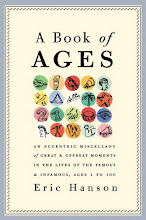
These and other famous childhoods are included in A Book of Ages.
It's a familiar story: a family hoping to change its luck thrusts the cute youngster on the stage. Child saves the family farm. Judy Garland and Mickey Rooney putting on a show in the old barn were only re-enacting their life stories. Garland started at age two, Rooney at 17 months. Being famous can be a terrible burden on the very young, but is stardom any worse than being poor? Some children thrive on it. Some adjust. Some never find their feet in life. Shirley Temple turned out all right, protected by a remarkable and practical stage mother. Shirley was the most famous person in America at age 5. The worst disillusionment occurred at age 7 when a department store Santa asked for her autograph. But years later, there she was, bright as paint and adorable as ever, on the album cover of Sgt. Pepper. As if she'd never grown up.
America didn't invent the child star. Mozart was one, playing the piano for crowned heads before his feet could reach the pedals. Christopher Milne was an ordinary shy London child, neglected by his society mother, adored by his nanny, observed from a discreet distance by his father who wrote comic verses for Punch. "Hush, hush, whisper who dares/ Christopher Robin is saying his prayers." Then there were the clever books about the boy's adventures with a stuffed bear. None of it went down particularly well when Christopher Robin went away to school, but his toilet training wasn't available on DVD.
Playwright James Barrie befriended a family of little boys in a London park. He gave them gifts and told them stories and played games with them, behaving very unlike a respectable London adult. When their parents died he adopted them. He wrote a very famous play about the youngest one, named Peter, imagining a boy who never grows up at all. But they did grow up, and all their ends were tragic. Biographers have suggested that Barrie corrupted them, but there is no real evidence. The story reminds us of another former child star who lives a strange, secluded life at a California ranch called Neverland. When the whole world is paying attention to you it must be very hard to grow up normal and average and happy. But there are cases where it's been done.
These and other famous childhoods are included in A Book of Ages.
Subscribe to:
Posts (Atom)

 Posts
Posts


