Moby Dick was published on this day in 1851. It was Herman Melville's sixth book and his most ambitious, but it didn't sell, and the experience nearly destroyed him. Readers wanted roistering sea tales more than deep dish metaphors. Melville's family life suffered. He drank. His wife's relatives urged her to have him put in an asylum. In 1852 the New York Day Book published an article titled "Herman Melville Crazy." Perhaps he was. He continued writing. He wrote an epic poem of 16,000 lines, which also failed. He eventually retired on legacies from dead relatives.
Herman Melville grew up in New York, the third child of a merchant and importer, descended from an old New England family––Melville's grandfather had participated in the Boston Tea Party. But the family fell into poverty when the import firm collapsed. Allan Melvill died bankrupt when Herman was 12, and his widow added an "e" to the end of the family name. Melville went to sea when he was 20. When he was 23 he jumped ship onto an island in the south Pacific, where he lived among the natives for several weeks. No clothes, free love and cannibalism provided material for a book which he called Typee. Despite the title, the manuscript was handwritten. He followed Typee with four other books about the sea, which found a ready audience. But this is the loop often followed by authors: repeated effort finds success and success creates a thirst for deeper significance, a masterpiece is written and published and the author learns that readers only wanted to be amused. They wanted sensation more than meaning. Herman Melville died at age 72, a forgotten author. Moby Dick had only sold a little over 3000 copies. Nobody read it in school. It wouldn't become the great nineteenth century novel until well into the twentieth.
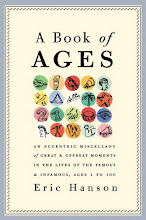
Herman Melville appears three times in A Book of Ages. I have never read Moby Dick, though I admire people who have tried. I put it in a special category among books written to be written about, and maybe that is its problem. I remember reading Hemingway's "The Old Man and the Sea" with a classroom of serious literary types––I could barely keep a straight face. When it comes to downbeat books about Man's Fate I prefer brisker, funnier, more ironic books, like Waugh's "A Handful of Dust", and Voltaire's "Candide". Among the hundreds of allusive fictions set upon the sea––Hemingway's, Jack London's, Joseph Conrad's, Waugh's, Homer's and Virginia Woolf's––I prize the short story by Stephen Crane most, perhaps because it is so brief and simply told. When he was 25 he was shipwrecked and set adrift in an open boat. The story begins "None of them knew the color of the sky." Now there is a description of man's helplessness.
The events of life gather their significance from what is occurring around them, the juxtapositions, tragedy alongside comedy, innocence beside grim experience, goodness prosecuted while villainy proceeds uninterrupted, seriousness (like Melville's) mocked and ignored while frivolousness sells and bad writing makes authors rich. Juxtapositions supply the irony. In A Book of Ages, the entry about Melville's Moby Dick is preceded by Clare Boothe finally letting Henry Luce go "all the way" on a trip to Florida. The next entry is about Carl Jung meeting Sigmund Freud for the first time; they spent thirteen hours talking about word association. Speaking of word association: the title Moby Dick always made adolescent boys laugh in the back of the classroom. I wonder what Melville was thinking. All of the authors cited here appear multiple times in my book. It's as if they are still conversing among themselves.
Showing posts with label Herman Melville. Show all posts
Showing posts with label Herman Melville. Show all posts
Saturday, November 14, 2009

Sunday, June 14, 2009
Harriet Beecher Stowe
Today is the birthday of the most influential novelist America has ever produced. Never mind J. D. Salinger and John Updike. Hemingway persuaded Americans to write shorter sentences, but Twitter would have done that eventually. Melville's novel didn't result in a ban on whaling. No, the most influential novelist in American history was a mother of seven from Cincinnati.
Harriet Beecher Stowe was born on June 14th, 1811, in Litchfield, Connecticut, the daughter of an abolitionist preacher. In 1852 she published Uncle Tom's Cabin. She was 40 years-old. The book went on to sell over a million copies. It was the first American novel to do so. It sold 10,000 copies in the first week, an astonishing thing considering there were no superstores then, no Amazon. In place of the author tour of radio stations and television talk shows, though, there were abolitionist lectures and meetings all across the North, where Uncle Tom's Cabin was talked about and quoted. It supplied the mythic underpinnings to the moral outrage that led to the American Civil War. A decade later, in 1862, there was the famous meeting between Harriet Beecher Stowe and Abraham Lincoln, when Lincoln said "So you're the little woman who wrote the book that started this Great War!" It was true.
Harriet Beecher Stowe appears on page 154 in A Book of Ages.
Harriet Beecher Stowe was born on June 14th, 1811, in Litchfield, Connecticut, the daughter of an abolitionist preacher. In 1852 she published Uncle Tom's Cabin. She was 40 years-old. The book went on to sell over a million copies. It was the first American novel to do so. It sold 10,000 copies in the first week, an astonishing thing considering there were no superstores then, no Amazon. In place of the author tour of radio stations and television talk shows, though, there were abolitionist lectures and meetings all across the North, where Uncle Tom's Cabin was talked about and quoted. It supplied the mythic underpinnings to the moral outrage that led to the American Civil War. A decade later, in 1862, there was the famous meeting between Harriet Beecher Stowe and Abraham Lincoln, when Lincoln said "So you're the little woman who wrote the book that started this Great War!" It was true.
Harriet Beecher Stowe appears on page 154 in A Book of Ages.
Subscribe to:
Posts (Atom)

 Posts
Posts


