Ninety one years ago, at 11 minutes and 11 seconds after 11 A.M. on the 11th day of the 11th month, the war ended. Sixteen million had died. Twenty one million were wounded. Blinded and maimed veterans would populate city streets for years, selling pencils or pen-wipes or whatever passersby might want. An entire generation was depleted, offices couldn't find the people they needed, women didn't marry. Poets and authors and painters didn't create great works because they died in the trenches.
Some did survive. J. R. R. Tolkien began writing about elves and hobbits while hunkering in a dugout on the Somme. E. E. Cummings wrote The Enormous Room about his experience being imprisoned in France; he'd written about the insanity of the war, and the generals didn't like it.
Ernest Hemingway was wounded on the Italian Front; he was a noncombatant, an ambulance driver. He had over 200 pieces of shrapnel removed from his legs. He was 18. He met and fell in love with a nurse; years later he wrote a book about it. Gertrude Stein called them The Lost Generation, a name that suited them, they were survivors but the battlefield would haunt them for the rest of their lives.
A few days before his 21st birthday, Robert Graves was wounded on the Western Front. His death was reported in the Times. His parents received his belongings. But he wasn't dead. He would survive another 69 years and write more than a hundred books.
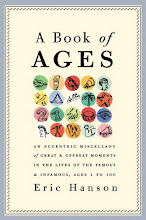
War supplies the defining moment in many novels, some written by authors who were there, others, like Stephen Crane's the Red Badge of Courage, written by authors who weren't even born when the conflict took place. Some of the most vivid depictions of heroism are acted out by film stars––John Wayne comes to mind––who stayed home. And then there are combat veterans like James Stewart––who was also too old to be drafted––who avoided war movies, instead playing disappointed men like George Bailey and Elwood P. Dowd. Veterans of World War I wrote America's musical comedies and edited its newspapers, performed surgeries, taught school and invented everyday products, built its cars and designed its skyscrapers. Many of their stories are in A Book of Ages. Whichever era they fought in, war runs like a seam through hundreds of the lives I included in the book, and it reverberates down the years, coloring everything they did.
Showing posts with label Robert Graves. Show all posts
Showing posts with label Robert Graves. Show all posts
Wednesday, November 11, 2009

Friday, July 31, 2009
Robert Graves reads his own obituary
In July 1916, a few days before his twentieth birthday, Captain Robert Graves was seriously wounded by an exploding shell on the Western Front. While he was recovering in hospital his parents were told that he'd died and were given his personal effects. His obituary appeared in the Times. He would live another 70 years. The poet and novelist appears twice in A Book of Ages.
Another interesting bit of obituaria, from page 288. When Artie Shaw died in 2004, at age 94, his New York Times obituary appeared under the byline of a writer who'd died two years earlier.
Another interesting bit of obituaria, from page 288. When Artie Shaw died in 2004, at age 94, his New York Times obituary appeared under the byline of a writer who'd died two years earlier.
Subscribe to:
Posts (Atom)

 Posts
Posts


