Martin Luther King Jr. was born on this day in 1929, in Atlanta. A soft-spoken man, conservatively-dressed in suit and tie, a Baptist minister, a believer in common ground and non-violence, King still managed to upset a lot of people. White people accustomed to the Jim Crow traditions of the South felt threatened by him. Even so, his protests were more like walks than marches. They sang hymns.
Martin preached the part in the Bible about turning the other cheek, about answering violence with gentle but firm persistence, even when the police got out the fire department's water cannons. He didn't believe in giving in though. Gentle firm persistence was met with more violence. J. Edgar Hoover set the FBI onto him to destroy his reputation. King was eventually murdered like others in the civil rights movement had been.
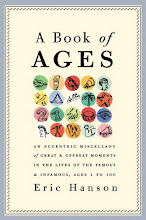
He came to national attention in 1955 after Rosa Parks refused to give up her seat to a white man on a Montgomery Alabama bus. King led the bus boycott that followed. He was 26. In 1963 he delivered his famous "I have a dream" speech from the steps of the Lincoln Memorial in Washington. He received the Nobel Peace Prize in 1964, and died in 1968 at the age of 39. Martin Luther King Jr. appears four times in A Book of Ages.
Showing posts with label Rosa Parks. Show all posts
Showing posts with label Rosa Parks. Show all posts
Friday, January 15, 2010

Thursday, January 7, 2010
Galileo
On this day in 1610 Galileo saw the four largest moons of Jupiter for the first time. He was 45. It was the first time anyone had seen the moons of Jupiter, and it's hard to think how anyone Galileo spoke to made sense of what he was describing. The moon, our moon, was a large bright disk in the sky; Jupiter was a pin prick by comparison. Brighter, certainly, than the other stars, but it was hard to imagine moons revolving around something so insignificant.
Galileo was a revolutionary. His telescope made the universe more enormous than anyone knew, larger than we could imagine, in a word: infinite. You might think this would make God infinitely larger as well, something the church would applaud and advertise. But it was mischievous to change the way people thought of the heavens. Faith doesn't know how to handle adjustments. Faith is supposed to be uniform and unchanging. The Vatican was his employer, and they thanked Galileo by freezing his salary. Eventually they stood him up in front of the Inquisition and had him recant what he knew. Galileo appears six times in A Book of Ages.
When you think about it, most of the great revolutionaries haven't been wild-eyed youths but middle aged men and women. People who've lived long enough to recognize that change is a natural part of how the world operates. People like Rosa Parks and Charles Darwin, Ben Franklin and Galileo precipitated revolutions that endured beyond their own time.
Galileo was a revolutionary. His telescope made the universe more enormous than anyone knew, larger than we could imagine, in a word: infinite. You might think this would make God infinitely larger as well, something the church would applaud and advertise. But it was mischievous to change the way people thought of the heavens. Faith doesn't know how to handle adjustments. Faith is supposed to be uniform and unchanging. The Vatican was his employer, and they thanked Galileo by freezing his salary. Eventually they stood him up in front of the Inquisition and had him recant what he knew. Galileo appears six times in A Book of Ages.
When you think about it, most of the great revolutionaries haven't been wild-eyed youths but middle aged men and women. People who've lived long enough to recognize that change is a natural part of how the world operates. People like Rosa Parks and Charles Darwin, Ben Franklin and Galileo precipitated revolutions that endured beyond their own time.
Subscribe to:
Posts (Atom)

 Posts
Posts


