Frederic Chopin was born two hundred years ago this week, in the village of Żelazowa Wola. When he was seven months old the family moved to Warsaw, to a house located on the palace grounds which was a much better place for a prodigy to be discovered. His father played the flute and the violin, his mother played the piano. By age six Chopin was playing the piano too and by seven he was performing publicly and being compared to Mozart who was much older, lived in Vienna and had been dead for 26 years. Chopin also composed two polonaises when he was seven, playing them for the amusement of the son of the Russian Archduke who was ruling Poland at the time. (The Archduke, not the son.)
In his teens, while he was staying in the rustic village Szafarnia as a guest of Count Radziwill, Chopin was exposed to the folk melodies that would influence much of his later work, and probably also to the tuberculosis which gave him his intriguing pallor. During this same rural sojourn Chopin learned the characteristic cough of the region, which he took with him when he went to Vienna in 1830. He was twenty years old and an exile. From then on he always carried a small container of Polish soil with him in his luggage. He would never see his homeland again.
When he was 26, Chopin met Amandine Aurore Lucile Dupin, better known as the novelist George Sand. She'd been wearing men's trousers for the previous five years and was a formidable personality. The meeting took place at the apartment of Franz Lizst's mistress. Chopin disliked her immediately but soon enough the two were living together. Two years later the two of them vacationed á deux in Majorca, but they had a miserable time because the weather was cold and the rented villa was drafty, and Chopin had to put up with a lousy rented piano. Even though he was sick most of the time he still managed to compose 24 Preludes. Preludes to what? One might well ask; it's never really said.
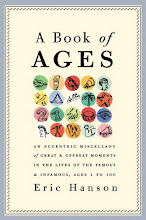
He was plagued by a cough most of his life, which I speculate may just have been his way of trying to get a word in edgewise in conversations, which Ms. Sand tended to dominate. I also believe it was Chopin who introduced the nineteenth century custom of coughing during the quieter passages of classical music, though I have no way of proving this. George Sand broke up with him in 1847 when she suspected him of falling in love with her daughter Solange. Chopin appears five times in A Book of Ages (Harmon 2008/Three Rivers Press 2010); George Sand appears twice.
Showing posts with label prodigy. Show all posts
Showing posts with label prodigy. Show all posts
Wednesday, March 3, 2010

Friday, May 1, 2009
The Marriage of Figaro, Catch 22
Wolfgang Amadeus Mozart premiered a brand new opera on this date in 1786. It was called The Marriage of Figaro, and the composer had high hopes. For one thing, it was absolutely brilliant. All his operas were. Colorful costumes. There were tunes you could hum. The characters were lovable, if a bit low-life for the fancy Viennese audiences. It closed after only nine performances, and Mozart went back to giving piano lessons.
It was a hit in Prague.
Mozart appears on pages 7, 10, 13, 17, 104 and 128 in A Book of Ages. He was a child prodigy and died young.
Joseph Heller was born on this day in 1923. He flew sixty missions as a bombardier for the Army Air Corps in World War II. Later he wrote a book about it, which he called Catch 22. He'd wanted to title it Catch 18 but his agent pointed out to him that there was another book with 18 in the title, so he changed it, and Catch 22 quickly entered the language as a byword for official absurdity. When the book came out he was working as a promotions manager for McCall's magazine. The book became a hit and was made into a film by Mike Nichols. Heller wrote other books, but none made as big a splash as his first. Joseph Heller appears on pages 63 and 143 in A Book of Ages.
It was a hit in Prague.
Mozart appears on pages 7, 10, 13, 17, 104 and 128 in A Book of Ages. He was a child prodigy and died young.
Joseph Heller was born on this day in 1923. He flew sixty missions as a bombardier for the Army Air Corps in World War II. Later he wrote a book about it, which he called Catch 22. He'd wanted to title it Catch 18 but his agent pointed out to him that there was another book with 18 in the title, so he changed it, and Catch 22 quickly entered the language as a byword for official absurdity. When the book came out he was working as a promotions manager for McCall's magazine. The book became a hit and was made into a film by Mike Nichols. Heller wrote other books, but none made as big a splash as his first. Joseph Heller appears on pages 63 and 143 in A Book of Ages.
Subscribe to:
Posts (Atom)

 Posts
Posts


