On May 14, 1643, Louis XIV was crowned king of France. He was four years old. History is full of four year-old monarchs, hovered over by helpful and malign viziers and privy counsellors and stage mothers, all lovingly asserting their own power. It's a familiar picture. Mary became Queen of Scots before she celebrated her first birthday. She was given lots of advice by her French uncles.
The more famous prodigies are musical. Mozart playing the piano for kings and grand dukes before his feet could reach the pedals. Judy Garland made her stage debut when she was two. Jascha Heifetz started violin lessons at three. And so on. A reviewer in Publishers Weekly picked up my book and worried that it was a catalog of prodigies. He was pleased to see it included unprodigies as well. Dolts like Albert Einstein who didn't speak until he was three, and Thomas Edison who was removed from school because the teacher thought he was too stupid to learn.
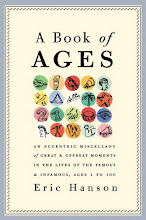
Mostly, childhood is a forbidding sort of place where children are right to be afraid and puzzled, and grateful for every friend they meet. Mick Jagger met Keith Richard when he was four, a meeting I imagine like d'Artagnon meeting Aramis. The best accounts of childhood are a bit surreal, like Alice in Wonderland, or strangely funny, like Thurber's My Life and Hard Times, or Dickens's autobiographical novel David Copperfield. In A Book of Ages you learn that James Thurber was four when his family purchased a dog that bit people. Alice Liddell was ten when she became the heroine of her famous story. Flannery O'Connor was five when she became famous for teaching her chicken to walk backwards.
Even famous childhoods are full of loss: Isaac Newton losing his mother, Ray Charles losing his sight, Jerry Garcia losing the end of his right middle finger, Mike Nichols losing all of his hair including his eyebrows, Shirley Temple losing her belief in Santa Claus. Children learn things to compensate. We begin rehearsing the things we will become as adults. Bobby Fischer learned chess at age six. J. K. Rowling wrote her first story when she was six; it was about a rabbit with measles. Prodigious or not, every childhood is an odd mix of danger and possibility. Which is why the stories we read are simultaneously funny and sad, strange and familiar.
Showing posts with label Alice LIddell. Show all posts
Showing posts with label Alice LIddell. Show all posts
Thursday, May 14, 2009

Monday, May 4, 2009
Alice in Wonderland
Alice Liddell was born on May 4, 1852, in London where her father was the Dean of Westminster School. Soon afterward the family moved to Christ Church College in Oxford, where Alice became the favorite of a young mathematics tutor who enjoyed riddles and taking pictures of little girls. On July 4, 1862, Charles Dodgson took 10 year-old Alice and her sister for a boat ride on the Thames and told them a story about Alice falling down a rabbit hole.
In 1953, when they were twelve years-old, Paul Simon and Art Garfunkel sang together for the first time in a sixth grade production of Alice in Wonderland at P.S. 164 in Queens, New York. Paul played the White Rabbit. Arthur played the Cheshire Cat. In 1966, when he was 66, Sir John Gielgud played the Mock Turtle in a film version directed by Jonathan Miller.
Alice Liddell appears three times in A Book of Ages, Charles Dodgson (Lewis Carroll) eight times, John Gielgud seven times, Paul Simon six times, and Art Garfunkel five.
In 1953, when they were twelve years-old, Paul Simon and Art Garfunkel sang together for the first time in a sixth grade production of Alice in Wonderland at P.S. 164 in Queens, New York. Paul played the White Rabbit. Arthur played the Cheshire Cat. In 1966, when he was 66, Sir John Gielgud played the Mock Turtle in a film version directed by Jonathan Miller.
Alice Liddell appears three times in A Book of Ages, Charles Dodgson (Lewis Carroll) eight times, John Gielgud seven times, Paul Simon six times, and Art Garfunkel five.
Subscribe to:
Posts (Atom)

 Posts
Posts


