Yesterday was Susan Sontag's birthday. The New York intellectual with the pale streak in her hair was born in New York City in 1933, but grew up in Tucson and Los Angeles, graduating from North Hollywood High School at age 15. It's interesting to note when intellectuals become intellectuals, when they self-identify as such. And how do they do it exactly? Does it begin with the black turtleneck? Do they start carrying a copy of Schopenhauer around with them? In 1948, Sontag, then called Susan Rosenblatt, bought her first copy of Partisan Review at a newsstand on Hollywood Boulevard. She was a deep thinker already, but that moment is significant. She was fifteen. When she was 31 she was screen tested by Andy Warhol, and her famous essay "Notes on Camp" appeared. In Partisan Review, of course. When she was 43 she was diagnosed with breast cancer, and given two years to live. They were wrong about her ability to survive. She lived another 28 years, writing 19 more books. At her death, her personal library contained fifteen thousand books, arranged by historical period. Susan Sontag appears four times in A Book of Ages.
Today is the birthday of Benjamin Franklin, the first public intellectual in America and the most famous person of his time. Franklin invented the role of the brainy celebrity, toying with the media of his day, provoking and amusing, pushing Americans towards independence and away from slavery, taking unpopular and untimely stands, inconveniencing people. He drove John Adams nearly mad. He was reckless and calculating. Hard to pin down. He was famously agnostic but he knew how to invoke God to make his adversaries look ridiculous. He was a libertine, an unwed father, a poor parent but full of wise advice on parenting, a wit, a scold, a public-spirited liberal and a famous millionaire. He retired in his early forties, but never really retired. Franklin appears 13 times in A Book of Ages, but the stories about him are so numerous and engaging I could have included him a dozen times more. The thing most appealing about Franklin? He made being old seem glamorous.
Showing posts with label Benjamin Franklin. Show all posts
Showing posts with label Benjamin Franklin. Show all posts
Sunday, January 17, 2010

Thursday, January 7, 2010
Galileo
On this day in 1610 Galileo saw the four largest moons of Jupiter for the first time. He was 45. It was the first time anyone had seen the moons of Jupiter, and it's hard to think how anyone Galileo spoke to made sense of what he was describing. The moon, our moon, was a large bright disk in the sky; Jupiter was a pin prick by comparison. Brighter, certainly, than the other stars, but it was hard to imagine moons revolving around something so insignificant.
Galileo was a revolutionary. His telescope made the universe more enormous than anyone knew, larger than we could imagine, in a word: infinite. You might think this would make God infinitely larger as well, something the church would applaud and advertise. But it was mischievous to change the way people thought of the heavens. Faith doesn't know how to handle adjustments. Faith is supposed to be uniform and unchanging. The Vatican was his employer, and they thanked Galileo by freezing his salary. Eventually they stood him up in front of the Inquisition and had him recant what he knew. Galileo appears six times in A Book of Ages.
When you think about it, most of the great revolutionaries haven't been wild-eyed youths but middle aged men and women. People who've lived long enough to recognize that change is a natural part of how the world operates. People like Rosa Parks and Charles Darwin, Ben Franklin and Galileo precipitated revolutions that endured beyond their own time.
Galileo was a revolutionary. His telescope made the universe more enormous than anyone knew, larger than we could imagine, in a word: infinite. You might think this would make God infinitely larger as well, something the church would applaud and advertise. But it was mischievous to change the way people thought of the heavens. Faith doesn't know how to handle adjustments. Faith is supposed to be uniform and unchanging. The Vatican was his employer, and they thanked Galileo by freezing his salary. Eventually they stood him up in front of the Inquisition and had him recant what he knew. Galileo appears six times in A Book of Ages.
When you think about it, most of the great revolutionaries haven't been wild-eyed youths but middle aged men and women. People who've lived long enough to recognize that change is a natural part of how the world operates. People like Rosa Parks and Charles Darwin, Ben Franklin and Galileo precipitated revolutions that endured beyond their own time.
Tuesday, November 24, 2009
Ben Franklin, the ideal dinner guest
I read in the paper this morning about a new Ben Franklin exhibit at the Minnesota History Center. Who better to spend an hour or two with over Thanksgiving? (Remember it was Franklin who wanted the turkey to be our national emblem, rather than the ill-behaved bald eagle.)
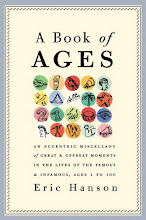
As I was collecting anecdotes and episodes for A Book of Ages, Franklin was the hardest to keep under control: there were so many stories, and so many begged for elaboration. But B. of A. is an ensemble piece. Each story is told at the right length for retelling in one elevator ride. Franklin appears 13 times, the same number as Freud, three fewer than Einstein, one more than Nixon.
At a dinner table ringed with personalities (which is how the book reads) Franklin is the most surprising, the most voluble. The kite is there (did he actually fly it in a thunderstorm?), the illegitimate son, the meeting with Voltaire in Paris (which many consider the high moment of the Enlightenment), his comment about the first manned flight (asked what good it was, he answered "What good is a newborn baby?"), as well as everyday matters of life and age: his retirement fund, his gout. Also his inventions: bifocals, the fire department, etc. Does anyone remember that Franklin was America's first best-selling author? On that score alone he'd have been an interesting person to know.
One item I edited out of the book (I had to edit out some things): it was Ben Franklin who brought rhubarb to America, in 1772.
As I was collecting anecdotes and episodes for A Book of Ages, Franklin was the hardest to keep under control: there were so many stories, and so many begged for elaboration. But B. of A. is an ensemble piece. Each story is told at the right length for retelling in one elevator ride. Franklin appears 13 times, the same number as Freud, three fewer than Einstein, one more than Nixon.
At a dinner table ringed with personalities (which is how the book reads) Franklin is the most surprising, the most voluble. The kite is there (did he actually fly it in a thunderstorm?), the illegitimate son, the meeting with Voltaire in Paris (which many consider the high moment of the Enlightenment), his comment about the first manned flight (asked what good it was, he answered "What good is a newborn baby?"), as well as everyday matters of life and age: his retirement fund, his gout. Also his inventions: bifocals, the fire department, etc. Does anyone remember that Franklin was America's first best-selling author? On that score alone he'd have been an interesting person to know.
One item I edited out of the book (I had to edit out some things): it was Ben Franklin who brought rhubarb to America, in 1772.
Subscribe to:
Posts (Atom)

 Posts
Posts


