On June 13, 1902, seven year-old George Herman Ruth was sent to St. Mary’s Industrial School For Boys, a Catholic school for orphans and delinquents. It turned out to be a lucky break. Ruth's parents owned a bar in working class Baltimore and didn't have the time or the energy to deal with the kid.
George wouldn't be known as Babe for a few years. He was a large and (by his own description) an ugly kid, and his habits were hardly infantile. He began smoking and chewing tobacco when he was seven, drinking beer at age eight. He disliked school but loved games. Ruth would learn to play baseball at St. Mary's from a monk named Brother Matthias. The nuns forced him to learn to write right-handed. Luckily, Matthias left his left-handed hitting and throwing alone.
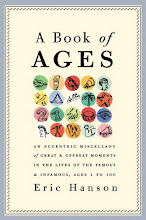
Babe Ruth appears on pages 16, 50, 59, 74 and 111 in A Book of Ages.
Showing posts with label A Book of Ages. Show all posts
Showing posts with label A Book of Ages. Show all posts
Saturday, June 13, 2009

Thursday, May 28, 2009
007
Today's the birthday of Ian Fleming, the author of twelve James Bond novels, born in the posh Mayfair neighborhood of London in 1908. He appears seven times in A Book of Ages. Being blackballed from a social club at Eton, engaging in adultery and espionage (sometimes simultaneously) purchasing a book about the birds of the West Indies by an ornithologist named James Bond, and finally inventing the elaborate and enduring male fantasy which finally made him rich. A suave, companionable but cold-blooded man, Fleming was known to write polite thank-you notes to the husbands he was cuckolding. He died at age 56 of a heart attack, thereby certifying that he had one. He only saw one Bond film: Dr. No. He didn't particularly like the casting of Sean Connery.
Tuesday, May 26, 2009
Mysteries
I couldn't fit everything or everyone into A Book of Ages. I left out interesting people whose significance was hard to explain in a short paragraph. I also left out events I couldn't pin down. Today is Miles Davis's birthday; he was born in 1926. Charlie Parker is in the book, so are Dave Brubeck, Billie Holiday, Ella Fitzgerald, Duke Ellington and Louis Armstrong, but no Miles.
The book is about changes and inspirations: Pete Townshend breaking his first guitar, Bob Dylan going electric, Duke Ellington meeting Billy Strayhorn. I wanted to include the moment when Miles Davis started playing with his back to the audience. It was a well known part of his stage mystique. Miles was an aloof genius who didn't cater to his fans. His posture when playing resembled a question mark. I asked friends who write about jazz and looked through the Miles Davis biographies to find out when and why he turned his back on his audience. I couldn't nail it down to a month or a year, so I left it out. If anyone out there knows, I'd like to know too. Happy Birthday Miles; Detour Ahead is on the turntable.
Today in 1828 a teenage boy was found wandering alone in the streets of Nuremberg. He could barely speak. A note he carried suggested his father had been a soldier and that he would like to be one too. The word "horse" was part of his limited vocabulary. He also knew the words "Don't know," which he repeated to most questions put to him. He had apparently lived all of his short life in a dark basement with little or no human contact except with a godlike jailer who fed him and taught him to write his name, which was Kaspar Hauser.
It was rumored that Kaspar was the bastard son of Mitteleuropean royalty, but he really was a bastard child of the European Enlightenment. A strange, cruel experiment, an intellectual puzzle. Soon enough his case attracted the attention of writers and the kulturati of the time. They were fascinated. He was a blank slate onto which the German Romantics could write their philosophies. He was a polemic in a revolutionary era. He was a cautionary tale. Kaspar Hauser was also a very bright pupil, but angry, devious, mercurial and remote as you would expect any child to be who had grown up without human contact. He was adopted by a schoolmaster, but it wasn't a happy home.
Kaspar Hauser isn't included in A Book of Ages either. Partly this is because he didn't have a birthdate, and nobody knew his age. His date of death is known. On December 14, 1833 he was lured to the garden of a local aristocrat where he was given a note even more cryptic than the one he'd been carrying when he was found five years earlier. The mysterious individual who gave him the note also gave him a stab wound in the chest, from which he died three days later. Life is full of metaphors, but it's often hard to say what they mean.
The book is about changes and inspirations: Pete Townshend breaking his first guitar, Bob Dylan going electric, Duke Ellington meeting Billy Strayhorn. I wanted to include the moment when Miles Davis started playing with his back to the audience. It was a well known part of his stage mystique. Miles was an aloof genius who didn't cater to his fans. His posture when playing resembled a question mark. I asked friends who write about jazz and looked through the Miles Davis biographies to find out when and why he turned his back on his audience. I couldn't nail it down to a month or a year, so I left it out. If anyone out there knows, I'd like to know too. Happy Birthday Miles; Detour Ahead is on the turntable.
Today in 1828 a teenage boy was found wandering alone in the streets of Nuremberg. He could barely speak. A note he carried suggested his father had been a soldier and that he would like to be one too. The word "horse" was part of his limited vocabulary. He also knew the words "Don't know," which he repeated to most questions put to him. He had apparently lived all of his short life in a dark basement with little or no human contact except with a godlike jailer who fed him and taught him to write his name, which was Kaspar Hauser.
It was rumored that Kaspar was the bastard son of Mitteleuropean royalty, but he really was a bastard child of the European Enlightenment. A strange, cruel experiment, an intellectual puzzle. Soon enough his case attracted the attention of writers and the kulturati of the time. They were fascinated. He was a blank slate onto which the German Romantics could write their philosophies. He was a polemic in a revolutionary era. He was a cautionary tale. Kaspar Hauser was also a very bright pupil, but angry, devious, mercurial and remote as you would expect any child to be who had grown up without human contact. He was adopted by a schoolmaster, but it wasn't a happy home.
Kaspar Hauser isn't included in A Book of Ages either. Partly this is because he didn't have a birthdate, and nobody knew his age. His date of death is known. On December 14, 1833 he was lured to the garden of a local aristocrat where he was given a note even more cryptic than the one he'd been carrying when he was found five years earlier. The mysterious individual who gave him the note also gave him a stab wound in the chest, from which he died three days later. Life is full of metaphors, but it's often hard to say what they mean.
Monday, May 18, 2009
Marrying Well
On this day in 1152 Eleanor of Aquitaine married Henry, the Duke of Normandy and soon-to-be King of England. It was her second marriage. Until six weeks earlier she'd been married to the King of France. Two of her sons with Henry II would become Kings of England too.
Richard I and John were difficult offspring, fighting between themselves and with their parents. Eleanor and Henry were played in the 1968 film by Katharine Hepburn and Peter O'Toole. For those of you keeping score, that's Queen of France, Queen of England and an Academy Award. At one point Eleanor conspired to take her husband off the throne, after which Henry put her in prison for 16 years. It wasn't an easy marriage but it was far from dull. Eleanor of Aquitaine has been the subject of several excellent biographies. She appears on page 101 in A Book of Ages.
There are dozens of other famous and cringe-making marriages in A Book of Ages. The horrifyingly funny union of Martha and George, as played by Dick and Liz in Mike Nichols' film of Who's Afraid of Virginia Woolf. Also Virginia and Leonard Woolf, and George and Martha Washington, the famous Shelleys, the happy George Eliots and unhappy T. S. Eliots, the E. B. Whites, the serial Updikes and Hemingways and Mailers and Mr. and Mrs. Henry Tudors. Marriage is one of life's significant landmarks, or watersheds, depending how you look at it. The institution contains an odd assortment, and each couple writes its own rules of engagement, has its own habits and rituals, which I enjoyed collecting and putting into words.
Richard I and John were difficult offspring, fighting between themselves and with their parents. Eleanor and Henry were played in the 1968 film by Katharine Hepburn and Peter O'Toole. For those of you keeping score, that's Queen of France, Queen of England and an Academy Award. At one point Eleanor conspired to take her husband off the throne, after which Henry put her in prison for 16 years. It wasn't an easy marriage but it was far from dull. Eleanor of Aquitaine has been the subject of several excellent biographies. She appears on page 101 in A Book of Ages.
There are dozens of other famous and cringe-making marriages in A Book of Ages. The horrifyingly funny union of Martha and George, as played by Dick and Liz in Mike Nichols' film of Who's Afraid of Virginia Woolf. Also Virginia and Leonard Woolf, and George and Martha Washington, the famous Shelleys, the happy George Eliots and unhappy T. S. Eliots, the E. B. Whites, the serial Updikes and Hemingways and Mailers and Mr. and Mrs. Henry Tudors. Marriage is one of life's significant landmarks, or watersheds, depending how you look at it. The institution contains an odd assortment, and each couple writes its own rules of engagement, has its own habits and rituals, which I enjoyed collecting and putting into words.
Sunday, May 10, 2009
Heroism and Anti-Heroism
On May 10, 1873, Father Damien arrives on the island of Molokai in Hawaii. He is 33. He will live there as parish priest to the leper colony until he dies in 1889.
On May 10, 1775, American forces under the command of Benedict Arnold and Ethan Allen capture Fort Ticonderoga in New York. The 34 year-old Arnold then leads a 1100 men on a heroice but unsuccessful invasion of Canada, where he is wounded in the assault on the citadel of Quebec. He is wounded again, more severely, winning a brilliant victory at Saratoga in 1777. Five years later, feeling unappreciated by his superiors, and having survived a court-martial for mismanaging funds, Arnold enters negotiations with the British. His career doesn't prosper very well in their employ either.
Paul Revere dies, a much revered and prosperous 83, on May 10, 1818. Henry Wadsworth Longfellow is only 11 years-old at the time and it will be another 45 years before he writes his famous poem.
Doris Lessing writes in the Sunday Times on May 10, 1992: “The great secret that all old people share is that you really haven’t changed in seventy or eighty years. Your body changes, but you don’t change at all. And that, of course, causes great confusion.”
These and other stories can be found in A Book of Ages.
On May 10, 1775, American forces under the command of Benedict Arnold and Ethan Allen capture Fort Ticonderoga in New York. The 34 year-old Arnold then leads a 1100 men on a heroice but unsuccessful invasion of Canada, where he is wounded in the assault on the citadel of Quebec. He is wounded again, more severely, winning a brilliant victory at Saratoga in 1777. Five years later, feeling unappreciated by his superiors, and having survived a court-martial for mismanaging funds, Arnold enters negotiations with the British. His career doesn't prosper very well in their employ either.
Paul Revere dies, a much revered and prosperous 83, on May 10, 1818. Henry Wadsworth Longfellow is only 11 years-old at the time and it will be another 45 years before he writes his famous poem.
Doris Lessing writes in the Sunday Times on May 10, 1992: “The great secret that all old people share is that you really haven’t changed in seventy or eighty years. Your body changes, but you don’t change at all. And that, of course, causes great confusion.”
These and other stories can be found in A Book of Ages.
Monday, May 4, 2009
Alice in Wonderland
Alice Liddell was born on May 4, 1852, in London where her father was the Dean of Westminster School. Soon afterward the family moved to Christ Church College in Oxford, where Alice became the favorite of a young mathematics tutor who enjoyed riddles and taking pictures of little girls. On July 4, 1862, Charles Dodgson took 10 year-old Alice and her sister for a boat ride on the Thames and told them a story about Alice falling down a rabbit hole.
In 1953, when they were twelve years-old, Paul Simon and Art Garfunkel sang together for the first time in a sixth grade production of Alice in Wonderland at P.S. 164 in Queens, New York. Paul played the White Rabbit. Arthur played the Cheshire Cat. In 1966, when he was 66, Sir John Gielgud played the Mock Turtle in a film version directed by Jonathan Miller.
Alice Liddell appears three times in A Book of Ages, Charles Dodgson (Lewis Carroll) eight times, John Gielgud seven times, Paul Simon six times, and Art Garfunkel five.
In 1953, when they were twelve years-old, Paul Simon and Art Garfunkel sang together for the first time in a sixth grade production of Alice in Wonderland at P.S. 164 in Queens, New York. Paul played the White Rabbit. Arthur played the Cheshire Cat. In 1966, when he was 66, Sir John Gielgud played the Mock Turtle in a film version directed by Jonathan Miller.
Alice Liddell appears three times in A Book of Ages, Charles Dodgson (Lewis Carroll) eight times, John Gielgud seven times, Paul Simon six times, and Art Garfunkel five.
Wednesday, April 15, 2009
Da Vinci & Lincoln
Today is the birthday of Leonardo Da Vinci, who was born in 1452 in the town of Vinci, hence the name. He was the quintessential Renaissance Man, doing a multitude of things and all of them well. At age 50 he was employed by the Borgias as a military engineer––a defense contractor, if you will; a year later he painted his serene masterpiece la Gioconda, better known today as the Mona Lisa. In difficult times it's good to be versatile. Da Vinci appears on pages 31, 190, 195 and 240 in A Book of Ages.
Abraham Lincoln was felled by an assassin's bullet on April 15, 1865. It's a story repeated often in history: the hero who isn't alive to enjoy the fruits of victory. Martin Luther King Jr., FDR, Bobby Kennedy, Admiral Horatio Nelson, Moses.
The eerie coincidences between the deaths of Lincoln and JFK have become folklore: Lincoln's assassin did the deed in a theater and was captured in a warehouse; Kennedy's assassin fired from a warehouse and was captured in a theater; Lincoln had a secretary named Kennedy, Kennedy had a secretary named Lincoln; both were succeeded by V.P.s named Johnson; etc. Famous stories are full of ironic details.
Writing about Lincoln's death in A Book of Ages I chose to describe the contents of his pockets, which, ironically enough, included a Confederate five dollar bill. Lincoln stories are told on pages 40, 49, 73, 135, 162-3, 189, 195, 199 and 210.
Abraham Lincoln was felled by an assassin's bullet on April 15, 1865. It's a story repeated often in history: the hero who isn't alive to enjoy the fruits of victory. Martin Luther King Jr., FDR, Bobby Kennedy, Admiral Horatio Nelson, Moses.
The eerie coincidences between the deaths of Lincoln and JFK have become folklore: Lincoln's assassin did the deed in a theater and was captured in a warehouse; Kennedy's assassin fired from a warehouse and was captured in a theater; Lincoln had a secretary named Kennedy, Kennedy had a secretary named Lincoln; both were succeeded by V.P.s named Johnson; etc. Famous stories are full of ironic details.
Writing about Lincoln's death in A Book of Ages I chose to describe the contents of his pockets, which, ironically enough, included a Confederate five dollar bill. Lincoln stories are told on pages 40, 49, 73, 135, 162-3, 189, 195, 199 and 210.
Subscribe to:
Posts (Atom)

 Posts
Posts


