Showing posts with label mysteries. Show all posts
Showing posts with label mysteries. Show all posts
Tuesday, December 22, 2009
How Old Were You When?
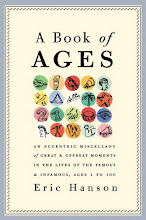
Shirley Temple stopped believing in Santa when her mother took her to see him at a department store and he asked for her autograph. True story. She was six and barely came up to your elbow. You'd never know from her subsequent performances that she'd become a cynical disbeliever, which just shows what a damn good actress she was. It's ironic, though. Hollywood is a dream factory but it makes it harder for us to believe anything. A Book of Ages is full of similar moments of truth. Darwin, Newton, Copernicus, Luther, Einstein, Temple. Rebelieving something is very hard. Galileo tried and it didn't work.

Tuesday, May 26, 2009
Mysteries
I couldn't fit everything or everyone into A Book of Ages. I left out interesting people whose significance was hard to explain in a short paragraph. I also left out events I couldn't pin down. Today is Miles Davis's birthday; he was born in 1926. Charlie Parker is in the book, so are Dave Brubeck, Billie Holiday, Ella Fitzgerald, Duke Ellington and Louis Armstrong, but no Miles.
The book is about changes and inspirations: Pete Townshend breaking his first guitar, Bob Dylan going electric, Duke Ellington meeting Billy Strayhorn. I wanted to include the moment when Miles Davis started playing with his back to the audience. It was a well known part of his stage mystique. Miles was an aloof genius who didn't cater to his fans. His posture when playing resembled a question mark. I asked friends who write about jazz and looked through the Miles Davis biographies to find out when and why he turned his back on his audience. I couldn't nail it down to a month or a year, so I left it out. If anyone out there knows, I'd like to know too. Happy Birthday Miles; Detour Ahead is on the turntable.
Today in 1828 a teenage boy was found wandering alone in the streets of Nuremberg. He could barely speak. A note he carried suggested his father had been a soldier and that he would like to be one too. The word "horse" was part of his limited vocabulary. He also knew the words "Don't know," which he repeated to most questions put to him. He had apparently lived all of his short life in a dark basement with little or no human contact except with a godlike jailer who fed him and taught him to write his name, which was Kaspar Hauser.
It was rumored that Kaspar was the bastard son of Mitteleuropean royalty, but he really was a bastard child of the European Enlightenment. A strange, cruel experiment, an intellectual puzzle. Soon enough his case attracted the attention of writers and the kulturati of the time. They were fascinated. He was a blank slate onto which the German Romantics could write their philosophies. He was a polemic in a revolutionary era. He was a cautionary tale. Kaspar Hauser was also a very bright pupil, but angry, devious, mercurial and remote as you would expect any child to be who had grown up without human contact. He was adopted by a schoolmaster, but it wasn't a happy home.
Kaspar Hauser isn't included in A Book of Ages either. Partly this is because he didn't have a birthdate, and nobody knew his age. His date of death is known. On December 14, 1833 he was lured to the garden of a local aristocrat where he was given a note even more cryptic than the one he'd been carrying when he was found five years earlier. The mysterious individual who gave him the note also gave him a stab wound in the chest, from which he died three days later. Life is full of metaphors, but it's often hard to say what they mean.
The book is about changes and inspirations: Pete Townshend breaking his first guitar, Bob Dylan going electric, Duke Ellington meeting Billy Strayhorn. I wanted to include the moment when Miles Davis started playing with his back to the audience. It was a well known part of his stage mystique. Miles was an aloof genius who didn't cater to his fans. His posture when playing resembled a question mark. I asked friends who write about jazz and looked through the Miles Davis biographies to find out when and why he turned his back on his audience. I couldn't nail it down to a month or a year, so I left it out. If anyone out there knows, I'd like to know too. Happy Birthday Miles; Detour Ahead is on the turntable.
Today in 1828 a teenage boy was found wandering alone in the streets of Nuremberg. He could barely speak. A note he carried suggested his father had been a soldier and that he would like to be one too. The word "horse" was part of his limited vocabulary. He also knew the words "Don't know," which he repeated to most questions put to him. He had apparently lived all of his short life in a dark basement with little or no human contact except with a godlike jailer who fed him and taught him to write his name, which was Kaspar Hauser.
It was rumored that Kaspar was the bastard son of Mitteleuropean royalty, but he really was a bastard child of the European Enlightenment. A strange, cruel experiment, an intellectual puzzle. Soon enough his case attracted the attention of writers and the kulturati of the time. They were fascinated. He was a blank slate onto which the German Romantics could write their philosophies. He was a polemic in a revolutionary era. He was a cautionary tale. Kaspar Hauser was also a very bright pupil, but angry, devious, mercurial and remote as you would expect any child to be who had grown up without human contact. He was adopted by a schoolmaster, but it wasn't a happy home.
Kaspar Hauser isn't included in A Book of Ages either. Partly this is because he didn't have a birthdate, and nobody knew his age. His date of death is known. On December 14, 1833 he was lured to the garden of a local aristocrat where he was given a note even more cryptic than the one he'd been carrying when he was found five years earlier. The mysterious individual who gave him the note also gave him a stab wound in the chest, from which he died three days later. Life is full of metaphors, but it's often hard to say what they mean.
Subscribe to:
Posts (Atom)

 Posts
Posts


