Showing posts with label religion. Show all posts
Showing posts with label religion. Show all posts
Tuesday, December 22, 2009
How Old Were You When?
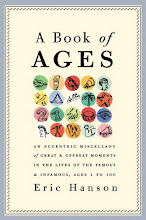
Shirley Temple stopped believing in Santa when her mother took her to see him at a department store and he asked for her autograph. True story. She was six and barely came up to your elbow. You'd never know from her subsequent performances that she'd become a cynical disbeliever, which just shows what a damn good actress she was. It's ironic, though. Hollywood is a dream factory but it makes it harder for us to believe anything. A Book of Ages is full of similar moments of truth. Darwin, Newton, Copernicus, Luther, Einstein, Temple. Rebelieving something is very hard. Galileo tried and it didn't work.

Wednesday, December 9, 2009
Paradise Lost
Today's John Milton's birthday. Born in 1608, he lived through one monarchy, a revolution, a brief republic, a dictatorship (disguised as a protectorate), then a restoration of monarchy. Being politically active, a political flack in fact, he rose and fell as changes occurred, spending time in favor and then in prison. He was also going blind as surely as Thurber, whose birthday was yesterday. He dictated much of his poetry to assistant Andrew Marvell, who was himself a great poet. Milton wrote Paradise Lost and Paradise Regained. For the former landmark in English literature his publisher paid him £10. He also wrote The Doctrine and Discipline of Divorce (he was unhappily married), which probably means he was no Puritan, despite his allegiances. John Milton appears four times in A Book of Ages.
Friday, December 4, 2009
Cincinnatus
On December 4th, 1783 George Washington made his famous final farewell to the band of brothers, his officers from the revolutionary army. The farewell became famous because Washington carefully organized all of his public relations. But final? Not really.
The event took place over drinks at Fraunces Tavern, around the corner from Wall Street in lower Manhattan. There's a plaque there. There are at most places Washington ate, drank or slept. The walk away from power is probably the most remarkable item in Washington's biography. Instead of using his adoring army to leverage himself in the new republic, he rode home to Mount Vernon, arriving there on Christmas Eve. He wanted to be a farmer again, or so he said, albeit a farmer whose slaves did the work.
For the past few weeks I've been reading Joseph Ellis's biography of Washington, and the man is a fascinating mixture. Honest but calculating. Wise and naive. Modern, yet bound by ancient Classical forms of behavior and honor. He freed a nation of yeoman farmers but had more in common, philosophically, with the landed aristocrats of England. At the same time he was saying goodbye to his loyal officers, he and they were organizing themselves into an elite club to rule the new nation. They called it the Society of the Cincinnati after Cincinnatus, the general who left his farm to fight for the Roman Republic, then returned to the plow after the war was won. The idea had a noble air about it, but it's motives were self-serving. For one thing, the membership wasn't just exclusive but hereditary.
Washington distanced himself from the group after Jefferson and others explained how bad it looked, even though he didn't quite understand the contradiction. How could anything he'd been involved in be dishonest or ignoble? He was always concerned about appearances, his legacy, his sacred reputation. It's why we have the marble statue today. The picture was so carefully composed it's hard to imagine a person underneath it. It's the contradictions that make him seem human today.
We think of the founding fathers (or some do) as the mythic creators of our national religion, fierce enemies of taxation and elitism. But Washington was elite and proud of it. (He envisioned his vast landholdings beyond the Allegheny being farmed by tenants, which was the European model. One scheme involved bringing in German immigrants to work his land as serfs.) He wasn't a Christian along the lines of modern fundamentalists; he was a child of the Enlightenment, speaking of Providence rather than God, a skeptical agnostic at best. He believed in a strong central government, primarily for the purposes of taxation. He'd spent the entire war feuding and fighting with a "no taxes" crowd in the Congress and the state legislatures. He'd won the war in spite of their refusal to fund the enterprise. Once he was pulled back into public life and made president, one of his most significant acts was to send an army to the frontier to put down a tax revolt. If he were our president today he would be the one sending in the black helicopters.
He presents an interesting and complex picture. I'll never look at a dollar bill the same way again. Washington appears 10 times in A Book of Ages.
The event took place over drinks at Fraunces Tavern, around the corner from Wall Street in lower Manhattan. There's a plaque there. There are at most places Washington ate, drank or slept. The walk away from power is probably the most remarkable item in Washington's biography. Instead of using his adoring army to leverage himself in the new republic, he rode home to Mount Vernon, arriving there on Christmas Eve. He wanted to be a farmer again, or so he said, albeit a farmer whose slaves did the work.
For the past few weeks I've been reading Joseph Ellis's biography of Washington, and the man is a fascinating mixture. Honest but calculating. Wise and naive. Modern, yet bound by ancient Classical forms of behavior and honor. He freed a nation of yeoman farmers but had more in common, philosophically, with the landed aristocrats of England. At the same time he was saying goodbye to his loyal officers, he and they were organizing themselves into an elite club to rule the new nation. They called it the Society of the Cincinnati after Cincinnatus, the general who left his farm to fight for the Roman Republic, then returned to the plow after the war was won. The idea had a noble air about it, but it's motives were self-serving. For one thing, the membership wasn't just exclusive but hereditary.
Washington distanced himself from the group after Jefferson and others explained how bad it looked, even though he didn't quite understand the contradiction. How could anything he'd been involved in be dishonest or ignoble? He was always concerned about appearances, his legacy, his sacred reputation. It's why we have the marble statue today. The picture was so carefully composed it's hard to imagine a person underneath it. It's the contradictions that make him seem human today.
We think of the founding fathers (or some do) as the mythic creators of our national religion, fierce enemies of taxation and elitism. But Washington was elite and proud of it. (He envisioned his vast landholdings beyond the Allegheny being farmed by tenants, which was the European model. One scheme involved bringing in German immigrants to work his land as serfs.) He wasn't a Christian along the lines of modern fundamentalists; he was a child of the Enlightenment, speaking of Providence rather than God, a skeptical agnostic at best. He believed in a strong central government, primarily for the purposes of taxation. He'd spent the entire war feuding and fighting with a "no taxes" crowd in the Congress and the state legislatures. He'd won the war in spite of their refusal to fund the enterprise. Once he was pulled back into public life and made president, one of his most significant acts was to send an army to the frontier to put down a tax revolt. If he were our president today he would be the one sending in the black helicopters.
He presents an interesting and complex picture. I'll never look at a dollar bill the same way again. Washington appears 10 times in A Book of Ages.
Wednesday, November 25, 2009
Evolution and other events
I somehow failed to notice that yesterday was the 150th anniversary of the publication of Darwin's The Origin of Species in 1859, an event I didn't forget to include in A Book of Ages. What people forget is how scrupulously cautious Darwin was as a revolutionary. He checked and double checked before leaping to a dangerous conclusion. He also remained firmly in the fold of believers. Would this make him a Creationist? Not ideologically, not to fly in the face of science, no. Darwin appears three times in A Book of Ages.
November 24th is also the day Agatha Christie's play "The Mouse Trap" opened in the West End of London. It's still running. I note this event on page 229. Christie was 62.
November 24th is also the day Agatha Christie's play "The Mouse Trap" opened in the West End of London. It's still running. I note this event on page 229. Christie was 62.
Monday, November 9, 2009
The High Priest of Self-Centeredness
There are two new biographies of Ayn Rand on the market. She of the icy glare, the modified Hitler hairdo, the large dollar-sign brooch. Her philosophy behaved more like a religion or a cult, with fierce dogmas and sudden excommunications. But her devotees are legion. Former Fed Chairman Alan Greenspan was one of the earliest, sitting at her feet during her living room sermonettes in the early days in New York. And her books have sold millions of copies, mostly, it seems, to disgruntled and arrested adolescents who think nobody understands them.
Rand was traumatized by the Russian Revolution. Her family lost everything when the Bolsheviks took over. Impoverishment at the hands of Russian governments has shaped some of the greatest and most peculiar literature we have, from Conrad to Nabokov (his sister was Ayn Rand's best friend). None, perhaps, as odd as Rand's. Nabokov's peculiarities are well cataloged in A Book of Ages. Had these Rand biographies been published earlier I would have included more about her. She preached holy individualism, and fixated on muscular, dominant males in her novels, yet she kept her husband in a state of servility. He was fully informed about her twice weekly sexual intercourse with her lover and deputy. She made Frank wear a bell on his shoes so she could hear his movements around the house. During the 1970s her Wednesday evenings were devoted to watching Charlie's Angels. Odd doesn't begin to describe her.
Rand was traumatized by the Russian Revolution. Her family lost everything when the Bolsheviks took over. Impoverishment at the hands of Russian governments has shaped some of the greatest and most peculiar literature we have, from Conrad to Nabokov (his sister was Ayn Rand's best friend). None, perhaps, as odd as Rand's. Nabokov's peculiarities are well cataloged in A Book of Ages. Had these Rand biographies been published earlier I would have included more about her. She preached holy individualism, and fixated on muscular, dominant males in her novels, yet she kept her husband in a state of servility. He was fully informed about her twice weekly sexual intercourse with her lover and deputy. She made Frank wear a bell on his shoes so she could hear his movements around the house. During the 1970s her Wednesday evenings were devoted to watching Charlie's Angels. Odd doesn't begin to describe her.
Saturday, October 31, 2009
Selling a Better Afterlife
On October 31st, 1517, Martin Luther composed a ninety-five point complaint against the Catholic church and nailed it to the door of his church in Wittenberg, Germany. He was especially angry that the church charged people to see holy relics and sold “indulgences” in exchange for fewer years in Purgatory. He was 33 and had no idea what he was unleashing. He considered himself a Catholic till the day he died. Luther appears one time in A Book of Ages.
Halloween is as good a day as any to think about the afterlife. Where can you buy one? Are the specs guaranteed by any reputable rating agency? Why aren't reliable afterlifes available through your bank or insurance agent? (Discuss.)
Halloween is as good a day as any to think about the afterlife. Where can you buy one? Are the specs guaranteed by any reputable rating agency? Why aren't reliable afterlifes available through your bank or insurance agent? (Discuss.)
Wednesday, April 1, 2009
Martha Graham and L. Ron Hubbard
L. Ron Hubbard was 13 when he was made an Eagle Scout on April Fool's Day in 1924. He went on to become a science fiction novelist and theologian. The two careers dovetailed in an interesting way in 1949, an anecdote which appears on page 141 of A Book of Ages.
Dancer and choreographer Martha Graham died on this day in 1991. She was 96 and busy choreographing a dance for the Barcelona Olympics. She also appears in A Book of Ages at 42 and 76, when she finally retired from dancing.
Dancer and choreographer Martha Graham died on this day in 1991. She was 96 and busy choreographing a dance for the Barcelona Olympics. She also appears in A Book of Ages at 42 and 76, when she finally retired from dancing.
Subscribe to:
Posts (Atom)

 Posts
Posts


