Showing posts with label George Washington. Show all posts
Showing posts with label George Washington. Show all posts
Sunday, January 10, 2010
Common Sense
By the time he was 38, Thomas Paine had been a tax collector, a schoolteacher, tobacconist, journalist, grocer, a failed inventor, an impoverished immigrant and a multiple bankrupt. On this day in 1776 he became a bestselling author. The book wasn't even a book, really; it was a pamphlet titled Common Sense. But it sold a half million copies, and it persuaded a sufficient number of Americans toward independence that independence was declared that summer. Paine also came up with the name for the new country. No mean accomplishment for someone who began his working life at age 13 making women's underwear. Later in 1776 he published another pamphlet, titled The Crisis, which Washington had read out to the troops at Valley Forge. It begins with the words, "These are the times that try men's souls." Thomas Paine appears three times in A Book of Ages.

Friday, December 18, 2009
Merry Christmas from Richard Nixon
On this day in 1972 President Nixon announced the Christmas bombing of North Vietnamese cities. Nixon appears 12 times in A Book of Ages. That's not counting the times he appears in other people's anecdotes. I'm thinking of Paul Newman discovering he was on the president's enemies list. Nixon spent Christmas 1972 in Florida with his old friend Bebe Rebozo. At the last moment he uninvited loyal acolyte Henry Kissinger who'd planned to join him. Who is invited to whose Christmas party has always been an interesting mark of favor and popularity. As we look back on Christmases past we remember each year by who we were with and how we celebrated, Christmases spent in a war zone far from home or in a balmy climate with friends or stuck in an airport somewhere. When he was 19 George Washington spent Christmas alone, aboard ship returning from Barbados. J. D. Salinger spent his 25th Christmas in deep snow in the Ardennes, fighting the Battle of the Bulge.
Wednesday, December 16, 2009
Holiday Tea Party
It was on this day in 1773 that Paul Revere and his fellow Sons of Liberty dressed up as Indians, boarded a merchant ship and dumped the cargo of tea into Boston Harbor. If you are picturing a delegation of clear-eyed, well-spoken idealists, think again. This was a mob action pure and simple, however legitimate their grievances were. Likely it was some of the same men who precipitated the Boston Massacre. Remember, John Adams defended the British soldiers charged with firing on that crowd––and won the case.
The origins of our Revolution are complex and not always pretty. Resentment of taxation began it, but once Washington's army was in the field, this same resentment of taxation left his soldiers hungry and barefoot through much of the war. During his second term, President Washington himself rode at the head of an army to put down a tax revolt on the frontier. Which places the Father of Our Country squarely on the side of taxing and spending. He was accused of betraying the principles our country was founded upon. Was he? Washington believed in a strong central government, which is why we stress the first word in our country's name. We are the United States, not a loose association of separate principalities. Washington learned from experience that the union meant something, and it also cost something to run.
It's interesting to consider the ages the founders were when they did these things. Paul Revere was 38 when he led that violent mob. (He didn't fit the profile of your average anarchist. He was a businessman.) John Adams was 34 when he defended the British soldiers who fired on a similar mob. Washington was 62 when he put on his old uniform to assert the government's taxing authority. Each of them appears several times in A Book of Ages, at critical moments in their lives.
The origins of our Revolution are complex and not always pretty. Resentment of taxation began it, but once Washington's army was in the field, this same resentment of taxation left his soldiers hungry and barefoot through much of the war. During his second term, President Washington himself rode at the head of an army to put down a tax revolt on the frontier. Which places the Father of Our Country squarely on the side of taxing and spending. He was accused of betraying the principles our country was founded upon. Was he? Washington believed in a strong central government, which is why we stress the first word in our country's name. We are the United States, not a loose association of separate principalities. Washington learned from experience that the union meant something, and it also cost something to run.
It's interesting to consider the ages the founders were when they did these things. Paul Revere was 38 when he led that violent mob. (He didn't fit the profile of your average anarchist. He was a businessman.) John Adams was 34 when he defended the British soldiers who fired on a similar mob. Washington was 62 when he put on his old uniform to assert the government's taxing authority. Each of them appears several times in A Book of Ages, at critical moments in their lives.
Friday, December 4, 2009
Cincinnatus
On December 4th, 1783 George Washington made his famous final farewell to the band of brothers, his officers from the revolutionary army. The farewell became famous because Washington carefully organized all of his public relations. But final? Not really.
The event took place over drinks at Fraunces Tavern, around the corner from Wall Street in lower Manhattan. There's a plaque there. There are at most places Washington ate, drank or slept. The walk away from power is probably the most remarkable item in Washington's biography. Instead of using his adoring army to leverage himself in the new republic, he rode home to Mount Vernon, arriving there on Christmas Eve. He wanted to be a farmer again, or so he said, albeit a farmer whose slaves did the work.
For the past few weeks I've been reading Joseph Ellis's biography of Washington, and the man is a fascinating mixture. Honest but calculating. Wise and naive. Modern, yet bound by ancient Classical forms of behavior and honor. He freed a nation of yeoman farmers but had more in common, philosophically, with the landed aristocrats of England. At the same time he was saying goodbye to his loyal officers, he and they were organizing themselves into an elite club to rule the new nation. They called it the Society of the Cincinnati after Cincinnatus, the general who left his farm to fight for the Roman Republic, then returned to the plow after the war was won. The idea had a noble air about it, but it's motives were self-serving. For one thing, the membership wasn't just exclusive but hereditary.
Washington distanced himself from the group after Jefferson and others explained how bad it looked, even though he didn't quite understand the contradiction. How could anything he'd been involved in be dishonest or ignoble? He was always concerned about appearances, his legacy, his sacred reputation. It's why we have the marble statue today. The picture was so carefully composed it's hard to imagine a person underneath it. It's the contradictions that make him seem human today.
We think of the founding fathers (or some do) as the mythic creators of our national religion, fierce enemies of taxation and elitism. But Washington was elite and proud of it. (He envisioned his vast landholdings beyond the Allegheny being farmed by tenants, which was the European model. One scheme involved bringing in German immigrants to work his land as serfs.) He wasn't a Christian along the lines of modern fundamentalists; he was a child of the Enlightenment, speaking of Providence rather than God, a skeptical agnostic at best. He believed in a strong central government, primarily for the purposes of taxation. He'd spent the entire war feuding and fighting with a "no taxes" crowd in the Congress and the state legislatures. He'd won the war in spite of their refusal to fund the enterprise. Once he was pulled back into public life and made president, one of his most significant acts was to send an army to the frontier to put down a tax revolt. If he were our president today he would be the one sending in the black helicopters.
He presents an interesting and complex picture. I'll never look at a dollar bill the same way again. Washington appears 10 times in A Book of Ages.
The event took place over drinks at Fraunces Tavern, around the corner from Wall Street in lower Manhattan. There's a plaque there. There are at most places Washington ate, drank or slept. The walk away from power is probably the most remarkable item in Washington's biography. Instead of using his adoring army to leverage himself in the new republic, he rode home to Mount Vernon, arriving there on Christmas Eve. He wanted to be a farmer again, or so he said, albeit a farmer whose slaves did the work.
For the past few weeks I've been reading Joseph Ellis's biography of Washington, and the man is a fascinating mixture. Honest but calculating. Wise and naive. Modern, yet bound by ancient Classical forms of behavior and honor. He freed a nation of yeoman farmers but had more in common, philosophically, with the landed aristocrats of England. At the same time he was saying goodbye to his loyal officers, he and they were organizing themselves into an elite club to rule the new nation. They called it the Society of the Cincinnati after Cincinnatus, the general who left his farm to fight for the Roman Republic, then returned to the plow after the war was won. The idea had a noble air about it, but it's motives were self-serving. For one thing, the membership wasn't just exclusive but hereditary.
Washington distanced himself from the group after Jefferson and others explained how bad it looked, even though he didn't quite understand the contradiction. How could anything he'd been involved in be dishonest or ignoble? He was always concerned about appearances, his legacy, his sacred reputation. It's why we have the marble statue today. The picture was so carefully composed it's hard to imagine a person underneath it. It's the contradictions that make him seem human today.
We think of the founding fathers (or some do) as the mythic creators of our national religion, fierce enemies of taxation and elitism. But Washington was elite and proud of it. (He envisioned his vast landholdings beyond the Allegheny being farmed by tenants, which was the European model. One scheme involved bringing in German immigrants to work his land as serfs.) He wasn't a Christian along the lines of modern fundamentalists; he was a child of the Enlightenment, speaking of Providence rather than God, a skeptical agnostic at best. He believed in a strong central government, primarily for the purposes of taxation. He'd spent the entire war feuding and fighting with a "no taxes" crowd in the Congress and the state legislatures. He'd won the war in spite of their refusal to fund the enterprise. Once he was pulled back into public life and made president, one of his most significant acts was to send an army to the frontier to put down a tax revolt. If he were our president today he would be the one sending in the black helicopters.
He presents an interesting and complex picture. I'll never look at a dollar bill the same way again. Washington appears 10 times in A Book of Ages.
Monday, May 11, 2009
Father's Day
Is it too early to talk about Father's Day? I don't think so. Men buy their wives Mother's Day presents the afternoon of the day before; women are more organized and probably bought the father of their children a gift in the post-Christmas sales. So, I am counting on the kids.
Kids? Fathers love books. Biographies are great. Military biographies even better. Sports biographies, excellent choice. Political biography?
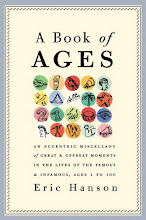
It's getting hard to choose isn't it? Which do you go for? The safest idea might be to spread your bets out a little. Cover the board. Buy Dad A BOOK OF AGES. It's got sports heroes, famous generals, film stars, chefs, cowboys and Indians, bank robbers, mountain climbers, spy novelists and real spies, rock stars, business tycoons, famous explorers, presidents, philosophers, inventors, scientists, heroes and arch-villains.
And A BOOK OF AGES is fun to read. Men love facts, and every page is jammed full of interesting facts, funny stories, amazing moments from over 700 amazing lives. Bite sized paragraphs. Dad will start reading them aloud to you: "Did you know that Ted Williams homered in his last time up?" "Did you know that George Washington didn't win a battle until he was 44?" "Did you know that Pete Townshend broke his first guitar onstage when he was 19?" (All true.)
And I know you will act as if you are interested when he does this because dads are at their most lovable when they are dispensing bite sized bits of wisdom. They are happiest when they are doing this. He will love this book. And you will refrain from rolling your eyes when he is reading from it, at least until you have left the room.
But seriously, it is a perfect gift. Suitable for grandfathers too.
Kids? Fathers love books. Biographies are great. Military biographies even better. Sports biographies, excellent choice. Political biography?
It's getting hard to choose isn't it? Which do you go for? The safest idea might be to spread your bets out a little. Cover the board. Buy Dad A BOOK OF AGES. It's got sports heroes, famous generals, film stars, chefs, cowboys and Indians, bank robbers, mountain climbers, spy novelists and real spies, rock stars, business tycoons, famous explorers, presidents, philosophers, inventors, scientists, heroes and arch-villains.
And A BOOK OF AGES is fun to read. Men love facts, and every page is jammed full of interesting facts, funny stories, amazing moments from over 700 amazing lives. Bite sized paragraphs. Dad will start reading them aloud to you: "Did you know that Ted Williams homered in his last time up?" "Did you know that George Washington didn't win a battle until he was 44?" "Did you know that Pete Townshend broke his first guitar onstage when he was 19?" (All true.)
And I know you will act as if you are interested when he does this because dads are at their most lovable when they are dispensing bite sized bits of wisdom. They are happiest when they are doing this. He will love this book. And you will refrain from rolling your eyes when he is reading from it, at least until you have left the room.
But seriously, it is a perfect gift. Suitable for grandfathers too.
Thursday, April 30, 2009
Father of his Country
220 years ago today, on April 30, 1789, George Washington was sworn in as the first President of the United States. He wore a brown suit.
The brief ceremony took place on Wall Street, appropriately enough. Few realize this but Washington was the richest president we've ever had. Some of his wealth was in land, but most was in slaves, never mind about life, liberty and the pursuit of happiness. It was acquired wealth: he married a rich widow.
President Washington refused to be called “your highness,” preferring the less formal “Mr. President." But he was not a humble man. Not chummy. Ask his friends privately and they'd probably have told you he was stuffy. People didn't joke about him. He'd spent his whole life learning the mannerisms of an aristocrat and was determined to behave like one. He spent most of the American Revolution losing battles, withdrawing, escaping, hiding, retreating, but always with dignity.
Washington had excellent posture. The chief reason he was chosen to chair important meetings was because he was always the tallest person in the room. And he kept his mouth shut. (Bad teeth.) He was also incorruptible. A consensus choice as leader, and, as it turned out, the perfect president for that moment. He set a high standard nobody came close to until another tall man was elected––from Illinois.
These and a few other stories about Washington are told on pages 12, 38, 68, 89, 167, 170, 213, 218, 229 and 239 in A Book of Ages.
The brief ceremony took place on Wall Street, appropriately enough. Few realize this but Washington was the richest president we've ever had. Some of his wealth was in land, but most was in slaves, never mind about life, liberty and the pursuit of happiness. It was acquired wealth: he married a rich widow.
President Washington refused to be called “your highness,” preferring the less formal “Mr. President." But he was not a humble man. Not chummy. Ask his friends privately and they'd probably have told you he was stuffy. People didn't joke about him. He'd spent his whole life learning the mannerisms of an aristocrat and was determined to behave like one. He spent most of the American Revolution losing battles, withdrawing, escaping, hiding, retreating, but always with dignity.
Washington had excellent posture. The chief reason he was chosen to chair important meetings was because he was always the tallest person in the room. And he kept his mouth shut. (Bad teeth.) He was also incorruptible. A consensus choice as leader, and, as it turned out, the perfect president for that moment. He set a high standard nobody came close to until another tall man was elected––from Illinois.
These and a few other stories about Washington are told on pages 12, 38, 68, 89, 167, 170, 213, 218, 229 and 239 in A Book of Ages.
Subscribe to:
Posts (Atom)

 Posts
Posts


