Showing posts with label Poetry. Show all posts
Showing posts with label Poetry. Show all posts
Thursday, December 10, 2009
Emily Dickinson
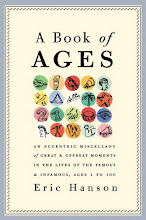
It's Emily Dickinson's birthday. I always picture a pale woman in sateen dress and a tight bun in an upstairs room comparing hope to a thing with feathers. Am I the only one who sees a facial resemblance to David Byrne? Maybe. She spent most of her later years inside her house in Amherst, but she wrote letters and had friendships. When she was 25 her bread won second prize at the county fair, so she did occasionally venture outdoors. Her personality, though, is preserved in the tightly wrought poems; they are her legacy. An agile mind darting around inside a narrow house. Emily Dickinson appears three times in A Book of Ages.

Wednesday, December 9, 2009
Paradise Lost
Today's John Milton's birthday. Born in 1608, he lived through one monarchy, a revolution, a brief republic, a dictatorship (disguised as a protectorate), then a restoration of monarchy. Being politically active, a political flack in fact, he rose and fell as changes occurred, spending time in favor and then in prison. He was also going blind as surely as Thurber, whose birthday was yesterday. He dictated much of his poetry to assistant Andrew Marvell, who was himself a great poet. Milton wrote Paradise Lost and Paradise Regained. For the former landmark in English literature his publisher paid him £10. He also wrote The Doctrine and Discipline of Divorce (he was unhappily married), which probably means he was no Puritan, despite his allegiances. John Milton appears four times in A Book of Ages.
Thursday, October 22, 2009
Arthur Rimbaud: Poet, Arms Dealer
On October 22, 1885, the former poet Arthur Rimbaud wrote to his mother from Ethiopia, telling her he was giving up coffee trading in favor of gun-running. Rimbaud appears three times in A Book of Ages.
Wednesday, October 7, 2009
Howl
Allen Ginsberg was six years-old when his mother was committed to an insane asylum. He was 18 and a student at Columbia when he met Jack Kerouac. He was expelled from the university the next year and joined the Merchant Marine. In 1948 he was back in New York, sitting in his Harlem apartment, when he had a vision of the poet Blake. He described it as “a sense of cosmic consciousness, vibrations, understanding, awe, and wonder and surprise." But writing poetry didn't pay the rent, so he got a job at an advertising agency located in the Empire State Building, where he wrote ads for Ipana toothpaste.
On October 7, 1955 Ginsberg read Howl for the first time to an audience in San Francisco. He was living in North Berkeley then, Kerouac was staying with him. They rode the bus together across the Bay Bridge and then bummed a ride in Lawrence Ferlinghetti’s Aston Martin to the Six Gallery near Fillmore and Union. Ginsberg was the fifth poet on the program. He began with the famous line: “I saw the best minds of my generation destroyed by madness.” Afterwards, Ginsburg, Kerouac, and a few others went out for Chinese. He was 29 and had finally arrived. Allen Ginsberg appears five times in A Book of Ages.
On October 7, 1955 Ginsberg read Howl for the first time to an audience in San Francisco. He was living in North Berkeley then, Kerouac was staying with him. They rode the bus together across the Bay Bridge and then bummed a ride in Lawrence Ferlinghetti’s Aston Martin to the Six Gallery near Fillmore and Union. Ginsberg was the fifth poet on the program. He began with the famous line: “I saw the best minds of my generation destroyed by madness.” Afterwards, Ginsburg, Kerouac, and a few others went out for Chinese. He was 29 and had finally arrived. Allen Ginsberg appears five times in A Book of Ages.
Friday, October 2, 2009
Career Tracks
Wallace Stevens was born on this day in 1879, in Reading, Pennsylvania. He always wanted to be a writer but then he studied law, as his father urged him to do, and spent his whole working life in the insurance business, eventually becoming an executive for the Hartford. Which is the story of everybody's life. Most of the novelists you read pay their mortgages by teaching. Poets write advertising copy. T. S. Eliot was an editor. Edgar Lee Masters wrote poems while sitting in a courtroom where he was defending a Chicago waitresses' union. For a while in his twenties Allen Ginsberg wrote ads for Ipana toothpaste. We live our lives on separate tracks. Wallace Stevens walked two miles to work every morning and two miles back home, composing his poems along the sidewalks of Hartford. An irreproachable life apart from the incident in Key West when he broke his hand on Ernest Hemingway's jaw. Stevens appears five times in A Book of Ages.
Tuesday, September 22, 2009
Keats
In one year, between September 1818 and September 1819, John Keats wrote most of the poems that would ensure his immortality, including “Ode on a Grecian Urn,” “Ode to a Nightingale” and “To Autumn.” He was 23 years-old and would live another two years. Keats appears twice in A Book of Ages.
Thursday, September 3, 2009
"Earth hasn't anything to show more fair"
Garrison Keillor's Writer's Almanac reminds me that it was 207 years ago today that William Wordsworth composed his sonnet upon Westminster Bridge. Wordsworth appears five times in A Book of Ages.
Saturday, August 8, 2009
The Road Not Taken
Robert Frost’s poem “The Road Not Taken” was published in the August 1915 issue of The Atlantic Monthly. Frost was 41, an age when poets begin to wonder what life might have been like if they'd gone into advertising.
Tuesday, August 4, 2009
The Poet Shelley
Percy Bysshe Shelley was born on this day in 1792, with a silver spoon in his mouth. His father was rich, landed and aristocratic; a baronet born, interestingly enough, in Newark, New Jersey, who'd married two wealthy heiresses in succession. His son Percy was cosseted, rebellious and intellectual. At 18 he was thrown out of Oxford for co-authoring a pamphlet titled "The Necessity of Atheism". At 19 he eloped to Scotland with a 16 year-old girl he'd met in a pub. At 21 he met and fell in love with Mary Wollestonecraft Godwin and eloped with her to the Continent. There, it being a small world, he and Mary quickly met and traveled around with Lord Byron and his coterie.
On a rainy evening in 1816, Byron, Polidori and the Shelleys had a contest to see who could write the most terrifying ghost story. Mary Shelley won with a tale about a man stitched together from body parts borrowed from the deceased. She called her story Frankenstein, and today when you look up "Shelley" you are likely to find her listed first. In their day, however, Shelley was the celebrity. This was the Romantic Era, and he wrote poems that suited the mood. He died, romantically and just short of his 30th birthday, in a boat in a storm off the coast of Italy. He was given a Viking funeral by Leigh Hunt and Lord Byron. The Shelleys appear twice each in A Book of Ages.
On a rainy evening in 1816, Byron, Polidori and the Shelleys had a contest to see who could write the most terrifying ghost story. Mary Shelley won with a tale about a man stitched together from body parts borrowed from the deceased. She called her story Frankenstein, and today when you look up "Shelley" you are likely to find her listed first. In their day, however, Shelley was the celebrity. This was the Romantic Era, and he wrote poems that suited the mood. He died, romantically and just short of his 30th birthday, in a boat in a storm off the coast of Italy. He was given a Viking funeral by Leigh Hunt and Lord Byron. The Shelleys appear twice each in A Book of Ages.
Monday, July 27, 2009
The Wollestonecraft-Shelleys
On July 27, 1814, Mary Wollestonecraft ran away to the Continent with the poet Percy Bysshe Shelley. He was already married, which meant they had to wait until December 1816 for Shelley’s first wife to drown herself before they could marry. The original literary power couple appear twice each in A Book of Ages.
Friday, July 10, 2009
Arthur Rimbaud and Paul Verlaine
on July 10, 1873 Arthur Rimbaud was shot in the wrist by his friend Paul Verlaine. Verlaine received two years imprisonment. Inspired by all the hoo-hah, the 18 year-old Rimbaud wrote his domestic farce "A Season In Hell", a pioneering work in the Symbolist movement. A century after his death, his poetry would inspire some of the more louche poets of Rock 'n' Roll, notably Bob Dylan, Van Morrison, Jim Morrison and Patti Smith. Soon after the Verlaine break-up, Rimbaud gave up poetry altogether. He spent the rest of his working life in construction, sales and the armaments business. Arthur Rimbaud appears three times in A Book of Ages, Verlaine twice.
Saturday, April 18, 2009
The House That Ruth Built, Ezra Pound
Yankee Stadium opened on April 18, 1923. It was called the House that Ruth Built, but more accurately it was the house that Ruth paid for. The day in 1919 when Red Sox owner Harry Frazee sold Ruth's contract to the Yankees is one that lives in baseball infamy. Frazee put the $100,000 into a Broadway Show, No No Nanette, but the transaction put a curse on the Red Sox that would last until October 2004.
Babe Ruth, who had been to that point the best left-handed pitcher in the game, quickly became the greatest slugger the game had ever known. He sold tickets. In the aftermath of the Black Sox scandal of 1919, Babe Ruth's larger than life personality and spectacular play probably saved major league baseball from itself. He was 24 when he became a Yankee and was given the number 3.
On April 18, 1958 the poet Ezra Pound was ordered freed from St. Elizabeth's Hospital where he'd been confined for 12 years for treason. Pound was a groundbreaking poet and an advisor, editor and champion of many of the century's great writers, including T. S. Eliot and Ernest Hemingway. But with the onset of World War II he also became a champion of fascism, which became a problem. He never relented. On his release from the asylum he was asked "How did it go in the madhouse?" "Rather badly," he said. "But what other place could one live in America?"
Babe Ruth, who had been to that point the best left-handed pitcher in the game, quickly became the greatest slugger the game had ever known. He sold tickets. In the aftermath of the Black Sox scandal of 1919, Babe Ruth's larger than life personality and spectacular play probably saved major league baseball from itself. He was 24 when he became a Yankee and was given the number 3.
On April 18, 1958 the poet Ezra Pound was ordered freed from St. Elizabeth's Hospital where he'd been confined for 12 years for treason. Pound was a groundbreaking poet and an advisor, editor and champion of many of the century's great writers, including T. S. Eliot and Ernest Hemingway. But with the onset of World War II he also became a champion of fascism, which became a problem. He never relented. On his release from the asylum he was asked "How did it go in the madhouse?" "Rather badly," he said. "But what other place could one live in America?"
Subscribe to:
Posts (Atom)

 Posts
Posts


