Percy Bysshe Shelley was born on this day in 1792, with a silver spoon in his mouth. His father was rich, landed and aristocratic; a baronet born, interestingly enough, in Newark, New Jersey, who'd married two wealthy heiresses in succession. His son Percy was cosseted, rebellious and intellectual. At 18 he was thrown out of Oxford for co-authoring a pamphlet titled "The Necessity of Atheism". At 19 he eloped to Scotland with a 16 year-old girl he'd met in a pub. At 21 he met and fell in love with Mary Wollestonecraft Godwin and eloped with her to the Continent. There, it being a small world, he and Mary quickly met and traveled around with Lord Byron and his coterie.
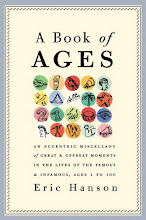
On a rainy evening in 1816, Byron, Polidori and the Shelleys had a contest to see who could write the most terrifying ghost story. Mary Shelley won with a tale about a man stitched together from body parts borrowed from the deceased. She called her story Frankenstein, and today when you look up "Shelley" you are likely to find her listed first. In their day, however, Shelley was the celebrity. This was the Romantic Era, and he wrote poems that suited the mood. He died, romantically and just short of his 30th birthday, in a boat in a storm off the coast of Italy. He was given a Viking funeral by Leigh Hunt and Lord Byron. The Shelleys appear twice each in A Book of Ages.
Showing posts with label Lord Byron. Show all posts
Showing posts with label Lord Byron. Show all posts
Tuesday, August 4, 2009

Friday, June 19, 2009
Mary Wollestonecraft tells a ghost story
On a rainy June 19th evening in 1816, Mary Wollestonecraft is in Geneva with her lover, Percy Bysshe Shelley, and Lord Byron, and Byron’s friend Polidori. It's Byron who suggests each of them write a ghost story. When the men can’t think of any good ideas, Mary writes one about a creature made out of spare parts from dead bodies. Back in England, she turns the story into a novel which she titles Frankenstein. The book will be published in March, 1818.
Mary Wollestonecraft Shelley appears twice in A Book of Ages, the same number as her poet husband. She will outlive him by almost thirty years.
Mary Wollestonecraft Shelley appears twice in A Book of Ages, the same number as her poet husband. She will outlive him by almost thirty years.
Sunday, May 3, 2009
Lord Byron swims the Hellespont
On May 3, 1810 Lord Byron swam the Hellespont, the channel separating Asia and Europe, not far from the buried ruins of ancient Troy. It took him an hour and ten minutes. He'd failed on his first try, having misjudged the currents. In the legend Leander crossed it so he could sleep with his beloved Hero. Byron did it so he could write letters home about it. He wrote many of those, as well as a famous poem. He was 22 and just beginning to write his own legend.
Byron was the first great literary celebrity. Aristocratic, talented, scandalous, handsome, competitive to a fault, self-promoting, larger than life. Far too outsized for proper London society, which is why he spent most of his adult life on the Continent. He had a troublesome habit of falling in love with married women. In 1812 he had his famous affair with Lady Caroline Lamb. It was Lady Caroline who described Byron as "mad, bad and dangerous to know."
In several ways he is the perfect hero for a book like mine. The word Byronic describes a certain kind of man, young, ambitious, poetic, dangerous, daring, romantic and a bit doomed. Byron died young while taking part in a revolution in Greece. He presided over the Viking funeral of Shelley on the Italian coast. He proposed the storytelling contest that resulted in Mary Shelley's Frankenstein. Half Peter Pan and half Odysseus, he is the prototype for millions of young men since, and several others described in the book: Bruce Chatwin, Dylan Thomas, Oscar Wilde, Hemingway, Fitzgerald, Kurt Cobain, John Lennon, Mick Jagger.
Byron appears on pages 21, 61, 66, 76, 77, 95, 117, 128 and 130 in A Book of Ages.
Byron was the first great literary celebrity. Aristocratic, talented, scandalous, handsome, competitive to a fault, self-promoting, larger than life. Far too outsized for proper London society, which is why he spent most of his adult life on the Continent. He had a troublesome habit of falling in love with married women. In 1812 he had his famous affair with Lady Caroline Lamb. It was Lady Caroline who described Byron as "mad, bad and dangerous to know."
In several ways he is the perfect hero for a book like mine. The word Byronic describes a certain kind of man, young, ambitious, poetic, dangerous, daring, romantic and a bit doomed. Byron died young while taking part in a revolution in Greece. He presided over the Viking funeral of Shelley on the Italian coast. He proposed the storytelling contest that resulted in Mary Shelley's Frankenstein. Half Peter Pan and half Odysseus, he is the prototype for millions of young men since, and several others described in the book: Bruce Chatwin, Dylan Thomas, Oscar Wilde, Hemingway, Fitzgerald, Kurt Cobain, John Lennon, Mick Jagger.
Byron appears on pages 21, 61, 66, 76, 77, 95, 117, 128 and 130 in A Book of Ages.
Subscribe to:
Posts (Atom)

 Posts
Posts


