Allen Ginsberg was six years-old when his mother was committed to an insane asylum. He was 18 and a student at Columbia when he met Jack Kerouac. He was expelled from the university the next year and joined the Merchant Marine. In 1948 he was back in New York, sitting in his Harlem apartment, when he had a vision of the poet Blake. He described it as “a sense of cosmic consciousness, vibrations, understanding, awe, and wonder and surprise." But writing poetry didn't pay the rent, so he got a job at an advertising agency located in the Empire State Building, where he wrote ads for Ipana toothpaste.
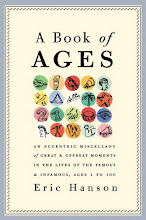
On October 7, 1955 Ginsberg read Howl for the first time to an audience in San Francisco. He was living in North Berkeley then, Kerouac was staying with him. They rode the bus together across the Bay Bridge and then bummed a ride in Lawrence Ferlinghetti’s Aston Martin to the Six Gallery near Fillmore and Union. Ginsberg was the fifth poet on the program. He began with the famous line: “I saw the best minds of my generation destroyed by madness.” Afterwards, Ginsburg, Kerouac, and a few others went out for Chinese. He was 29 and had finally arrived. Allen Ginsberg appears five times in A Book of Ages.
Showing posts with label Allen Ginsberg. Show all posts
Showing posts with label Allen Ginsberg. Show all posts
Wednesday, October 7, 2009

Sunday, May 10, 2009
Mother's Day
On the day after our maternal parents have been celebrated, kissed, given potted plants and cards drawn with crayon and plaster handprints of small children, we are left to wonder what it's all about. Motherhood is one of many themes in A Book of Ages. No surprise, really. It's a book about life's changes, the relationships we nurture and endure, and there is no relationship more profound than that of mother and child.
Famous people have mothers too. Mothers who died young, like Lincoln's, Somerset Maugham's, Poe's, Orson Welles's and Mary McCarthy's. Allen Ginsberg's mother was institutionalized when he was six, Cary Grant's when he was nine. Marilyn Monroe's mother was unable to raise her. Hitler's smothered him with affection. Buster Keaton's and Judy Garland's parents took them into the family business, which happened to be show business. Eudora Welty surrendered her New York writing career to care for her mother back in Mississippi. Child monarchs receive a legacy as heavy as any family curse. Most parents do the best they know how in the circumstances they are given, and their children muddle through. I found this again and again in the lives I describe in the book.
When P. G. Wodehouse was two his parents returned to British Hong Kong, leaving the youngster in the care of assorted maternal aunts. The adult Wodehouse didn't bear a grudge. Dickens's mother allowed him to be removed from school and put to work in a shoe polish factory at the age of twelve, and he never forgave her. In both cases, these events became part of their fiction. In an important sense we are children all of our lives, and as parents we re-enact what we learned.
Famous people have mothers too. Mothers who died young, like Lincoln's, Somerset Maugham's, Poe's, Orson Welles's and Mary McCarthy's. Allen Ginsberg's mother was institutionalized when he was six, Cary Grant's when he was nine. Marilyn Monroe's mother was unable to raise her. Hitler's smothered him with affection. Buster Keaton's and Judy Garland's parents took them into the family business, which happened to be show business. Eudora Welty surrendered her New York writing career to care for her mother back in Mississippi. Child monarchs receive a legacy as heavy as any family curse. Most parents do the best they know how in the circumstances they are given, and their children muddle through. I found this again and again in the lives I describe in the book.
When P. G. Wodehouse was two his parents returned to British Hong Kong, leaving the youngster in the care of assorted maternal aunts. The adult Wodehouse didn't bear a grudge. Dickens's mother allowed him to be removed from school and put to work in a shoe polish factory at the age of twelve, and he never forgave her. In both cases, these events became part of their fiction. In an important sense we are children all of our lives, and as parents we re-enact what we learned.
Subscribe to:
Posts (Atom)

 Posts
Posts


