In September 1935 Judy Garland had a personal audition with Louis B. Mayer at MGM and was signed to a contract for $100 a week. She was 13, bright-eyed, pudgy, adorable and enormously talented. The talent came paired with a trembling vulnerability, the eyes almost on the verge of tears, the tremble in the voice. She starred in nine movies opposite Mickey Rooney, usually playing the true-hearted best friend, then in 1939 she played Dorothy in The Wizard of Oz; she was 16.
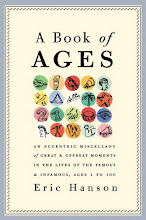
Louis B. Mayer thought her plumpness unattractive and he and other MGM executives urged her to lose weight. She was given pills to accomplish this. She grew thinner but became addicted to the pills. Pills and alcohol made her an unreliable performer on set and she was fired from several pictures during production, she suffered nervous breakdowns and paralyzing episodes of self-doubt, but she remained a galvanizing presence on stage. Audiences sat mesmerized while she performed on that narrow space between perfection and collapse, an apt metaphor for stardom if there ever was one. Judy Garland appears six times in A Book of Ages.
Showing posts with label Judy Garland. Show all posts
Showing posts with label Judy Garland. Show all posts
Thursday, September 17, 2009

Thursday, May 28, 2009
Famous Childhoods
Watching eight adorable children tumble across the TV screen puts me in mind of earlier versions of the same thing. I sometimes wonder what America will be remembered for. Will it be Coca Cola or baseball or will it be famous children? They are the quintessential American product.
It's a familiar story: a family hoping to change its luck thrusts the cute youngster on the stage. Child saves the family farm. Judy Garland and Mickey Rooney putting on a show in the old barn were only re-enacting their life stories. Garland started at age two, Rooney at 17 months. Being famous can be a terrible burden on the very young, but is stardom any worse than being poor? Some children thrive on it. Some adjust. Some never find their feet in life. Shirley Temple turned out all right, protected by a remarkable and practical stage mother. Shirley was the most famous person in America at age 5. The worst disillusionment occurred at age 7 when a department store Santa asked for her autograph. But years later, there she was, bright as paint and adorable as ever, on the album cover of Sgt. Pepper. As if she'd never grown up.
America didn't invent the child star. Mozart was one, playing the piano for crowned heads before his feet could reach the pedals. Christopher Milne was an ordinary shy London child, neglected by his society mother, adored by his nanny, observed from a discreet distance by his father who wrote comic verses for Punch. "Hush, hush, whisper who dares/ Christopher Robin is saying his prayers." Then there were the clever books about the boy's adventures with a stuffed bear. None of it went down particularly well when Christopher Robin went away to school, but his toilet training wasn't available on DVD.
Playwright James Barrie befriended a family of little boys in a London park. He gave them gifts and told them stories and played games with them, behaving very unlike a respectable London adult. When their parents died he adopted them. He wrote a very famous play about the youngest one, named Peter, imagining a boy who never grows up at all. But they did grow up, and all their ends were tragic. Biographers have suggested that Barrie corrupted them, but there is no real evidence. The story reminds us of another former child star who lives a strange, secluded life at a California ranch called Neverland. When the whole world is paying attention to you it must be very hard to grow up normal and average and happy. But there are cases where it's been done.
These and other famous childhoods are included in A Book of Ages.
It's a familiar story: a family hoping to change its luck thrusts the cute youngster on the stage. Child saves the family farm. Judy Garland and Mickey Rooney putting on a show in the old barn were only re-enacting their life stories. Garland started at age two, Rooney at 17 months. Being famous can be a terrible burden on the very young, but is stardom any worse than being poor? Some children thrive on it. Some adjust. Some never find their feet in life. Shirley Temple turned out all right, protected by a remarkable and practical stage mother. Shirley was the most famous person in America at age 5. The worst disillusionment occurred at age 7 when a department store Santa asked for her autograph. But years later, there she was, bright as paint and adorable as ever, on the album cover of Sgt. Pepper. As if she'd never grown up.
America didn't invent the child star. Mozart was one, playing the piano for crowned heads before his feet could reach the pedals. Christopher Milne was an ordinary shy London child, neglected by his society mother, adored by his nanny, observed from a discreet distance by his father who wrote comic verses for Punch. "Hush, hush, whisper who dares/ Christopher Robin is saying his prayers." Then there were the clever books about the boy's adventures with a stuffed bear. None of it went down particularly well when Christopher Robin went away to school, but his toilet training wasn't available on DVD.
Playwright James Barrie befriended a family of little boys in a London park. He gave them gifts and told them stories and played games with them, behaving very unlike a respectable London adult. When their parents died he adopted them. He wrote a very famous play about the youngest one, named Peter, imagining a boy who never grows up at all. But they did grow up, and all their ends were tragic. Biographers have suggested that Barrie corrupted them, but there is no real evidence. The story reminds us of another former child star who lives a strange, secluded life at a California ranch called Neverland. When the whole world is paying attention to you it must be very hard to grow up normal and average and happy. But there are cases where it's been done.
These and other famous childhoods are included in A Book of Ages.
Thursday, May 14, 2009
Prodigies
On May 14, 1643, Louis XIV was crowned king of France. He was four years old. History is full of four year-old monarchs, hovered over by helpful and malign viziers and privy counsellors and stage mothers, all lovingly asserting their own power. It's a familiar picture. Mary became Queen of Scots before she celebrated her first birthday. She was given lots of advice by her French uncles.
The more famous prodigies are musical. Mozart playing the piano for kings and grand dukes before his feet could reach the pedals. Judy Garland made her stage debut when she was two. Jascha Heifetz started violin lessons at three. And so on. A reviewer in Publishers Weekly picked up my book and worried that it was a catalog of prodigies. He was pleased to see it included unprodigies as well. Dolts like Albert Einstein who didn't speak until he was three, and Thomas Edison who was removed from school because the teacher thought he was too stupid to learn.
Mostly, childhood is a forbidding sort of place where children are right to be afraid and puzzled, and grateful for every friend they meet. Mick Jagger met Keith Richard when he was four, a meeting I imagine like d'Artagnon meeting Aramis. The best accounts of childhood are a bit surreal, like Alice in Wonderland, or strangely funny, like Thurber's My Life and Hard Times, or Dickens's autobiographical novel David Copperfield. In A Book of Ages you learn that James Thurber was four when his family purchased a dog that bit people. Alice Liddell was ten when she became the heroine of her famous story. Flannery O'Connor was five when she became famous for teaching her chicken to walk backwards.
Even famous childhoods are full of loss: Isaac Newton losing his mother, Ray Charles losing his sight, Jerry Garcia losing the end of his right middle finger, Mike Nichols losing all of his hair including his eyebrows, Shirley Temple losing her belief in Santa Claus. Children learn things to compensate. We begin rehearsing the things we will become as adults. Bobby Fischer learned chess at age six. J. K. Rowling wrote her first story when she was six; it was about a rabbit with measles. Prodigious or not, every childhood is an odd mix of danger and possibility. Which is why the stories we read are simultaneously funny and sad, strange and familiar.
The more famous prodigies are musical. Mozart playing the piano for kings and grand dukes before his feet could reach the pedals. Judy Garland made her stage debut when she was two. Jascha Heifetz started violin lessons at three. And so on. A reviewer in Publishers Weekly picked up my book and worried that it was a catalog of prodigies. He was pleased to see it included unprodigies as well. Dolts like Albert Einstein who didn't speak until he was three, and Thomas Edison who was removed from school because the teacher thought he was too stupid to learn.
Mostly, childhood is a forbidding sort of place where children are right to be afraid and puzzled, and grateful for every friend they meet. Mick Jagger met Keith Richard when he was four, a meeting I imagine like d'Artagnon meeting Aramis. The best accounts of childhood are a bit surreal, like Alice in Wonderland, or strangely funny, like Thurber's My Life and Hard Times, or Dickens's autobiographical novel David Copperfield. In A Book of Ages you learn that James Thurber was four when his family purchased a dog that bit people. Alice Liddell was ten when she became the heroine of her famous story. Flannery O'Connor was five when she became famous for teaching her chicken to walk backwards.
Even famous childhoods are full of loss: Isaac Newton losing his mother, Ray Charles losing his sight, Jerry Garcia losing the end of his right middle finger, Mike Nichols losing all of his hair including his eyebrows, Shirley Temple losing her belief in Santa Claus. Children learn things to compensate. We begin rehearsing the things we will become as adults. Bobby Fischer learned chess at age six. J. K. Rowling wrote her first story when she was six; it was about a rabbit with measles. Prodigious or not, every childhood is an odd mix of danger and possibility. Which is why the stories we read are simultaneously funny and sad, strange and familiar.
Sunday, May 10, 2009
Mother's Day
On the day after our maternal parents have been celebrated, kissed, given potted plants and cards drawn with crayon and plaster handprints of small children, we are left to wonder what it's all about. Motherhood is one of many themes in A Book of Ages. No surprise, really. It's a book about life's changes, the relationships we nurture and endure, and there is no relationship more profound than that of mother and child.
Famous people have mothers too. Mothers who died young, like Lincoln's, Somerset Maugham's, Poe's, Orson Welles's and Mary McCarthy's. Allen Ginsberg's mother was institutionalized when he was six, Cary Grant's when he was nine. Marilyn Monroe's mother was unable to raise her. Hitler's smothered him with affection. Buster Keaton's and Judy Garland's parents took them into the family business, which happened to be show business. Eudora Welty surrendered her New York writing career to care for her mother back in Mississippi. Child monarchs receive a legacy as heavy as any family curse. Most parents do the best they know how in the circumstances they are given, and their children muddle through. I found this again and again in the lives I describe in the book.
When P. G. Wodehouse was two his parents returned to British Hong Kong, leaving the youngster in the care of assorted maternal aunts. The adult Wodehouse didn't bear a grudge. Dickens's mother allowed him to be removed from school and put to work in a shoe polish factory at the age of twelve, and he never forgave her. In both cases, these events became part of their fiction. In an important sense we are children all of our lives, and as parents we re-enact what we learned.
Famous people have mothers too. Mothers who died young, like Lincoln's, Somerset Maugham's, Poe's, Orson Welles's and Mary McCarthy's. Allen Ginsberg's mother was institutionalized when he was six, Cary Grant's when he was nine. Marilyn Monroe's mother was unable to raise her. Hitler's smothered him with affection. Buster Keaton's and Judy Garland's parents took them into the family business, which happened to be show business. Eudora Welty surrendered her New York writing career to care for her mother back in Mississippi. Child monarchs receive a legacy as heavy as any family curse. Most parents do the best they know how in the circumstances they are given, and their children muddle through. I found this again and again in the lives I describe in the book.
When P. G. Wodehouse was two his parents returned to British Hong Kong, leaving the youngster in the care of assorted maternal aunts. The adult Wodehouse didn't bear a grudge. Dickens's mother allowed him to be removed from school and put to work in a shoe polish factory at the age of twelve, and he never forgave her. In both cases, these events became part of their fiction. In an important sense we are children all of our lives, and as parents we re-enact what we learned.
Subscribe to:
Posts (Atom)

 Posts
Posts


