Christopher Robin Milne received a stuffed donkey for Christmas in 1921. He was one year-old and had already received a stuffed bear for his birthday in August. You know the rest of the story. His clever father wrote a book about Christopher Robin and his toys, and then another. They were bestsellers, which embarrassed the boy no end when he went away to school. (The other boys enjoyed chanting "Hush hush, whisper who dares! Christopher Robin is saying his prayers!")
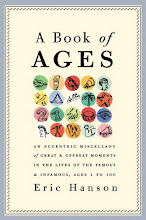
The books, in their fiftieth printing by now, were read to you when you were small, long before you understood the wit. Then you reread them in college. Trying to recapture the innocence of childhood worked as a temporary respite from first semester finals. Christopher Robin eventually grew up. He was wounded in action in World War II, married, and opened a bookstore in Dorset. He later wrote a book about the difficulties of living a famous childhood. He appears six times in A Book of Ages.
Showing posts with label Christopher Robin. Show all posts
Showing posts with label Christopher Robin. Show all posts
Monday, December 21, 2009

Tuesday, October 20, 2009
Tonstant Weader Fwowed Up
On October 20, 1928, Dorothy Parker reviewed "The House at Pooh Corner" in the New Yorker magazine. It was an inspired pairing. A. A. Milne was a cozy writer most famous for light verse about bunnies and honeybees. Parker was the most savage wit of the Algonquin round table, whose remarks were avidly recorded by the New York columnists. Parker's book reviewing byline was Constant Reader. Not surprisingly Parker found Milne's book about stuffed animals painfully twee, and she decided to say so in the appropriate baby voice. When she got to the part where Pooh is feeling "hummy" she announced that "Tonstant Weader fwowed up." But books of this type are immune to sarcasm. Pooh's devotees thought Parker was just being mean. A new book of Pooh stories has just appeared, with a new author channeling Milne's sensibility and a new illustrator imitating the inimitable Shepard. Ms. Parker is no doubt throwing up in her grave. Dorothy Parker appears six times in A Book of Ages, Christopher Robin Milne also appears six times.
Friday, August 21, 2009
A Very Famous Childhood
On August 21, 1921, Christopher Robin Milne got a stuffed bear for his first birthday. He would receive a stuffed donkey for Christmas, and he already had a small stuffed pig, a gift from a neighbor. His father wrote humorous stories about fashionable Londoners, and successful plays that ran in the West End. His mother was attractive and very chic. They lived in Chelsea. Christopher had a perfect childhood in many ways. In a few years, through no fault of his own, he would be the most famous child in the English-speaking world. None of this sounds like a recipe for unhappiness, but he hated fame. He would spend the rest of his life hiding from it. Christopher Robin appears six times in A Book of Ages.
Thursday, May 28, 2009
Famous Childhoods
Watching eight adorable children tumble across the TV screen puts me in mind of earlier versions of the same thing. I sometimes wonder what America will be remembered for. Will it be Coca Cola or baseball or will it be famous children? They are the quintessential American product.
It's a familiar story: a family hoping to change its luck thrusts the cute youngster on the stage. Child saves the family farm. Judy Garland and Mickey Rooney putting on a show in the old barn were only re-enacting their life stories. Garland started at age two, Rooney at 17 months. Being famous can be a terrible burden on the very young, but is stardom any worse than being poor? Some children thrive on it. Some adjust. Some never find their feet in life. Shirley Temple turned out all right, protected by a remarkable and practical stage mother. Shirley was the most famous person in America at age 5. The worst disillusionment occurred at age 7 when a department store Santa asked for her autograph. But years later, there she was, bright as paint and adorable as ever, on the album cover of Sgt. Pepper. As if she'd never grown up.
America didn't invent the child star. Mozart was one, playing the piano for crowned heads before his feet could reach the pedals. Christopher Milne was an ordinary shy London child, neglected by his society mother, adored by his nanny, observed from a discreet distance by his father who wrote comic verses for Punch. "Hush, hush, whisper who dares/ Christopher Robin is saying his prayers." Then there were the clever books about the boy's adventures with a stuffed bear. None of it went down particularly well when Christopher Robin went away to school, but his toilet training wasn't available on DVD.
Playwright James Barrie befriended a family of little boys in a London park. He gave them gifts and told them stories and played games with them, behaving very unlike a respectable London adult. When their parents died he adopted them. He wrote a very famous play about the youngest one, named Peter, imagining a boy who never grows up at all. But they did grow up, and all their ends were tragic. Biographers have suggested that Barrie corrupted them, but there is no real evidence. The story reminds us of another former child star who lives a strange, secluded life at a California ranch called Neverland. When the whole world is paying attention to you it must be very hard to grow up normal and average and happy. But there are cases where it's been done.
These and other famous childhoods are included in A Book of Ages.
It's a familiar story: a family hoping to change its luck thrusts the cute youngster on the stage. Child saves the family farm. Judy Garland and Mickey Rooney putting on a show in the old barn were only re-enacting their life stories. Garland started at age two, Rooney at 17 months. Being famous can be a terrible burden on the very young, but is stardom any worse than being poor? Some children thrive on it. Some adjust. Some never find their feet in life. Shirley Temple turned out all right, protected by a remarkable and practical stage mother. Shirley was the most famous person in America at age 5. The worst disillusionment occurred at age 7 when a department store Santa asked for her autograph. But years later, there she was, bright as paint and adorable as ever, on the album cover of Sgt. Pepper. As if she'd never grown up.
America didn't invent the child star. Mozart was one, playing the piano for crowned heads before his feet could reach the pedals. Christopher Milne was an ordinary shy London child, neglected by his society mother, adored by his nanny, observed from a discreet distance by his father who wrote comic verses for Punch. "Hush, hush, whisper who dares/ Christopher Robin is saying his prayers." Then there were the clever books about the boy's adventures with a stuffed bear. None of it went down particularly well when Christopher Robin went away to school, but his toilet training wasn't available on DVD.
Playwright James Barrie befriended a family of little boys in a London park. He gave them gifts and told them stories and played games with them, behaving very unlike a respectable London adult. When their parents died he adopted them. He wrote a very famous play about the youngest one, named Peter, imagining a boy who never grows up at all. But they did grow up, and all their ends were tragic. Biographers have suggested that Barrie corrupted them, but there is no real evidence. The story reminds us of another former child star who lives a strange, secluded life at a California ranch called Neverland. When the whole world is paying attention to you it must be very hard to grow up normal and average and happy. But there are cases where it's been done.
These and other famous childhoods are included in A Book of Ages.
Subscribe to:
Posts (Atom)

 Posts
Posts


