Showing posts with label the New Yorker magazine. Show all posts
Showing posts with label the New Yorker magazine. Show all posts
Tuesday, October 20, 2009
Tonstant Weader Fwowed Up
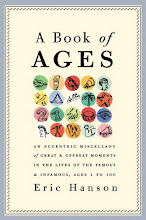
On October 20, 1928, Dorothy Parker reviewed "The House at Pooh Corner" in the New Yorker magazine. It was an inspired pairing. A. A. Milne was a cozy writer most famous for light verse about bunnies and honeybees. Parker was the most savage wit of the Algonquin round table, whose remarks were avidly recorded by the New York columnists. Parker's book reviewing byline was Constant Reader. Not surprisingly Parker found Milne's book about stuffed animals painfully twee, and she decided to say so in the appropriate baby voice. When she got to the part where Pooh is feeling "hummy" she announced that "Tonstant Weader fwowed up." But books of this type are immune to sarcasm. Pooh's devotees thought Parker was just being mean. A new book of Pooh stories has just appeared, with a new author channeling Milne's sensibility and a new illustrator imitating the inimitable Shepard. Ms. Parker is no doubt throwing up in her grave. Dorothy Parker appears six times in A Book of Ages, Christopher Robin Milne also appears six times.

Thursday, July 16, 2009
Catcher in the Rye
On July 16, 1951, J. D. Salinger published A Catcher In The Rye. He was 32. He'd created the character of Holden Caulfield ten years earlier, and The New Yorker was about to publish the first Holden story when the Japanese attacked Pearl Harbor. Salinger would take part in the Normandy landings, fight in the Battle of the Bulge and meet Ernest Hemingway in Paris before he saw New York again. Salinger appears six times in A Book of Ages. I believe J. D. Salinger is the only American novelist to ever lose a girlfriend to Charlie Chaplin or to serve as a recreation director aboard a cruise ship.
Saturday, May 23, 2009
Inventor of Dreams
Americans adore their own mythology. Maybe it's because we're still young enough as a country. The biggest manufacturer of that mythology is and was the movie business, which was a far more energetic and prolific creative force earlier on, during the Studio Era. The era, to take two examples, of Gone with the Wind and The Wizard of Oz. Both pictures are fundamental to how America imagines itself. Both were made in one year, 1939, by one film director who hardly anybody remembers today: Victor Fleming.
Fleming gets his desserts (or is it deserts?) on page 211 of A Book of Ages, and is one of only a handful of unfamous people in the whole book. But his imprint is so indelible our forgetfulness ought to be a crime. The half of us who don't dream about Oz dream of Tara.
Fleming also gets a well-deserved treatment in this week's New Yorker magazine, in the capable hands of David Denby. The occasion is a new biography of Fleming by Michael Sragow. Biographers are like entrepreneurs in one important sense. They devote years of toil based on a hope that people will give a damn, if I may quote Rhett Butler. In this case, the subject is fascinating and important but virtually unknown, less famous, for instance, than Chelsea and her vodka.
Fleming gets his desserts (or is it deserts?) on page 211 of A Book of Ages, and is one of only a handful of unfamous people in the whole book. But his imprint is so indelible our forgetfulness ought to be a crime. The half of us who don't dream about Oz dream of Tara.
Fleming also gets a well-deserved treatment in this week's New Yorker magazine, in the capable hands of David Denby. The occasion is a new biography of Fleming by Michael Sragow. Biographers are like entrepreneurs in one important sense. They devote years of toil based on a hope that people will give a damn, if I may quote Rhett Butler. In this case, the subject is fascinating and important but virtually unknown, less famous, for instance, than Chelsea and her vodka.
Subscribe to:
Posts (Atom)

 Posts
Posts


