The New York Stock Exchange was formed on this day in 1792. Located on Wall Street, the stock exchange became a place of wild ups and downs, frequent panics and frauds. It remained so until 1934 when FDR formed the S.E.C. Since then the American economy has enjoyed a steady, mildly fluctuating prosperity, with no great panics and only occasional frauds, unless you consider Market Capitalism a fraud. Roosevelt put Joseph Kennedy, one of the greatest of Wall Street's buccaneers, in charge of cleaning the street up. Kennedy did a remarkable job and kept a straight face enforcing the rules that would have prevented him from acquiring his fortune. You could say FDR and Joe Kennedy were mother and father to the American middle class
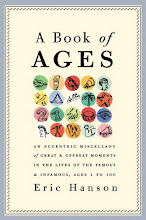
Left to its own devices, life is a rollercoaster, and A Book of Ages reads like one. Mark Twain, Winston Churchill, Thomas Paine, Ulysses S. Grant, Alfred Nobel, F. Scott Fitzgerald, Mary McCarthy, Buckminster Fuller, Charles Dickens, Georg Friderich Handel, and Philo T. Farnsworth (the man who invented television) all experienced bankruptcy firsthand. Churchill lost everything in the Crash of '29 and had to write his way back to properity. John D. Rockefeller lost half of his fortune in 1929, but he still had enough left over to restore colonial Williamsburg, create Grand Teton National Park, build Rockefeller Center and found the Museum of Modern Art. Being rich insulates you from life's troubles. John Steinbeck wrote about the other 99% of us in The Grapes of Wrath, which I also mention. I sometimes think a book is a better monument.
“The world is the house of the strong. I shall not know until the end what I have lost or won in this place, in this vast gambling den where I have spent more than sixty years, dicebox in hand, shaking the dice.” Denis Diderot, Elements of Physiology (1774-1780)
Showing posts with label Charles Dickens. Show all posts
Showing posts with label Charles Dickens. Show all posts
Sunday, May 17, 2009

Sunday, May 10, 2009
Mother's Day
On the day after our maternal parents have been celebrated, kissed, given potted plants and cards drawn with crayon and plaster handprints of small children, we are left to wonder what it's all about. Motherhood is one of many themes in A Book of Ages. No surprise, really. It's a book about life's changes, the relationships we nurture and endure, and there is no relationship more profound than that of mother and child.
Famous people have mothers too. Mothers who died young, like Lincoln's, Somerset Maugham's, Poe's, Orson Welles's and Mary McCarthy's. Allen Ginsberg's mother was institutionalized when he was six, Cary Grant's when he was nine. Marilyn Monroe's mother was unable to raise her. Hitler's smothered him with affection. Buster Keaton's and Judy Garland's parents took them into the family business, which happened to be show business. Eudora Welty surrendered her New York writing career to care for her mother back in Mississippi. Child monarchs receive a legacy as heavy as any family curse. Most parents do the best they know how in the circumstances they are given, and their children muddle through. I found this again and again in the lives I describe in the book.
When P. G. Wodehouse was two his parents returned to British Hong Kong, leaving the youngster in the care of assorted maternal aunts. The adult Wodehouse didn't bear a grudge. Dickens's mother allowed him to be removed from school and put to work in a shoe polish factory at the age of twelve, and he never forgave her. In both cases, these events became part of their fiction. In an important sense we are children all of our lives, and as parents we re-enact what we learned.
Famous people have mothers too. Mothers who died young, like Lincoln's, Somerset Maugham's, Poe's, Orson Welles's and Mary McCarthy's. Allen Ginsberg's mother was institutionalized when he was six, Cary Grant's when he was nine. Marilyn Monroe's mother was unable to raise her. Hitler's smothered him with affection. Buster Keaton's and Judy Garland's parents took them into the family business, which happened to be show business. Eudora Welty surrendered her New York writing career to care for her mother back in Mississippi. Child monarchs receive a legacy as heavy as any family curse. Most parents do the best they know how in the circumstances they are given, and their children muddle through. I found this again and again in the lives I describe in the book.
When P. G. Wodehouse was two his parents returned to British Hong Kong, leaving the youngster in the care of assorted maternal aunts. The adult Wodehouse didn't bear a grudge. Dickens's mother allowed him to be removed from school and put to work in a shoe polish factory at the age of twelve, and he never forgave her. In both cases, these events became part of their fiction. In an important sense we are children all of our lives, and as parents we re-enact what we learned.
Subscribe to:
Posts (Atom)

 Posts
Posts


