Sometimes it seems as if modern events were written by a satirist, though a satirist might have thought a few public beliefs and behaviors too implausible for print or television. How can you tell if someone is joking? My wife says my lips move. But insane times are difficult for satirists. Good satire needs a solid rational footing to be funny. People need to be sane for something to strike them as funny.
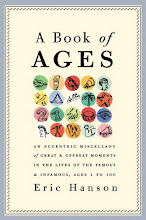
Anyway, Happy Birthday to Jonathan Swift and Mark Twain, born on November 30th in 1667 and 1835 respectively. People didn't always know that Swift was joking, for instance when he modestly proposed to end poverty and starvation in Ireland by feeding the children of the poor to the upper classes. People were outraged––but they were perpetrating the same ends by other means, and that was Swift's point. We recall Gulliver's Travels as a whimsical bit of children's literature, which it's not; it's a brilliantly extended piece of satire, wonderfully deadpan and perfectly targeted at follies our "civilization" has yet to outgrow. Swift appears in four fairly cunning anecdotes in A Book of Ages (which, I modestly propose, contains its own ingredient of satire.)
Twain is better known today as a gentle kidder, a grandfatherly teller of jokes, but he really was a merciless scold, an irate crank, a persistent progressive, enemy of the gilded wealthy, and an undying unapologetic atheist. (Imagine that.) If pious parents had any idea what his politics and beliefs were they'd ban his books from children's bookshelves. He was a great celebrity and a huge success, but his own spectacular bankruptcy made him more understanding of failure in others, and a greater respecter of luck as a shaper of human events. He was the opposite of the Horatio Algers and Norman Vincent Peales and the modern day charlatans who preach (for large sums) that all it takes to be rich is hard work and regular church attendance. Twain vivisected that kind of phony philosophy a century ago, but it's still around. Which is why we need satirists today more than ever. Twain appears ten times in A Book of Ages.
(Have I reminded anyone lately that it's the perfect Christmas and birthday gift?)
Showing posts with label Mark Twain. Show all posts
Showing posts with label Mark Twain. Show all posts
Monday, November 30, 2009

Wednesday, November 18, 2009
Mark Twain
On this day in 1865, Mark Twain made his first impression on the reading public with the publication of "Jim Smiley and His Jumping Frog" in the New York Saturday Press. He was 29. The story was retitled "The Celebrated Jumping Frog of Calaveras County" and became the title story of his first book in 1867.
Twain was a Midwesterner transplanted to the California gold fields writing for a New York audience, but there was something universal, or at least All-American, in his colloquial humor and his mixture of high and low life. People felt they knew his characters; the lowlifes put on airs and the toffs were phonies, and only the reader and the author were wise.
Twain appears ten times in A Book of Ages. When he was 21 he was training to be a riverboat pilot. (An education as rigorous as becoming an airline pilot today, a process he describes in his book Life on the Mississippi). At age 27 he set aside Samuel Clemens and began writing under the famous pen name. He didn't write his masterpiece until he was 49.
At 60 he was a famous novelist––and bankrupt. To recoup his losses he embarked on a world lecture tour. He met Gandhi and Sigmund Freud, visited Rome and the Taj Mahal. He had dinner with President Theodore Roosevelt. He owned a grand house in Connecticut. But his finances were always tenuous. Success was a fragile thing. This realization fed his cynicism and made him the greatest American writer of his time.
Twain was a Midwesterner transplanted to the California gold fields writing for a New York audience, but there was something universal, or at least All-American, in his colloquial humor and his mixture of high and low life. People felt they knew his characters; the lowlifes put on airs and the toffs were phonies, and only the reader and the author were wise.
Twain appears ten times in A Book of Ages. When he was 21 he was training to be a riverboat pilot. (An education as rigorous as becoming an airline pilot today, a process he describes in his book Life on the Mississippi). At age 27 he set aside Samuel Clemens and began writing under the famous pen name. He didn't write his masterpiece until he was 49.
At 60 he was a famous novelist––and bankrupt. To recoup his losses he embarked on a world lecture tour. He met Gandhi and Sigmund Freud, visited Rome and the Taj Mahal. He had dinner with President Theodore Roosevelt. He owned a grand house in Connecticut. But his finances were always tenuous. Success was a fragile thing. This realization fed his cynicism and made him the greatest American writer of his time.
Sunday, May 17, 2009
Bulls and Bears
The New York Stock Exchange was formed on this day in 1792. Located on Wall Street, the stock exchange became a place of wild ups and downs, frequent panics and frauds. It remained so until 1934 when FDR formed the S.E.C. Since then the American economy has enjoyed a steady, mildly fluctuating prosperity, with no great panics and only occasional frauds, unless you consider Market Capitalism a fraud. Roosevelt put Joseph Kennedy, one of the greatest of Wall Street's buccaneers, in charge of cleaning the street up. Kennedy did a remarkable job and kept a straight face enforcing the rules that would have prevented him from acquiring his fortune. You could say FDR and Joe Kennedy were mother and father to the American middle class
Left to its own devices, life is a rollercoaster, and A Book of Ages reads like one. Mark Twain, Winston Churchill, Thomas Paine, Ulysses S. Grant, Alfred Nobel, F. Scott Fitzgerald, Mary McCarthy, Buckminster Fuller, Charles Dickens, Georg Friderich Handel, and Philo T. Farnsworth (the man who invented television) all experienced bankruptcy firsthand. Churchill lost everything in the Crash of '29 and had to write his way back to properity. John D. Rockefeller lost half of his fortune in 1929, but he still had enough left over to restore colonial Williamsburg, create Grand Teton National Park, build Rockefeller Center and found the Museum of Modern Art. Being rich insulates you from life's troubles. John Steinbeck wrote about the other 99% of us in The Grapes of Wrath, which I also mention. I sometimes think a book is a better monument.
“The world is the house of the strong. I shall not know until the end what I have lost or won in this place, in this vast gambling den where I have spent more than sixty years, dicebox in hand, shaking the dice.” Denis Diderot, Elements of Physiology (1774-1780)
Left to its own devices, life is a rollercoaster, and A Book of Ages reads like one. Mark Twain, Winston Churchill, Thomas Paine, Ulysses S. Grant, Alfred Nobel, F. Scott Fitzgerald, Mary McCarthy, Buckminster Fuller, Charles Dickens, Georg Friderich Handel, and Philo T. Farnsworth (the man who invented television) all experienced bankruptcy firsthand. Churchill lost everything in the Crash of '29 and had to write his way back to properity. John D. Rockefeller lost half of his fortune in 1929, but he still had enough left over to restore colonial Williamsburg, create Grand Teton National Park, build Rockefeller Center and found the Museum of Modern Art. Being rich insulates you from life's troubles. John Steinbeck wrote about the other 99% of us in The Grapes of Wrath, which I also mention. I sometimes think a book is a better monument.
“The world is the house of the strong. I shall not know until the end what I have lost or won in this place, in this vast gambling den where I have spent more than sixty years, dicebox in hand, shaking the dice.” Denis Diderot, Elements of Physiology (1774-1780)
Subscribe to:
Posts (Atom)

 Posts
Posts


