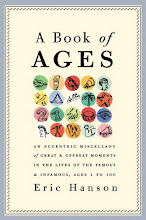
On January 4th, 1952, Che Guevara set out from Buenos Aires on his motorcycle, la Poderosa. He was 23 years old, a child of privilege, a medical student, ambitious, inexperienced, more than a bit naive about motorcycle mechanics and life, but his eyes were wide open. The journey took Che and his companion, 29 year-old biochemist Alberto Granado, to Chile, Peru and over the Andes into Amazonia, where they wound up working at a leper colony. Che Guevara appears five times in A Book of Ages, including the crucial meeting with Fidel Castro, being photographed by Alberto Korda, addressing the United Nations and having dinner with the Rockefellers, and finally being captured and executed in a remote area of Bolivia at age 39.
(A Book of Ages makes a perfect birthday gift for intelligent people of any age, whether they are revolutionaries, monarchists or Republicans. A useful book to take on any journey.)
Showing posts with label Rockefeller. Show all posts
Showing posts with label Rockefeller. Show all posts
Monday, January 4, 2010

Sunday, May 17, 2009
Bulls and Bears
The New York Stock Exchange was formed on this day in 1792. Located on Wall Street, the stock exchange became a place of wild ups and downs, frequent panics and frauds. It remained so until 1934 when FDR formed the S.E.C. Since then the American economy has enjoyed a steady, mildly fluctuating prosperity, with no great panics and only occasional frauds, unless you consider Market Capitalism a fraud. Roosevelt put Joseph Kennedy, one of the greatest of Wall Street's buccaneers, in charge of cleaning the street up. Kennedy did a remarkable job and kept a straight face enforcing the rules that would have prevented him from acquiring his fortune. You could say FDR and Joe Kennedy were mother and father to the American middle class
Left to its own devices, life is a rollercoaster, and A Book of Ages reads like one. Mark Twain, Winston Churchill, Thomas Paine, Ulysses S. Grant, Alfred Nobel, F. Scott Fitzgerald, Mary McCarthy, Buckminster Fuller, Charles Dickens, Georg Friderich Handel, and Philo T. Farnsworth (the man who invented television) all experienced bankruptcy firsthand. Churchill lost everything in the Crash of '29 and had to write his way back to properity. John D. Rockefeller lost half of his fortune in 1929, but he still had enough left over to restore colonial Williamsburg, create Grand Teton National Park, build Rockefeller Center and found the Museum of Modern Art. Being rich insulates you from life's troubles. John Steinbeck wrote about the other 99% of us in The Grapes of Wrath, which I also mention. I sometimes think a book is a better monument.
“The world is the house of the strong. I shall not know until the end what I have lost or won in this place, in this vast gambling den where I have spent more than sixty years, dicebox in hand, shaking the dice.” Denis Diderot, Elements of Physiology (1774-1780)
Left to its own devices, life is a rollercoaster, and A Book of Ages reads like one. Mark Twain, Winston Churchill, Thomas Paine, Ulysses S. Grant, Alfred Nobel, F. Scott Fitzgerald, Mary McCarthy, Buckminster Fuller, Charles Dickens, Georg Friderich Handel, and Philo T. Farnsworth (the man who invented television) all experienced bankruptcy firsthand. Churchill lost everything in the Crash of '29 and had to write his way back to properity. John D. Rockefeller lost half of his fortune in 1929, but he still had enough left over to restore colonial Williamsburg, create Grand Teton National Park, build Rockefeller Center and found the Museum of Modern Art. Being rich insulates you from life's troubles. John Steinbeck wrote about the other 99% of us in The Grapes of Wrath, which I also mention. I sometimes think a book is a better monument.
“The world is the house of the strong. I shall not know until the end what I have lost or won in this place, in this vast gambling den where I have spent more than sixty years, dicebox in hand, shaking the dice.” Denis Diderot, Elements of Physiology (1774-1780)
Subscribe to:
Posts (Atom)

 Posts
Posts


