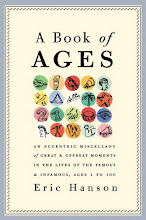
On January 4th, 1952, Che Guevara set out from Buenos Aires on his motorcycle, la Poderosa. He was 23 years old, a child of privilege, a medical student, ambitious, inexperienced, more than a bit naive about motorcycle mechanics and life, but his eyes were wide open. The journey took Che and his companion, 29 year-old biochemist Alberto Granado, to Chile, Peru and over the Andes into Amazonia, where they wound up working at a leper colony. Che Guevara appears five times in A Book of Ages, including the crucial meeting with Fidel Castro, being photographed by Alberto Korda, addressing the United Nations and having dinner with the Rockefellers, and finally being captured and executed in a remote area of Bolivia at age 39.
(A Book of Ages makes a perfect birthday gift for intelligent people of any age, whether they are revolutionaries, monarchists or Republicans. A useful book to take on any journey.)
Showing posts with label photography. Show all posts
Showing posts with label photography. Show all posts
Monday, January 4, 2010

Thursday, November 19, 2009
"Four Score, etc."
It was on this day in 1863 that Abraham Lincoln stood up to say a few words about the Union and Confederate dead at Gettysburg. The Gettysburg Address was around 265 words long (it wouldn't have qualified as a minor essay in one of our children's writing classes), and it only took a couple of minutes to deliver it. The president was preceded on the program by Edward Everett who spoke for over two hours. There is one photograph of Lincoln on the occasion. It shows him getting down from the podium, which suggests that the photographer had barely gotten set up when he realized the speech was over, which is a bit like life itself, isn't it? Two years later, the war was over and Lincoln was dead. Abraham Lincoln appears nine times in A Book of Ages. Edward Everett doesn't appear at all.
Tuesday, November 3, 2009
Snapshots
Today is the birthday of the photographer Walker Evans, born in St. Louis in 1903. His father abandoned the family when he was 15, and it was around this time that Walker picked up his first camera. It was a Kodak Brownie. He took it around Toledo, everywhere he went, taking pictures of people unaware, "like a spy" is how he later described it. He spent a year in Paris, thought about being a painter, then settled in New York among the Bohemians. His first published photographs were of the Brooklyn Bridge. They appeared in a 1930 book of poems by Hart Crane. Evans was 27. Most of his photography was of people, though, people sitting on stoops, people working, people sitting on subways who didn't know they were having their picture taken. He took pictures of working men's bedrooms and empty houses.
In 1935 he embarked on a tour of the South, paid for by FDR's Farm Security Administration. Until this time poverty was a private matter, something that wasn't reported in newspapers, wasn't measured, certainly wasn't shown. The photographs appeared in a book accompanied by a text written by James Agee. Let Us Now Praise Famous Men wasn't about famous men at all, but about invisible men––poor men, women and children. Most didn't like having their pictures taken, some were too worn down to protest. Viewers took umbrage, but it brought poverty into the open where people felt obliged to do something about it. For a while anyway. After the Depression was over, poverty went back in the back of the closet. After World War II, Walker Evans spent twenty years taking pictures for Fortune magazine, and he and his wife moved to Connecticut. He appears five times in A Book of Ages.
(Other photographers appear in the book too: Henri Cartier-Bresson, Ansel Adams, Mathew Brady, Louis Lumiére, Alfred Stieglitz, Alberto Korda, Lewis Carroll, Annie Lebowitz, Abraham Zapruder among them.)
In 1935 he embarked on a tour of the South, paid for by FDR's Farm Security Administration. Until this time poverty was a private matter, something that wasn't reported in newspapers, wasn't measured, certainly wasn't shown. The photographs appeared in a book accompanied by a text written by James Agee. Let Us Now Praise Famous Men wasn't about famous men at all, but about invisible men––poor men, women and children. Most didn't like having their pictures taken, some were too worn down to protest. Viewers took umbrage, but it brought poverty into the open where people felt obliged to do something about it. For a while anyway. After the Depression was over, poverty went back in the back of the closet. After World War II, Walker Evans spent twenty years taking pictures for Fortune magazine, and he and his wife moved to Connecticut. He appears five times in A Book of Ages.
(Other photographers appear in the book too: Henri Cartier-Bresson, Ansel Adams, Mathew Brady, Louis Lumiére, Alfred Stieglitz, Alberto Korda, Lewis Carroll, Annie Lebowitz, Abraham Zapruder among them.)
Friday, September 4, 2009
Snap
It was on this day in 1888 that George Eastman received a patent for the camera design he called a Kodak. It used film that unspooled like a strip of flypaper. It required chemicals and enlargers and skill and patience to convert the images to paper. Now we snap pictures with our phones. Thousands of them. Most of them we never develop or print at all. We look at them in miniature form on a tiny screen. We phone them to our friends who do the same before throwing them away. I expect most of the photography of our era will last no longer than the cheap ephemeral devices we carry them around in, devices which we replace every few years. I suppose that this is an improvement on the boxes and boxes of printed photos that sit unsorted in closets and under beds. Charles Eastman doesn't appear in A Book of Ages, but photographers Diane Arbus, Ansel Adams, Lewis Carroll, Henri Cartier-Bresson, Louis Daguerre, Alberto Korda, Alfred Stieglitz, Walker Evans, Mathew Brady, Annie Lebowitz and Abraham Zapruder do.
Subscribe to:
Posts (Atom)

 Posts
Posts


