There are two new biographies of Ayn Rand on the market. She of the icy glare, the modified Hitler hairdo, the large dollar-sign brooch. Her philosophy behaved more like a religion or a cult, with fierce dogmas and sudden excommunications. But her devotees are legion. Former Fed Chairman Alan Greenspan was one of the earliest, sitting at her feet during her living room sermonettes in the early days in New York. And her books have sold millions of copies, mostly, it seems, to disgruntled and arrested adolescents who think nobody understands them.
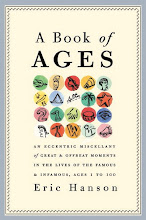
Rand was traumatized by the Russian Revolution. Her family lost everything when the Bolsheviks took over. Impoverishment at the hands of Russian governments has shaped some of the greatest and most peculiar literature we have, from Conrad to Nabokov (his sister was Ayn Rand's best friend). None, perhaps, as odd as Rand's. Nabokov's peculiarities are well cataloged in A Book of Ages. Had these Rand biographies been published earlier I would have included more about her. She preached holy individualism, and fixated on muscular, dominant males in her novels, yet she kept her husband in a state of servility. He was fully informed about her twice weekly sexual intercourse with her lover and deputy. She made Frank wear a bell on his shoes so she could hear his movements around the house. During the 1970s her Wednesday evenings were devoted to watching Charlie's Angels. Odd doesn't begin to describe her.
Showing posts with label New York. Show all posts
Showing posts with label New York. Show all posts
Monday, November 9, 2009

Wednesday, October 7, 2009
Joe Bananas
In October 1964, Guiseppe Bonanno, a.k.a. “Joe Bananas”, was allegedly kidnapped by alleged mob rivals Peter and Nino Magaddino, while allegedly walking down Park Avenue in New York City. Bonanno was allegedly released after he agreed to retire from the business he was engaged in. But according to Sam “The Plumber” Decavalcante, none of this ever happened. Mr. Bonanno was 59. He appears five times in A Book of Ages.
I leavened the mixture of sports heroes, rock stars, politicians, film actors, authors and artists with a selection of anti-heroes, rogues, bank robbers like Bonnie and Clyde, and a few murderers. It gave the book more flavor. Bonanno finally died of natural causes in Tucson, Arizona at age 97. Clean living and regular habits, I guess. After the boss's death, Joseph "Big Joey" Massino and Richard "Shellackhead" Cantarella immediately started singing to the Feds.
I leavened the mixture of sports heroes, rock stars, politicians, film actors, authors and artists with a selection of anti-heroes, rogues, bank robbers like Bonnie and Clyde, and a few murderers. It gave the book more flavor. Bonanno finally died of natural causes in Tucson, Arizona at age 97. Clean living and regular habits, I guess. After the boss's death, Joseph "Big Joey" Massino and Richard "Shellackhead" Cantarella immediately started singing to the Feds.
Monday, October 5, 2009
A Letter to 84 Charing Cross Road
Sixty years ago today, on October 5, 1949, Helene Hanff wrote a letter to a bookstore in London. Marks & Co. was located at 84 Charing Cross Road; Miss Hanff was located on East 95th Street in New York City. She'd read their ad in the Saturday Review (a magazine once influential and now dead) and asked if they could send her "clean secondhand copies" of books on a list she enclosed. Hazlitt, Stevenson, Leigh Hunt––she loved books of essays. Also English authors, mostly 19th century. (In the letter she disparages the "grimy, marked-up schoolboy copies" available at Barnes & Noble, which was where NYU students flogged their books.) This initial note began a twenty-year friendship.
Helene Hanff was a 33 year-old writer of radio and television scripts and unproduced stage plays. She never visited Marks & Co. Friends of hers who visited London stopped by the shop and described its details and its people to her; that's the closest she came. By the time she could afford the fare to London the store had closed and her book-dealer correspondent, Frank Doel, had died. Hanff didn't particularly like travel anyway. She traveled through books, and the books traveled to her. Despite her love of cigarettes and martinis, she lived to be 80. Helene Hanff appears once in A Book of Ages, writing that first of many letters. In 1970 the two-way correspondence was collected into a book of its own, which I still reread occasionally. It remains in print.
I remember reading 84 Charing Cross Road when it was first published. I was a 14 year-old book collector, and obtained most of my books not by catalog but by bicycle. I rode the ten or so miles from suburban Minneapolis to Nelson's Book Shop and Oudal's Used and Rare located downtown, bringing the books home in a backpack. Hanff and I had similar tastes, though I preferred Charles Lamb to Hazlitt and Hunt. I still have the books I bought then, the prices I paid remain unerased inside the endpapers. The 1900 Dent edition of The Last Essays of Elia (with illustrations by C. E. Brock) cost $2.
Saturday, October 3, 2009
Patriotic Gore
Gore Vidal first enjoyed the public gaze at age three when he became the first child to fly across the United States in a plane. He's enjoyed attention ever since. A preening, arrogant, articulate, intelligent, entertaining scold. A critic of almost everything Americans do or say or think, but a defender of our rights to be as stupid as we are, which makes him the most valuable kind of American: a troublesome patriot. I like Barbara Ehrenreich's line: "Dissent, rebellion, and all-around hell-raising remain the true duty of patriots." He and H. L. Mencken serve as bookends to the American sensibility, one left-wing, the other right, both discontented and contemptuous.
Gore Vidal was born on this day in 1925 in, of all places, West Point, New York. His mother was an actress and New York socialite. His father, a former West Point All-American quarterback, was the academy's first aeronautics instructor when Gore was born, and went on to direct FDR's bureau of air commerce in the Department of Commerce. Which is how the toddler wound up in a plane at such a tender age. At age 11 Gore was flying his own airplane in a Pathé newsreel. He fought in World War II and wrote a novel about it. His third novel, The City and the Pillar (provocative title) was daring enough to suggest that homosexuals were as normal as anybody else, which caused the New York Times to ban reviews of his next five novels. He was 22. He wrote the script for Ben Hur, became friends with Tennessee Williams and the Paul Newmans. In 1960 he ran for Congress––and lost. His most celebrated moment may have been his televised scuffle with William F. Buckley Jr. during ABC's coverage of the the 1968 Democratic Convention.
In the 1970s Vidal said this: "There is only one party in the United States, the Property Party...and it has two right wings: Republican and Democrat. Republicans are a bit stupider, more rigid, more doctrinaire in their laissez-faire capitalism than the Democrats, who are cuter, prettier, a bit more corrupt—until recently... and more willing than the Republicans to make small adjustments when the poor, the black, the anti-imperialists get out of hand. But, essentially, there is no difference between the two parties." Thus proving he could be very right and very wrong in one paragraph, but always provocative and intelligent. In spite of everything, he always considered himself a conservative. If conservative means preserving what works, for instance a functioning and fair-minded government to serve public needs, then he probably is one, and so am I. Gore Vidal appears six times in A Book of Ages.
Subscribe to:
Posts (Atom)

 Posts


