I learned during my random reading this morning that cheerleading was invented 111 years ago today. At the University of Minnesota of all places, which makes me either proud or embarrassed or both. There are no cheerleaders or former cheerleaders in A Book of Ages. George W. Bush's cheerleading career was edited out last fall. W. did have an interesting rollercoaster life, full of cautionary notes and alarming incidents. He might have been an excellent baseball commissioner.
It was on this day in 1967 that Lyndon B. Johnson and his privy counselors decided that Americans should be fed a sugar-coated account of "progress" in the Vietnam War. Cheerleading began almost immediately. The daily briefings began to sound chirpier, more upbeat, like something being written by a chamber of commerce booster or a public relations writer.
The war was a trap Johnson had been caught in. After Truman's experience at the hands of the McCarthyites no Democrat dared step back from a fight, afraid of being labelled "soft on Communism". So in we waded, right up to our necks. Johnson didn't send himself or his wife or daughter to fight and die there, but he did sacrifice his beloved Great Society to avoid losing a war. Vietnam has become a metaphor for avoidable failure and political quagmire, taking the place of the term "albatross" which had been put into service by Samuel Taylor Coleridge in the 1800s.
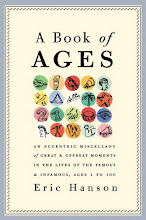
The unnecessary war is a recurring theme in A Book of Ages, seen through episodes in the lives of LBJ and JFK, Norman Mailer and Gore Vidal and William F. Buckley Jr. who got into fights over it, Daniel Ellsberg, and Richard Nixon who sent his plumbers after Ellsberg, and Bob Woodward who told us about the plumbers, and Henry Kissinger who won a Nobel after washing his hands thoroughly, and Walter Cronkite and one Lieutenant Calley. We see Lieutenant Calleys in every war. A sad business all around, but probably no more rife with cockups than any war, except that it was foolish to begin with. Like Iraq, some say. Which should remind us why we need newspapers and clear eyed journalists, even though they are expensive to send places. They are our eyes and ears.
Showing posts with label William F. Buckley Jr.. Show all posts
Showing posts with label William F. Buckley Jr.. Show all posts
Monday, November 2, 2009

Saturday, October 3, 2009
Patriotic Gore
Gore Vidal first enjoyed the public gaze at age three when he became the first child to fly across the United States in a plane. He's enjoyed attention ever since. A preening, arrogant, articulate, intelligent, entertaining scold. A critic of almost everything Americans do or say or think, but a defender of our rights to be as stupid as we are, which makes him the most valuable kind of American: a troublesome patriot. I like Barbara Ehrenreich's line: "Dissent, rebellion, and all-around hell-raising remain the true duty of patriots." He and H. L. Mencken serve as bookends to the American sensibility, one left-wing, the other right, both discontented and contemptuous.
Gore Vidal was born on this day in 1925 in, of all places, West Point, New York. His mother was an actress and New York socialite. His father, a former West Point All-American quarterback, was the academy's first aeronautics instructor when Gore was born, and went on to direct FDR's bureau of air commerce in the Department of Commerce. Which is how the toddler wound up in a plane at such a tender age. At age 11 Gore was flying his own airplane in a Pathé newsreel. He fought in World War II and wrote a novel about it. His third novel, The City and the Pillar (provocative title) was daring enough to suggest that homosexuals were as normal as anybody else, which caused the New York Times to ban reviews of his next five novels. He was 22. He wrote the script for Ben Hur, became friends with Tennessee Williams and the Paul Newmans. In 1960 he ran for Congress––and lost. His most celebrated moment may have been his televised scuffle with William F. Buckley Jr. during ABC's coverage of the the 1968 Democratic Convention.
In the 1970s Vidal said this: "There is only one party in the United States, the Property Party...and it has two right wings: Republican and Democrat. Republicans are a bit stupider, more rigid, more doctrinaire in their laissez-faire capitalism than the Democrats, who are cuter, prettier, a bit more corrupt—until recently... and more willing than the Republicans to make small adjustments when the poor, the black, the anti-imperialists get out of hand. But, essentially, there is no difference between the two parties." Thus proving he could be very right and very wrong in one paragraph, but always provocative and intelligent. In spite of everything, he always considered himself a conservative. If conservative means preserving what works, for instance a functioning and fair-minded government to serve public needs, then he probably is one, and so am I. Gore Vidal appears six times in A Book of Ages.
Gore Vidal was born on this day in 1925 in, of all places, West Point, New York. His mother was an actress and New York socialite. His father, a former West Point All-American quarterback, was the academy's first aeronautics instructor when Gore was born, and went on to direct FDR's bureau of air commerce in the Department of Commerce. Which is how the toddler wound up in a plane at such a tender age. At age 11 Gore was flying his own airplane in a Pathé newsreel. He fought in World War II and wrote a novel about it. His third novel, The City and the Pillar (provocative title) was daring enough to suggest that homosexuals were as normal as anybody else, which caused the New York Times to ban reviews of his next five novels. He was 22. He wrote the script for Ben Hur, became friends with Tennessee Williams and the Paul Newmans. In 1960 he ran for Congress––and lost. His most celebrated moment may have been his televised scuffle with William F. Buckley Jr. during ABC's coverage of the the 1968 Democratic Convention.
In the 1970s Vidal said this: "There is only one party in the United States, the Property Party...and it has two right wings: Republican and Democrat. Republicans are a bit stupider, more rigid, more doctrinaire in their laissez-faire capitalism than the Democrats, who are cuter, prettier, a bit more corrupt—until recently... and more willing than the Republicans to make small adjustments when the poor, the black, the anti-imperialists get out of hand. But, essentially, there is no difference between the two parties." Thus proving he could be very right and very wrong in one paragraph, but always provocative and intelligent. In spite of everything, he always considered himself a conservative. If conservative means preserving what works, for instance a functioning and fair-minded government to serve public needs, then he probably is one, and so am I. Gore Vidal appears six times in A Book of Ages.
Wednesday, June 3, 2009
T. S. Eliot and Groucho have dinner
On June 3, 1964, T. S. Eliot sent a car to London’s Savoy Hotel to bring Mr. and Mrs. Groucho Marx to dinner. Eliot told Groucho that their friendship had greatly enhanced his credit with the grocer across the street. Eliot was 75, Groucho 73. Both were masters of the wisecrack, coiners of famous epigrams, now measuring out their lives in coffee spoons.
A Book of Ages is full of people meeting who you'd never thought met each other, or perhaps wondered if they had. Freud giving advice to Mahler, having his portrait drawn by Salvador Dali, Salinger meeting Hemingway in Paris, Marilyn Monroe having tea with Isak Dinesen at Carson McCullers's apartment, William F. Buckley Jr. meeting John Kenneth Galbraith for the first time in an elevator on the way to Truman Capote's Black & White Ball. Life is full of crossed paths. You never know who you might meet tomorrow.
A Book of Ages is full of people meeting who you'd never thought met each other, or perhaps wondered if they had. Freud giving advice to Mahler, having his portrait drawn by Salvador Dali, Salinger meeting Hemingway in Paris, Marilyn Monroe having tea with Isak Dinesen at Carson McCullers's apartment, William F. Buckley Jr. meeting John Kenneth Galbraith for the first time in an elevator on the way to Truman Capote's Black & White Ball. Life is full of crossed paths. You never know who you might meet tomorrow.
Subscribe to:
Posts (Atom)

 Posts
Posts


