Showing posts with label Nazism. Show all posts
Showing posts with label Nazism. Show all posts
Friday, May 21, 2010
Lucky Lindy
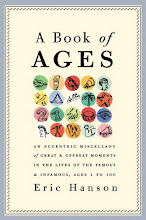
On this day in 1927 Charles Lindbergh landed in Paris, where he was greeted by an enthusiastic crowd. He'd been alone in his plane for two days and hadn't slept in 55 hours. He survived on four sandwiches, two canteens of water and 451 gallons of gasoline. He might have landed anywhere from Portugal to Norway; the $25,000 prize was for crossing the Atlantic and didn't specify a destination. Still a crowd of 100,000 was at Le Bourget to greet him when his plane emerged from low clouds. They lifted him out of the plane like a newborn baby. He became an instant world celebrity, a role he never came to grips with. Fame led to the kidnapping and murder of his young son in 1932. World leaders courted him. In the thirties he became a friend and political ally of the Nazis. Luftwaffe chief Hermann Goering pinned a medal on him in 1936. Charles Lindbergh appears seven times in A BOOK OF AGES.

Friday, December 11, 2009
Gone with the Windsors
On this day in 1936 Edward VIII became the Duke of Windsor. The abdication came as an enormous shock to an empire that was already in a precarious condition. Royal doings had no real importance here in America, but the reports were very interesting, especially on some phone exchanges in Upper East Side New York and Palm Beach. The idea that a king would give up his throne and his important job of opening grocery stores and accepting keys to cities to marry an American divorcee, actually a double divorcee. It makes you wonder what marital skills the duchess possessed. It's rumored she was a hermaphrodite (unproven) and a bit of a gymnast (not hard to visualize with that hairdo).
The Duke and Duchess were and remain interesting for being trivial, and A Book of Ages includes many of those small, telling details. For instance, the last thing Edward VIII did as king was have his toenails done. I also chronicle the Duke's flirtation with the Nazis, the number of pieces of luggage he took with him on his sudden escape from France in 1940, his card playing habits, his wife's complaints, the couple's various haunts down the years. He defined the role of "has been", which makes him a useful marker in a book about career arcs.
The Duke and Duchess were and remain interesting for being trivial, and A Book of Ages includes many of those small, telling details. For instance, the last thing Edward VIII did as king was have his toenails done. I also chronicle the Duke's flirtation with the Nazis, the number of pieces of luggage he took with him on his sudden escape from France in 1940, his card playing habits, his wife's complaints, the couple's various haunts down the years. He defined the role of "has been", which makes him a useful marker in a book about career arcs.
Saturday, November 7, 2009
The Revolution
On November 7th, 1917, the Bolsheviks overthrew the short-lived democratic government that had replaced the Tsarist government, putting in place a ragtag, ruthless, disorganized, incompetent, religiously committed but fanatically irreligious Soviet government that nobody thought would last three months, much less 70 years. It lasted far longer than the Thousand Year Reich of the Nazis, who had superior planning and machinery, not to mention far better art direction. In the end it was hard to distinguish the heroic statues promoting the two violently opposed ideologies. The two systems weren't that different in their design and operation. Both kleptocracies, both wonderfully efficient at appropriating property and killing their citizens.
During the Twenties capitalists didn't sleep at night, worrying about the Red Menace, expecting a Revolution to occur here any day. Communism made the Nazis seem far more attractive to people like Henry Ford and Charles Lindbergh and the Duke of Windsor, something I note in A Book of Ages. When the Crash came in 1929 Capitalism appeared doomed. For three years, the Hoover administration waited patiently for the economy to revive itself magically, but it didn't. It turned out that money hidden away by plutocrats was no more useful at stimulating an economy than money stolen by Bolsheviks.
Then on November 8th, 1932, FDR was elected president. He quickly betrayed his fellow patricians and rewrote the rulebook. His regulatory system presided over the best half century the US or any nation ever enjoyed. Until Ronald Reagan arrived and put things back to where they were before. But pure, unopposed capitalism is uninteresting on its own. It doesn't galvanize people. Twenty years after its death, Communism remains the energizing philosophy of an important part of the American political spectrum––not the left, but the right. They love it still. It's why they exist, even when it isn't there.
During the Twenties capitalists didn't sleep at night, worrying about the Red Menace, expecting a Revolution to occur here any day. Communism made the Nazis seem far more attractive to people like Henry Ford and Charles Lindbergh and the Duke of Windsor, something I note in A Book of Ages. When the Crash came in 1929 Capitalism appeared doomed. For three years, the Hoover administration waited patiently for the economy to revive itself magically, but it didn't. It turned out that money hidden away by plutocrats was no more useful at stimulating an economy than money stolen by Bolsheviks.
Then on November 8th, 1932, FDR was elected president. He quickly betrayed his fellow patricians and rewrote the rulebook. His regulatory system presided over the best half century the US or any nation ever enjoyed. Until Ronald Reagan arrived and put things back to where they were before. But pure, unopposed capitalism is uninteresting on its own. It doesn't galvanize people. Twenty years after its death, Communism remains the energizing philosophy of an important part of the American political spectrum––not the left, but the right. They love it still. It's why they exist, even when it isn't there.
Subscribe to:
Posts (Atom)

 Posts
Posts


