Frederic Chopin was born two hundred years ago this week, in the village of Żelazowa Wola. When he was seven months old the family moved to Warsaw, to a house located on the palace grounds which was a much better place for a prodigy to be discovered. His father played the flute and the violin, his mother played the piano. By age six Chopin was playing the piano too and by seven he was performing publicly and being compared to Mozart who was much older, lived in Vienna and had been dead for 26 years. Chopin also composed two polonaises when he was seven, playing them for the amusement of the son of the Russian Archduke who was ruling Poland at the time. (The Archduke, not the son.)
In his teens, while he was staying in the rustic village Szafarnia as a guest of Count Radziwill, Chopin was exposed to the folk melodies that would influence much of his later work, and probably also to the tuberculosis which gave him his intriguing pallor. During this same rural sojourn Chopin learned the characteristic cough of the region, which he took with him when he went to Vienna in 1830. He was twenty years old and an exile. From then on he always carried a small container of Polish soil with him in his luggage. He would never see his homeland again.
When he was 26, Chopin met Amandine Aurore Lucile Dupin, better known as the novelist George Sand. She'd been wearing men's trousers for the previous five years and was a formidable personality. The meeting took place at the apartment of Franz Lizst's mistress. Chopin disliked her immediately but soon enough the two were living together. Two years later the two of them vacationed á deux in Majorca, but they had a miserable time because the weather was cold and the rented villa was drafty, and Chopin had to put up with a lousy rented piano. Even though he was sick most of the time he still managed to compose 24 Preludes. Preludes to what? One might well ask; it's never really said.
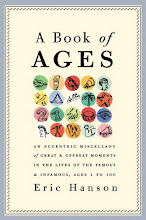
He was plagued by a cough most of his life, which I speculate may just have been his way of trying to get a word in edgewise in conversations, which Ms. Sand tended to dominate. I also believe it was Chopin who introduced the nineteenth century custom of coughing during the quieter passages of classical music, though I have no way of proving this. George Sand broke up with him in 1847 when she suspected him of falling in love with her daughter Solange. Chopin appears five times in A Book of Ages (Harmon 2008/Three Rivers Press 2010); George Sand appears twice.
Showing posts with label Paris. Show all posts
Showing posts with label Paris. Show all posts
Wednesday, March 3, 2010

Wednesday, November 4, 2009
Did Not Invent Levis
I just read the obituary of Claude Levi-Strauss, the French anthropologist who died last Friday in Paris. He was 100. Why didn't I include him in the book? Why indeed.
Although he didn't invent Levis (that was a different Levi Strauss entirely) Claude L-S changed the way we thought about humanity by asking questions that sounded fundamental and were. "Who are we? How did we come to be be in this time and place?" Questions which conjure the same thoughts of simultaneity raised by A Book of Ages. If I ever get asked to publish a French edition I might have greater latitude to include the kind of public intellectual they have in France. Not pundits but thinkers. If Letterman were on TV in France, Claude Levi-Strauss would have been a regular guest.
Although he didn't invent Levis (that was a different Levi Strauss entirely) Claude L-S changed the way we thought about humanity by asking questions that sounded fundamental and were. "Who are we? How did we come to be be in this time and place?" Questions which conjure the same thoughts of simultaneity raised by A Book of Ages. If I ever get asked to publish a French edition I might have greater latitude to include the kind of public intellectual they have in France. Not pundits but thinkers. If Letterman were on TV in France, Claude Levi-Strauss would have been a regular guest.
Wednesday, October 21, 2009
George Sand and Frederic Chopin
In October 1836, Frederic Chopin met George Sand at a party at the Paris apartment of Franz Liszt’s mistress. Chopin was 26, Sand was 32. She was assertive and self-possessed and he took an instant dislike to her. In spite of this they became one of the most famous couples in the history of art and literature. He played the piano and coughed a lot. She wrote sensational novels and wore men's clothes. Having seen the film Impromptu I can't help picturing Hugh Grant and Judy Davis. Grant is prettier, but Davis is more interesting. Together and separately, Chopin and Sand appear seven times in A Book of Ages.
Friday, October 16, 2009
Marie Antoinette
On October 16, 1793, Marie Antoinette was guillotined in the center of what is now the Place de la Concorde in Paris. She was 37. During the previous four years in prison her hair had turned white. The charges that led to her death were high treason and illicit sexual practices, but most of the resentment was over how much she spent on jewelry. Marie Antoinette appears twice in A Book of Ages.
Saturday, October 10, 2009
Naked Lunch
William Burroughs published his seminal work in October 1959, in Paris, where novels of this sort were usually published. Then to be smuggled back into England and the U.S. in the suitcases of graduates of the Sorbonne, and young women who had gone to France to "be finished." I have a feeling, though, that the last of the Beat novelists would have blushed at some of the passages in Updike and Roth. Despite looking as if he'd slept the previous night in a seedy hotel, Burroughs was an heir to the Burroughs Adding Machine fortune. He was 45 when he published Naked Lunch. He traveled everywhere with a notebook in which he recorded the things he was doing, reading and thinking in separate columns. In 1994, when he was 80, he did a TV commercial for Nike. Burroughs appears six times in A Book of Ages.
Tuesday, July 21, 2009
Papa's Birthday
Ernest Hemingway was born on July 21, 1899 in Oak Park, Illinois. He learned to fish when he was 3. At age 12 his mother told him her dream was for him to become a concert cellist. At 18 he was serving as an ambulance driver on the Italian front in World War I, and was wounded saving the life of an Italian soldier. While in hospital he fell in love with his nurse, Agnes von Kurowsky, but she wouldn't marry him. At age 22 he moved to Paris, and a year later he ran with the bulls at the Feast of San Fermin in Pamplona, Spain.
It is hard to think of a manly, romantic, heroic, enviable thing that Hemingway didn't do a century earlier (and then write about for large sums of money.) Which is why his life remains a touchstone or a benchmark for our own. He is the reason most of the celebrated watering holes around the world are celebrated by anyone. Men still like to dress like him, grin like him. Tough guys talk like him, even in Paris. When we behave like fools we are doing it in imitation. Hemingway is why literary men feel the need to be amateur boxers. American novelists are still working in his shadow, even though his short stories are arguably his best form. An eighth grader turning in an essay shorter than the requisite 800 words can explain, plausibly, that Hemingway would have written it in fewer than 250.
Hemingway appears 16 times in A Book of Ages.
It is hard to think of a manly, romantic, heroic, enviable thing that Hemingway didn't do a century earlier (and then write about for large sums of money.) Which is why his life remains a touchstone or a benchmark for our own. He is the reason most of the celebrated watering holes around the world are celebrated by anyone. Men still like to dress like him, grin like him. Tough guys talk like him, even in Paris. When we behave like fools we are doing it in imitation. Hemingway is why literary men feel the need to be amateur boxers. American novelists are still working in his shadow, even though his short stories are arguably his best form. An eighth grader turning in an essay shorter than the requisite 800 words can explain, plausibly, that Hemingway would have written it in fewer than 250.
Hemingway appears 16 times in A Book of Ages.
Tuesday, June 23, 2009
Picasso
Pablo Picasso opened his first gallery exhibition on June 24, 1901 in the Rue Lafitte in Paris. The 19 year-old Spaniard was just entering his Blue Period and still painting in a representational manner. He appears ten times in A Book of Ages. Being a suspect in the theft of the Mona Lisa, painting Les Demoiselles d'Avignon, marrying a ballerina, having an affair with a shopgirl, suing a biographer, rewriting his will, etc. An interesting life.
Wednesday, May 20, 2009
Atlantic Crossings
On May 20, 1927, at 7:53 in the morning, Charles Lindbergh took off from an airfield on Long Island, New York, headed east. He was alone, except for 450 gallons of gasoline, a Wright Whirlwind J-5C radial engine, coffee and sandwiches. The fabric-covered Spirit of St. Louis had no radio, no navigation equipment and no forward window for him to see where he was going. Lindbergh was 25. The flight to Paris took him 33 1/2 hours. When he arrived at Le Bourget Field he was greeted by a crowd estimated at 150,000 people. He was very tired, but he was suddenly the most famous man in the world and would remain so for many years. Lindbergh appears seven times in A Book of Ages.
May 20th is also the birthday of the actor James Stewart, who played Charles Lindbergh in the film The Spirit of St. Louis. He was born in 1908 in Indiana, Pennsylvania, where his father owned a hardware store. Stewart also appears seven times in A Book of Ages.
Christopher Columbus died, largely forgotten, on May 20th, 1506. He was 54. He'd crossed the Atlantic in 1492, landing in the Bahamas, but he died still believing he had reached the coast of Asia, unaware or not believing that he had discovered (or actually rediscovered) a new continent. A few months after his death a mapmaker in France named the New World after somebody else. Columbus appears twice in A Book of Ages.
May 20th is also the birthday of the actor James Stewart, who played Charles Lindbergh in the film The Spirit of St. Louis. He was born in 1908 in Indiana, Pennsylvania, where his father owned a hardware store. Stewart also appears seven times in A Book of Ages.
Christopher Columbus died, largely forgotten, on May 20th, 1506. He was 54. He'd crossed the Atlantic in 1492, landing in the Bahamas, but he died still believing he had reached the coast of Asia, unaware or not believing that he had discovered (or actually rediscovered) a new continent. A few months after his death a mapmaker in France named the New World after somebody else. Columbus appears twice in A Book of Ages.
Tuesday, April 28, 2009
Alice and Julia
Alice Waters was born on this day in 1944. She was 27 when she opened her famous Berkeley California restaurant, Chez Panisse. On that first night they served a set menu: paté en croute followed by duck with olives, salad, and almond tart; $3.95. But they ran out of silverware.
When I'm reading a life story I am always looking for signposts, points along the way where the person chooses this road instead of that one, where they meet someone or learn something that changes their life. When Alice Waters was 19 she transferred from the University of California at Santa Barbara to Berkeley. Would she have become the same person if she hadn't moved to Berkeley? Could Chez Panisse have started a food revolution anywhere else?
Alice Waters was 21 when she visited France for the first time. France, too, has a habit of changing people in profound ways. In A Book of Ages I note the Paris arrivals of Gertrude Stein and Alice B. Toklas, Giacomo Casanova, Voltaire, Benjamin Franklin, Ernest Hemingway, Josephine Baker, J. D. Salinger, William F. Buckley Jr., Robert M. Parker, Frederic Chopin and Adolf Hitler.
Julia Child was 36 the first time she saw Paris. She'd never cooked before. Up to this point she'd been employed as an American spy. But she would learn to cook in the French manner, and so would we.
When I'm reading a life story I am always looking for signposts, points along the way where the person chooses this road instead of that one, where they meet someone or learn something that changes their life. When Alice Waters was 19 she transferred from the University of California at Santa Barbara to Berkeley. Would she have become the same person if she hadn't moved to Berkeley? Could Chez Panisse have started a food revolution anywhere else?
Alice Waters was 21 when she visited France for the first time. France, too, has a habit of changing people in profound ways. In A Book of Ages I note the Paris arrivals of Gertrude Stein and Alice B. Toklas, Giacomo Casanova, Voltaire, Benjamin Franklin, Ernest Hemingway, Josephine Baker, J. D. Salinger, William F. Buckley Jr., Robert M. Parker, Frederic Chopin and Adolf Hitler.
Julia Child was 36 the first time she saw Paris. She'd never cooked before. Up to this point she'd been employed as an American spy. But she would learn to cook in the French manner, and so would we.
Monday, April 20, 2009
Joan Miro
Today is also the birthday of surrealist painter Joan Miro. Miro was a good friend of Ernest Hemingway's and was Hemingway's preferred timekeeper in the impromptu boxing matches he sometimes had a the American Club in Paris. On page 99 in A Book of Ages I retell the story of the time in 1929 when Hemingway got his ears boxed by Canadian writer Morley Callaghan. Hemingway blamed F. Scott Fitzgerald who was sitting in for Miro. Miro may have been a reliable timekeeper but he also painted some rather surreal timepieces.
My favorite stories in the book are the ones in which various artists and literary lions cross paths. A Book of Ages is a perfect gift for Joan Miro's birthday or anyone else's.
My favorite stories in the book are the ones in which various artists and literary lions cross paths. A Book of Ages is a perfect gift for Joan Miro's birthday or anyone else's.
Adolf Hitler
Adolf Hitler was born on this day in 1889. Reading about his strange life one looks for signposts. What events turned him this way or that way? What were the key events?
He was born in Austria but moved to Germany at age 6. His mother smothered him with affection and his father beat him. As a boy he dreamed of entering the priesthood. (A swastika was the most prominent feature in the coat of arms on the monastery across the street.)
At age 12 he attended a performance of Wagner's Lohengrin. At 17 he failed to get into art school. At 20 he was living as a bum on the streets of Vienna. At 24 he ran away to Germany to avoid military service. (He was arrested and returned but found to weak to serve.)
He was 30 when he grew his famous moustache, became an author at 36, a vegetarian at 42, Chancellor of Germany at 43.
He saw Paris for the first and only time on June 23, 1940. He was 51. He spent three hours there, having his picture taken near the Eiffel Tower, being disappointed by the Louvre and meditating at Napoleon's tomb. He died at age 56, in a bunker 24 feet beneath a burning city, having murdered millions and pulled all of Europe down around his ears. These are the moments I include in A Book of Ages.
Why note these events and not others? Are they significant? They are fairly ordinary, actually. (Apart from being a monster, Hitler was unremarkable.) But they are suggestive, just as many of our own remembered moments jump out at us for reasons we don't understand. Lives can be written out in full detail or remembered in odd moments and vignettes, which is how we remember our own. One anecdote suggesting another, like stories told at a party or a funeral.
He was born in Austria but moved to Germany at age 6. His mother smothered him with affection and his father beat him. As a boy he dreamed of entering the priesthood. (A swastika was the most prominent feature in the coat of arms on the monastery across the street.)
At age 12 he attended a performance of Wagner's Lohengrin. At 17 he failed to get into art school. At 20 he was living as a bum on the streets of Vienna. At 24 he ran away to Germany to avoid military service. (He was arrested and returned but found to weak to serve.)
He was 30 when he grew his famous moustache, became an author at 36, a vegetarian at 42, Chancellor of Germany at 43.
He saw Paris for the first and only time on June 23, 1940. He was 51. He spent three hours there, having his picture taken near the Eiffel Tower, being disappointed by the Louvre and meditating at Napoleon's tomb. He died at age 56, in a bunker 24 feet beneath a burning city, having murdered millions and pulled all of Europe down around his ears. These are the moments I include in A Book of Ages.
Why note these events and not others? Are they significant? They are fairly ordinary, actually. (Apart from being a monster, Hitler was unremarkable.) But they are suggestive, just as many of our own remembered moments jump out at us for reasons we don't understand. Lives can be written out in full detail or remembered in odd moments and vignettes, which is how we remember our own. One anecdote suggesting another, like stories told at a party or a funeral.
Friday, April 10, 2009
Mona Lisa, Gatsby, Theroux
The story about the 1911 theft of the Mona Lisa is detailed in the new Vanity Fair, but the most interesting anecdote, involving the poet Guillaume Apollinaire and a young painter named Pablo Picasso, appears on page 109 of A Book of Ages.
Today is author Paul Theroux's birthday; he's 68. He was thirty when he quit teaching to be a writer full time. He also was making enough, finally, to own his own telephone. Page 107, A Book of Ages.
The Great Gatsby was published on April 10, 1925. Fitzgerald wrote much of it the year before while living in France. While there he also took the time to recommend a young writer to his editor at Scribners, a writer he hadn't even met yet named Ernest Hemingway, who was also living in Paris. Fitzgerald is already drinking heavily but not disastrously, as his prose demonstrates, but the novel doesn't sell very well, nor will the next or the one following it, all of which leads Fitz to observe that there are no second acts in American life. F. Scott Fitzgerald appears on pages 69, 89, 103, 148, 153, 161 and 171 in A Book of Ages. There are second acts, by the way, you just have to survive to see them.
Today is author Paul Theroux's birthday; he's 68. He was thirty when he quit teaching to be a writer full time. He also was making enough, finally, to own his own telephone. Page 107, A Book of Ages.
The Great Gatsby was published on April 10, 1925. Fitzgerald wrote much of it the year before while living in France. While there he also took the time to recommend a young writer to his editor at Scribners, a writer he hadn't even met yet named Ernest Hemingway, who was also living in Paris. Fitzgerald is already drinking heavily but not disastrously, as his prose demonstrates, but the novel doesn't sell very well, nor will the next or the one following it, all of which leads Fitz to observe that there are no second acts in American life. F. Scott Fitzgerald appears on pages 69, 89, 103, 148, 153, 161 and 171 in A Book of Ages. There are second acts, by the way, you just have to survive to see them.
Subscribe to:
Posts (Atom)

 Posts
Posts


