(This essay first appeared in Leite's Culinaria in 2009, where it has been reprised this year.)
Early January has always been a time for rethinking and reinvention. New destinations get mapped out, new partnerships are sealed over lunch. Seed catalogs arrive while the garden is buried under snow. New projects are often dreamed up during the fallow week between Christmas and New Year’s. When nobody is doing business, everyone is planning.
New ventures seem like an especially good topic for this January, with its dramatic sea changes ushered in a year ago. January 2009 saw a new president, a new Congress, a harsh economic winter, and radically shifting circumstances. Our empty larder required all new ingredients. But there’s reason for hope in 2010: As a Chinese philosopher pointed out, crises also present opportunities.
Such opportunities can unfold swiftly, especially when we’re young. On a Christmas ski trip from Paris to Switzerland, Ernest Hemingway lost a suitcase containing all of his early stories; the ones he rewrote (often at tables in Paris cafés) are the ones that made him famous. A lost purse aboard a New York bus changed Carson McCullers’s career plans from concert pianist to author; she was 17. When he was 17, Aristotle Onassis was working as a dishwasher in a restaurant in Argentina. But not for long. James Beard failed at acting before he turned to cooking for a living. He was 32 when he opened a small catering business in New York in 1935.
Youth is open to new possibilities because everything is possible and nothing is certain. There is so much that has not yet been tried. Robert M. Parker was 20 and spending Christmas in France when he tasted his first glass of wine. Did it make a crucial difference that Alice Waters, when she was 19, transferred from the University of California in Santa Barbara to Berkeley? It was in Berkeley where she opened Chez Panisse in 1971, when she was 27. Often it’s a matter of being at the right place at the right time. When he was 19, film director David Lean had a job serving tea and pastries. The job just happened to be at London’s Gaumont film studio.
New beginnings can happen at any age. Julia McWilliams was well into her thirties before she learned to cook. In 1942 she was living in Washington D.C., in a two-room apartment in the Brighton Hotel, working for the Office of Strategic Services, the wartime forerunner of the CIA. What cooking she did was managed on a hotplate she kept atop the refrigerator in her living room; being 6′2” made this a bit easier. She met fellow spy Paul Child on the veranda of a tea plantation in Ceylon (a perfect place for spies to meet.) Paul introduced her to some of the better things in life, including proper, interesting food. They married, and in November 1948, Mr. and Mrs. Child arrived in France. Her first visit. Somewhere on the road between Le Havre and Paris she had her first French meal: oysters, sole meunière, salad, cheese, and coffee. France changed her life. Her experience of France changed ours.
Necessity and boredom often provide the spur that launches us in new directions. Martha Stewart quit the modeling business when she became a mother at 24. Home and kitchen were a new field, with a new skill-set, a new area of competence. But it would be another eleven years before she became a food maven at 35. Irma Rombauer was 52, a widow, with grown children, when she took a sheaf of old mimeographed recipes to an inn in Charlevoix, Michigan, and began writing a cookbook. In 1930 there were millions of American women who suddenly needed to cook for themselves, by themselves. (One of Rombauer’s helpful instructions: “Stand facing the stove.”) The Joy of Cooking made Rombauer a household name. Alice B. Toklas published her famous cookbook in 1954, when she was 77. She too had been collecting its recipes all her life. Anna Mary Robinson Moses spent many years raising children, putting up preserves and selling homemade butter and potato chips before she took up painting and became famous at age 78. Her first paintings were shown at the county fair in upstate New York; her raspberry jam won a ribbon, but her art did not.
Food is a key ingredient in many creative endeavors. Proust begins A la recherche de temps perdu with a bite of a madeleine, which unleashes the subsequent thousands of pages. Dickens’s first novel also begins around a table. Truman Capote’s most famous story is about breakfast in a place that doesn’t serve breakfast; his best-loved story is about fruitcake. It is significant that Hemingway titled his last book, A Moveable Feast. One of the most important stories in the Bible involves a bite from an apple. Cezanne’s most sublime paintings are of apples and pears, but apples and pears like no apples and pears we’ve ever eaten, as if the artist needed to reinvent the fruit before setting brush to canvas. You could say that cooking was humankind’s first invention, our first improvement on nature, taking raw ingredients and circumstances and making the best we could of them, something enjoyable and worth living for.
Perhaps it’s a good idea to begin the New Year in the kitchen, trying something new. Experimenting, discussing, tasting, attempting, sharing. It will be interesting to see what happens next.
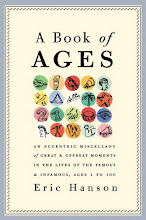
(These stories and many others appear in A Book of Ages, which is an appetizing read for any year.)
Showing posts with label Hemingway. Show all posts
Showing posts with label Hemingway. Show all posts
Wednesday, January 6, 2010

Monday, December 7, 2009
A Day That Will Live In Infamy
Leafing through A Book of Ages, you begin to realize how many lives were changed by the events of that one day. Courses changed, careers delayed or created, stories rewritten.
Churchill gained an ally and Hitler an enemy. The war in Europe had transformed Churchill from a back number into the indispensable leader, and December 7th made it likelier he would prevail, because FDR suddenly had the ability to act. FDR became a war president. Douglas MacArthur, George Patton and Dwight Eisenhower had a reason to put their boots on. (MacArthur's most recent engagement had been against World War I veterans camped on the Capitol Mall.)
Men at arms were relevant, and thousands of people who never thought of themselves as military men (or women) were put into uniform. Norman Mailer and Gore Vidal and Kurt Vonnegut would write war novels out of the experience. J. D. Salinger's story about a prep school boy named Holden Caulfield was slated to appear in the New Yorker that December. After Pearl Harbor was attacked the editors set it aside for the duration; it suddenly seemed frivolous. Salinger would see action on D-Day and meet Hemingway in Paris, and fight in the Battle of the Bulge. The war would send echoes down through his subsequent work, in characters' disrupted lives and sudden suicides in postwar living rooms.
Hemingway had seen World War I as a teenager; now he was too old to fight, but he outfitted his fishing boat to hunt submarines. In 1944 he single-handedly liberated the Ritz Bar in Paris. Edward R. Murrow became "Edward R. Murrow" reporting on a war that America was half interested in. That too changed. Walter Cronkite cut his journalistic teeth as a war correspondent, and Martha Gellhorn outran most of her male counterparts to get the big story. Her professional rivalry with Hemingway ended their marriage.
Richard Nixon's war was spent playing cards in the Pacific; he won enough from poker to win a seat in Congress. James Michener would write stories about his own experiences in the Pacific, and Rodgers and Hammerstein would make a musical from them. James Stewart enlisted and rose through the ranks to become a bomber pilot over Germany. John Wayne, a near contemporary, made the decision to stay home and play war heroes in movies. Bandleader Glenn Miller lost his life over the English Channel. On FDR's death Harry Truman was transformed from an obscure figure to the most powerful man in the world, burdened with the decision to deploy the atomic bomb. J. Robert Oppenheimer, who marshaled the hundreds of scientists to create that weapon, was dismayed by what he had created. Charles Schulz discovered first-hand how inhuman humanity could be; he would express this cynicism in a comic strip.
The most galvanizing event in American life in the 20th century was triggered by the events of this day 68 years ago on an obscure island in the Pacific. Nobody's life would be the same again.
Churchill gained an ally and Hitler an enemy. The war in Europe had transformed Churchill from a back number into the indispensable leader, and December 7th made it likelier he would prevail, because FDR suddenly had the ability to act. FDR became a war president. Douglas MacArthur, George Patton and Dwight Eisenhower had a reason to put their boots on. (MacArthur's most recent engagement had been against World War I veterans camped on the Capitol Mall.)
Men at arms were relevant, and thousands of people who never thought of themselves as military men (or women) were put into uniform. Norman Mailer and Gore Vidal and Kurt Vonnegut would write war novels out of the experience. J. D. Salinger's story about a prep school boy named Holden Caulfield was slated to appear in the New Yorker that December. After Pearl Harbor was attacked the editors set it aside for the duration; it suddenly seemed frivolous. Salinger would see action on D-Day and meet Hemingway in Paris, and fight in the Battle of the Bulge. The war would send echoes down through his subsequent work, in characters' disrupted lives and sudden suicides in postwar living rooms.
Hemingway had seen World War I as a teenager; now he was too old to fight, but he outfitted his fishing boat to hunt submarines. In 1944 he single-handedly liberated the Ritz Bar in Paris. Edward R. Murrow became "Edward R. Murrow" reporting on a war that America was half interested in. That too changed. Walter Cronkite cut his journalistic teeth as a war correspondent, and Martha Gellhorn outran most of her male counterparts to get the big story. Her professional rivalry with Hemingway ended their marriage.
Richard Nixon's war was spent playing cards in the Pacific; he won enough from poker to win a seat in Congress. James Michener would write stories about his own experiences in the Pacific, and Rodgers and Hammerstein would make a musical from them. James Stewart enlisted and rose through the ranks to become a bomber pilot over Germany. John Wayne, a near contemporary, made the decision to stay home and play war heroes in movies. Bandleader Glenn Miller lost his life over the English Channel. On FDR's death Harry Truman was transformed from an obscure figure to the most powerful man in the world, burdened with the decision to deploy the atomic bomb. J. Robert Oppenheimer, who marshaled the hundreds of scientists to create that weapon, was dismayed by what he had created. Charles Schulz discovered first-hand how inhuman humanity could be; he would express this cynicism in a comic strip.
The most galvanizing event in American life in the 20th century was triggered by the events of this day 68 years ago on an obscure island in the Pacific. Nobody's life would be the same again.
Saturday, November 14, 2009
Moby Dick and the life around it
Moby Dick was published on this day in 1851. It was Herman Melville's sixth book and his most ambitious, but it didn't sell, and the experience nearly destroyed him. Readers wanted roistering sea tales more than deep dish metaphors. Melville's family life suffered. He drank. His wife's relatives urged her to have him put in an asylum. In 1852 the New York Day Book published an article titled "Herman Melville Crazy." Perhaps he was. He continued writing. He wrote an epic poem of 16,000 lines, which also failed. He eventually retired on legacies from dead relatives.
Herman Melville grew up in New York, the third child of a merchant and importer, descended from an old New England family––Melville's grandfather had participated in the Boston Tea Party. But the family fell into poverty when the import firm collapsed. Allan Melvill died bankrupt when Herman was 12, and his widow added an "e" to the end of the family name. Melville went to sea when he was 20. When he was 23 he jumped ship onto an island in the south Pacific, where he lived among the natives for several weeks. No clothes, free love and cannibalism provided material for a book which he called Typee. Despite the title, the manuscript was handwritten. He followed Typee with four other books about the sea, which found a ready audience. But this is the loop often followed by authors: repeated effort finds success and success creates a thirst for deeper significance, a masterpiece is written and published and the author learns that readers only wanted to be amused. They wanted sensation more than meaning. Herman Melville died at age 72, a forgotten author. Moby Dick had only sold a little over 3000 copies. Nobody read it in school. It wouldn't become the great nineteenth century novel until well into the twentieth.
Herman Melville appears three times in A Book of Ages. I have never read Moby Dick, though I admire people who have tried. I put it in a special category among books written to be written about, and maybe that is its problem. I remember reading Hemingway's "The Old Man and the Sea" with a classroom of serious literary types––I could barely keep a straight face. When it comes to downbeat books about Man's Fate I prefer brisker, funnier, more ironic books, like Waugh's "A Handful of Dust", and Voltaire's "Candide". Among the hundreds of allusive fictions set upon the sea––Hemingway's, Jack London's, Joseph Conrad's, Waugh's, Homer's and Virginia Woolf's––I prize the short story by Stephen Crane most, perhaps because it is so brief and simply told. When he was 25 he was shipwrecked and set adrift in an open boat. The story begins "None of them knew the color of the sky." Now there is a description of man's helplessness.
The events of life gather their significance from what is occurring around them, the juxtapositions, tragedy alongside comedy, innocence beside grim experience, goodness prosecuted while villainy proceeds uninterrupted, seriousness (like Melville's) mocked and ignored while frivolousness sells and bad writing makes authors rich. Juxtapositions supply the irony. In A Book of Ages, the entry about Melville's Moby Dick is preceded by Clare Boothe finally letting Henry Luce go "all the way" on a trip to Florida. The next entry is about Carl Jung meeting Sigmund Freud for the first time; they spent thirteen hours talking about word association. Speaking of word association: the title Moby Dick always made adolescent boys laugh in the back of the classroom. I wonder what Melville was thinking. All of the authors cited here appear multiple times in my book. It's as if they are still conversing among themselves.
Herman Melville grew up in New York, the third child of a merchant and importer, descended from an old New England family––Melville's grandfather had participated in the Boston Tea Party. But the family fell into poverty when the import firm collapsed. Allan Melvill died bankrupt when Herman was 12, and his widow added an "e" to the end of the family name. Melville went to sea when he was 20. When he was 23 he jumped ship onto an island in the south Pacific, where he lived among the natives for several weeks. No clothes, free love and cannibalism provided material for a book which he called Typee. Despite the title, the manuscript was handwritten. He followed Typee with four other books about the sea, which found a ready audience. But this is the loop often followed by authors: repeated effort finds success and success creates a thirst for deeper significance, a masterpiece is written and published and the author learns that readers only wanted to be amused. They wanted sensation more than meaning. Herman Melville died at age 72, a forgotten author. Moby Dick had only sold a little over 3000 copies. Nobody read it in school. It wouldn't become the great nineteenth century novel until well into the twentieth.
Herman Melville appears three times in A Book of Ages. I have never read Moby Dick, though I admire people who have tried. I put it in a special category among books written to be written about, and maybe that is its problem. I remember reading Hemingway's "The Old Man and the Sea" with a classroom of serious literary types––I could barely keep a straight face. When it comes to downbeat books about Man's Fate I prefer brisker, funnier, more ironic books, like Waugh's "A Handful of Dust", and Voltaire's "Candide". Among the hundreds of allusive fictions set upon the sea––Hemingway's, Jack London's, Joseph Conrad's, Waugh's, Homer's and Virginia Woolf's––I prize the short story by Stephen Crane most, perhaps because it is so brief and simply told. When he was 25 he was shipwrecked and set adrift in an open boat. The story begins "None of them knew the color of the sky." Now there is a description of man's helplessness.
The events of life gather their significance from what is occurring around them, the juxtapositions, tragedy alongside comedy, innocence beside grim experience, goodness prosecuted while villainy proceeds uninterrupted, seriousness (like Melville's) mocked and ignored while frivolousness sells and bad writing makes authors rich. Juxtapositions supply the irony. In A Book of Ages, the entry about Melville's Moby Dick is preceded by Clare Boothe finally letting Henry Luce go "all the way" on a trip to Florida. The next entry is about Carl Jung meeting Sigmund Freud for the first time; they spent thirteen hours talking about word association. Speaking of word association: the title Moby Dick always made adolescent boys laugh in the back of the classroom. I wonder what Melville was thinking. All of the authors cited here appear multiple times in my book. It's as if they are still conversing among themselves.
Wednesday, November 11, 2009
Veterans' Day
Ninety one years ago, at 11 minutes and 11 seconds after 11 A.M. on the 11th day of the 11th month, the war ended. Sixteen million had died. Twenty one million were wounded. Blinded and maimed veterans would populate city streets for years, selling pencils or pen-wipes or whatever passersby might want. An entire generation was depleted, offices couldn't find the people they needed, women didn't marry. Poets and authors and painters didn't create great works because they died in the trenches.
Some did survive. J. R. R. Tolkien began writing about elves and hobbits while hunkering in a dugout on the Somme. E. E. Cummings wrote The Enormous Room about his experience being imprisoned in France; he'd written about the insanity of the war, and the generals didn't like it.
Ernest Hemingway was wounded on the Italian Front; he was a noncombatant, an ambulance driver. He had over 200 pieces of shrapnel removed from his legs. He was 18. He met and fell in love with a nurse; years later he wrote a book about it. Gertrude Stein called them The Lost Generation, a name that suited them, they were survivors but the battlefield would haunt them for the rest of their lives.
A few days before his 21st birthday, Robert Graves was wounded on the Western Front. His death was reported in the Times. His parents received his belongings. But he wasn't dead. He would survive another 69 years and write more than a hundred books.
War supplies the defining moment in many novels, some written by authors who were there, others, like Stephen Crane's the Red Badge of Courage, written by authors who weren't even born when the conflict took place. Some of the most vivid depictions of heroism are acted out by film stars––John Wayne comes to mind––who stayed home. And then there are combat veterans like James Stewart––who was also too old to be drafted––who avoided war movies, instead playing disappointed men like George Bailey and Elwood P. Dowd. Veterans of World War I wrote America's musical comedies and edited its newspapers, performed surgeries, taught school and invented everyday products, built its cars and designed its skyscrapers. Many of their stories are in A Book of Ages. Whichever era they fought in, war runs like a seam through hundreds of the lives I included in the book, and it reverberates down the years, coloring everything they did.
Some did survive. J. R. R. Tolkien began writing about elves and hobbits while hunkering in a dugout on the Somme. E. E. Cummings wrote The Enormous Room about his experience being imprisoned in France; he'd written about the insanity of the war, and the generals didn't like it.
Ernest Hemingway was wounded on the Italian Front; he was a noncombatant, an ambulance driver. He had over 200 pieces of shrapnel removed from his legs. He was 18. He met and fell in love with a nurse; years later he wrote a book about it. Gertrude Stein called them The Lost Generation, a name that suited them, they were survivors but the battlefield would haunt them for the rest of their lives.
A few days before his 21st birthday, Robert Graves was wounded on the Western Front. His death was reported in the Times. His parents received his belongings. But he wasn't dead. He would survive another 69 years and write more than a hundred books.
War supplies the defining moment in many novels, some written by authors who were there, others, like Stephen Crane's the Red Badge of Courage, written by authors who weren't even born when the conflict took place. Some of the most vivid depictions of heroism are acted out by film stars––John Wayne comes to mind––who stayed home. And then there are combat veterans like James Stewart––who was also too old to be drafted––who avoided war movies, instead playing disappointed men like George Bailey and Elwood P. Dowd. Veterans of World War I wrote America's musical comedies and edited its newspapers, performed surgeries, taught school and invented everyday products, built its cars and designed its skyscrapers. Many of their stories are in A Book of Ages. Whichever era they fought in, war runs like a seam through hundreds of the lives I included in the book, and it reverberates down the years, coloring everything they did.
Friday, October 2, 2009
Career Tracks
Wallace Stevens was born on this day in 1879, in Reading, Pennsylvania. He always wanted to be a writer but then he studied law, as his father urged him to do, and spent his whole working life in the insurance business, eventually becoming an executive for the Hartford. Which is the story of everybody's life. Most of the novelists you read pay their mortgages by teaching. Poets write advertising copy. T. S. Eliot was an editor. Edgar Lee Masters wrote poems while sitting in a courtroom where he was defending a Chicago waitresses' union. For a while in his twenties Allen Ginsberg wrote ads for Ipana toothpaste. We live our lives on separate tracks. Wallace Stevens walked two miles to work every morning and two miles back home, composing his poems along the sidewalks of Hartford. An irreproachable life apart from the incident in Key West when he broke his hand on Ernest Hemingway's jaw. Stevens appears five times in A Book of Ages.
Tuesday, July 21, 2009
Papa's Birthday
Ernest Hemingway was born on July 21, 1899 in Oak Park, Illinois. He learned to fish when he was 3. At age 12 his mother told him her dream was for him to become a concert cellist. At 18 he was serving as an ambulance driver on the Italian front in World War I, and was wounded saving the life of an Italian soldier. While in hospital he fell in love with his nurse, Agnes von Kurowsky, but she wouldn't marry him. At age 22 he moved to Paris, and a year later he ran with the bulls at the Feast of San Fermin in Pamplona, Spain.
It is hard to think of a manly, romantic, heroic, enviable thing that Hemingway didn't do a century earlier (and then write about for large sums of money.) Which is why his life remains a touchstone or a benchmark for our own. He is the reason most of the celebrated watering holes around the world are celebrated by anyone. Men still like to dress like him, grin like him. Tough guys talk like him, even in Paris. When we behave like fools we are doing it in imitation. Hemingway is why literary men feel the need to be amateur boxers. American novelists are still working in his shadow, even though his short stories are arguably his best form. An eighth grader turning in an essay shorter than the requisite 800 words can explain, plausibly, that Hemingway would have written it in fewer than 250.
Hemingway appears 16 times in A Book of Ages.
It is hard to think of a manly, romantic, heroic, enviable thing that Hemingway didn't do a century earlier (and then write about for large sums of money.) Which is why his life remains a touchstone or a benchmark for our own. He is the reason most of the celebrated watering holes around the world are celebrated by anyone. Men still like to dress like him, grin like him. Tough guys talk like him, even in Paris. When we behave like fools we are doing it in imitation. Hemingway is why literary men feel the need to be amateur boxers. American novelists are still working in his shadow, even though his short stories are arguably his best form. An eighth grader turning in an essay shorter than the requisite 800 words can explain, plausibly, that Hemingway would have written it in fewer than 250.
Hemingway appears 16 times in A Book of Ages.
Sunday, June 14, 2009
Harriet Beecher Stowe
Today is the birthday of the most influential novelist America has ever produced. Never mind J. D. Salinger and John Updike. Hemingway persuaded Americans to write shorter sentences, but Twitter would have done that eventually. Melville's novel didn't result in a ban on whaling. No, the most influential novelist in American history was a mother of seven from Cincinnati.
Harriet Beecher Stowe was born on June 14th, 1811, in Litchfield, Connecticut, the daughter of an abolitionist preacher. In 1852 she published Uncle Tom's Cabin. She was 40 years-old. The book went on to sell over a million copies. It was the first American novel to do so. It sold 10,000 copies in the first week, an astonishing thing considering there were no superstores then, no Amazon. In place of the author tour of radio stations and television talk shows, though, there were abolitionist lectures and meetings all across the North, where Uncle Tom's Cabin was talked about and quoted. It supplied the mythic underpinnings to the moral outrage that led to the American Civil War. A decade later, in 1862, there was the famous meeting between Harriet Beecher Stowe and Abraham Lincoln, when Lincoln said "So you're the little woman who wrote the book that started this Great War!" It was true.
Harriet Beecher Stowe appears on page 154 in A Book of Ages.
Harriet Beecher Stowe was born on June 14th, 1811, in Litchfield, Connecticut, the daughter of an abolitionist preacher. In 1852 she published Uncle Tom's Cabin. She was 40 years-old. The book went on to sell over a million copies. It was the first American novel to do so. It sold 10,000 copies in the first week, an astonishing thing considering there were no superstores then, no Amazon. In place of the author tour of radio stations and television talk shows, though, there were abolitionist lectures and meetings all across the North, where Uncle Tom's Cabin was talked about and quoted. It supplied the mythic underpinnings to the moral outrage that led to the American Civil War. A decade later, in 1862, there was the famous meeting between Harriet Beecher Stowe and Abraham Lincoln, when Lincoln said "So you're the little woman who wrote the book that started this Great War!" It was true.
Harriet Beecher Stowe appears on page 154 in A Book of Ages.
Wednesday, May 13, 2009
Restlessness
People change. Authors dress differently and stop eating in the same restaurants after they hit the bestseller lists. Hemingway's second wife was rich and he began wintering in Gstaad instead of Schruns. Ballplayers reach a sweet spot in their careers and decline from there, becoming clubhouse sages and managers and posing in ads for Interwoven socks. Rock stars continue on and on, always wealthy, always attractive, because they sell their souls to the devil. This is why lives are interesting to read. Writing A Book of Ages it was these transformations I jotted down. When did Robert Benchley have his first drink? When did Julia Child discover French cuisine? When did the prophet receive wisdom? When did Ty Cobb invest in Coca Cola and make himself a millionaire?
May 13th is the birthday of the writer Bruce Chatwin, born in 1940 in England's industrial midlands. He was an attractive and ingratiating youth, beginning his working life as a lowly usher at Sotheby's, the auction house. His job was to schlep the artworks around. But he had a magic quality that caught the eye of his upperclass bosses. More importantly he had an eye for good art, a nose for the "genuine article." And he spoke his mind. He rose quickly, becoming one of the directors of the firm, a recognized art expert. Then he quit to become a nomad. He wrote articles about places he visited, and published in top London newspapers. He also became what friends describe as a professional houseguest. Then he wrote a novel, and another, metamorphosing into a bestselling novelist. He was charming and charmed, attractive, enigmatic––and everywhere. Then he contracted a rare disease and died in a matter of months. He described his disease as something he'd picked up in central Asia or Africa, depending on who he was speaking to. But it was AIDS. He died a relatively young 48, a decade and a half older than Byron but rather Byronic. Bruce Chatwin appears on pages 46, 117, 136 and 185 in A Book of Ages.
May 13th is the birthday of the writer Bruce Chatwin, born in 1940 in England's industrial midlands. He was an attractive and ingratiating youth, beginning his working life as a lowly usher at Sotheby's, the auction house. His job was to schlep the artworks around. But he had a magic quality that caught the eye of his upperclass bosses. More importantly he had an eye for good art, a nose for the "genuine article." And he spoke his mind. He rose quickly, becoming one of the directors of the firm, a recognized art expert. Then he quit to become a nomad. He wrote articles about places he visited, and published in top London newspapers. He also became what friends describe as a professional houseguest. Then he wrote a novel, and another, metamorphosing into a bestselling novelist. He was charming and charmed, attractive, enigmatic––and everywhere. Then he contracted a rare disease and died in a matter of months. He described his disease as something he'd picked up in central Asia or Africa, depending on who he was speaking to. But it was AIDS. He died a relatively young 48, a decade and a half older than Byron but rather Byronic. Bruce Chatwin appears on pages 46, 117, 136 and 185 in A Book of Ages.
Monday, April 20, 2009
Joan Miro
Today is also the birthday of surrealist painter Joan Miro. Miro was a good friend of Ernest Hemingway's and was Hemingway's preferred timekeeper in the impromptu boxing matches he sometimes had a the American Club in Paris. On page 99 in A Book of Ages I retell the story of the time in 1929 when Hemingway got his ears boxed by Canadian writer Morley Callaghan. Hemingway blamed F. Scott Fitzgerald who was sitting in for Miro. Miro may have been a reliable timekeeper but he also painted some rather surreal timepieces.
My favorite stories in the book are the ones in which various artists and literary lions cross paths. A Book of Ages is a perfect gift for Joan Miro's birthday or anyone else's.
My favorite stories in the book are the ones in which various artists and literary lions cross paths. A Book of Ages is a perfect gift for Joan Miro's birthday or anyone else's.
Friday, April 10, 2009
Mona Lisa, Gatsby, Theroux
The story about the 1911 theft of the Mona Lisa is detailed in the new Vanity Fair, but the most interesting anecdote, involving the poet Guillaume Apollinaire and a young painter named Pablo Picasso, appears on page 109 of A Book of Ages.
Today is author Paul Theroux's birthday; he's 68. He was thirty when he quit teaching to be a writer full time. He also was making enough, finally, to own his own telephone. Page 107, A Book of Ages.
The Great Gatsby was published on April 10, 1925. Fitzgerald wrote much of it the year before while living in France. While there he also took the time to recommend a young writer to his editor at Scribners, a writer he hadn't even met yet named Ernest Hemingway, who was also living in Paris. Fitzgerald is already drinking heavily but not disastrously, as his prose demonstrates, but the novel doesn't sell very well, nor will the next or the one following it, all of which leads Fitz to observe that there are no second acts in American life. F. Scott Fitzgerald appears on pages 69, 89, 103, 148, 153, 161 and 171 in A Book of Ages. There are second acts, by the way, you just have to survive to see them.
Today is author Paul Theroux's birthday; he's 68. He was thirty when he quit teaching to be a writer full time. He also was making enough, finally, to own his own telephone. Page 107, A Book of Ages.
The Great Gatsby was published on April 10, 1925. Fitzgerald wrote much of it the year before while living in France. While there he also took the time to recommend a young writer to his editor at Scribners, a writer he hadn't even met yet named Ernest Hemingway, who was also living in Paris. Fitzgerald is already drinking heavily but not disastrously, as his prose demonstrates, but the novel doesn't sell very well, nor will the next or the one following it, all of which leads Fitz to observe that there are no second acts in American life. F. Scott Fitzgerald appears on pages 69, 89, 103, 148, 153, 161 and 171 in A Book of Ages. There are second acts, by the way, you just have to survive to see them.
Subscribe to:
Posts (Atom)

 Posts
Posts


