(This essay first appeared in Leite's Culinaria in 2009, where it has been reprised this year.)
Early January has always been a time for rethinking and reinvention. New destinations get mapped out, new partnerships are sealed over lunch. Seed catalogs arrive while the garden is buried under snow. New projects are often dreamed up during the fallow week between Christmas and New Year’s. When nobody is doing business, everyone is planning.
New ventures seem like an especially good topic for this January, with its dramatic sea changes ushered in a year ago. January 2009 saw a new president, a new Congress, a harsh economic winter, and radically shifting circumstances. Our empty larder required all new ingredients. But there’s reason for hope in 2010: As a Chinese philosopher pointed out, crises also present opportunities.
Such opportunities can unfold swiftly, especially when we’re young. On a Christmas ski trip from Paris to Switzerland, Ernest Hemingway lost a suitcase containing all of his early stories; the ones he rewrote (often at tables in Paris cafés) are the ones that made him famous. A lost purse aboard a New York bus changed Carson McCullers’s career plans from concert pianist to author; she was 17. When he was 17, Aristotle Onassis was working as a dishwasher in a restaurant in Argentina. But not for long. James Beard failed at acting before he turned to cooking for a living. He was 32 when he opened a small catering business in New York in 1935.
Youth is open to new possibilities because everything is possible and nothing is certain. There is so much that has not yet been tried. Robert M. Parker was 20 and spending Christmas in France when he tasted his first glass of wine. Did it make a crucial difference that Alice Waters, when she was 19, transferred from the University of California in Santa Barbara to Berkeley? It was in Berkeley where she opened Chez Panisse in 1971, when she was 27. Often it’s a matter of being at the right place at the right time. When he was 19, film director David Lean had a job serving tea and pastries. The job just happened to be at London’s Gaumont film studio.
New beginnings can happen at any age. Julia McWilliams was well into her thirties before she learned to cook. In 1942 she was living in Washington D.C., in a two-room apartment in the Brighton Hotel, working for the Office of Strategic Services, the wartime forerunner of the CIA. What cooking she did was managed on a hotplate she kept atop the refrigerator in her living room; being 6′2” made this a bit easier. She met fellow spy Paul Child on the veranda of a tea plantation in Ceylon (a perfect place for spies to meet.) Paul introduced her to some of the better things in life, including proper, interesting food. They married, and in November 1948, Mr. and Mrs. Child arrived in France. Her first visit. Somewhere on the road between Le Havre and Paris she had her first French meal: oysters, sole meunière, salad, cheese, and coffee. France changed her life. Her experience of France changed ours.
Necessity and boredom often provide the spur that launches us in new directions. Martha Stewart quit the modeling business when she became a mother at 24. Home and kitchen were a new field, with a new skill-set, a new area of competence. But it would be another eleven years before she became a food maven at 35. Irma Rombauer was 52, a widow, with grown children, when she took a sheaf of old mimeographed recipes to an inn in Charlevoix, Michigan, and began writing a cookbook. In 1930 there were millions of American women who suddenly needed to cook for themselves, by themselves. (One of Rombauer’s helpful instructions: “Stand facing the stove.”) The Joy of Cooking made Rombauer a household name. Alice B. Toklas published her famous cookbook in 1954, when she was 77. She too had been collecting its recipes all her life. Anna Mary Robinson Moses spent many years raising children, putting up preserves and selling homemade butter and potato chips before she took up painting and became famous at age 78. Her first paintings were shown at the county fair in upstate New York; her raspberry jam won a ribbon, but her art did not.
Food is a key ingredient in many creative endeavors. Proust begins A la recherche de temps perdu with a bite of a madeleine, which unleashes the subsequent thousands of pages. Dickens’s first novel also begins around a table. Truman Capote’s most famous story is about breakfast in a place that doesn’t serve breakfast; his best-loved story is about fruitcake. It is significant that Hemingway titled his last book, A Moveable Feast. One of the most important stories in the Bible involves a bite from an apple. Cezanne’s most sublime paintings are of apples and pears, but apples and pears like no apples and pears we’ve ever eaten, as if the artist needed to reinvent the fruit before setting brush to canvas. You could say that cooking was humankind’s first invention, our first improvement on nature, taking raw ingredients and circumstances and making the best we could of them, something enjoyable and worth living for.
Perhaps it’s a good idea to begin the New Year in the kitchen, trying something new. Experimenting, discussing, tasting, attempting, sharing. It will be interesting to see what happens next.
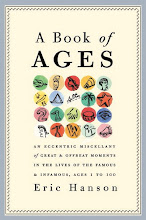
(These stories and many others appear in A Book of Ages, which is an appetizing read for any year.)
Showing posts with label Julia Child. Show all posts
Showing posts with label Julia Child. Show all posts
Wednesday, January 6, 2010

Wednesday, August 5, 2009
The Spy Who Couldn't Cook
In August 1942, Julia McWilliams began her new job at the O.S.S., the World War II forerunner of the C.I.A. She was 30. She wore a leopard fur coat to work on cold days, and lived in a tiny two-room apartment in the Brighton Hotel in Washington. For a kitchen she made do with a two-burner hot-plate set on top of the refrigerator in her living room. She wasn’t famous for her cooking, but she later would be, after marrying Paul Child and moving to France. Julia Child appears six times in A Book of Ages.
Saturday, August 1, 2009
Julia
The new Julia Child movie opens this weekend. The shelves are full of books about her and by her, by people who remember her, and by people who want to be like her or at least want to cook like her. Her kitchen is in the Smithsonian. Her voice is in our heads whenever we cook, although it might be the voice of Dan Ackroyd. No wonder. She is our modern domestic goddess, never mind Martha Stewart and Alice Waters. (All three women have several anecdotes each in A Book of Ages.)
What surprises me is that Nora Ephron didn't think Julia had enough back story for a movie of her own, that she needed to share the screen with a young woman blogging about her recipes. What can you say? Today's TV obsession with chefs and kitchens has more to do with egos and speed and extravagance, with concept, less to do with the down-to-earth creation of good food and eating it. This young wife, played by Amy Adams, promises to cook every recipe from The Art of French Cooking in one year. Hilarity ensues. But which life are we more interested in? Who do we identify with?
That's the point, I guess. Julia works for the spy agency called the O.S.S. during WWII, travels to India and China, marries an urbane diplomat, moves to Paris, enrolls at the Cordon Bleu to learn French cooking (she didn't know how to cook at all until her mid-30s), she writes a cookbook (which her publisher turns down), then goes on public TV and becomes a star. Every life has an arc, and Julia's is interesting and full of surprises. She appears six times in A Book of Ages.
My book is about how famous lives reflect our own, so it's the private, domestic details I find most interesting. Freud and Henry Ford collecting antiques, Steve Martin collecting art, Churchill learning to paint, Jack Kerouac and Edward Elgar learning to drive, Hitler becoming a vegetarian. So I include Julia Child's first meal on her first trip to France––she was 36. The most vivid detail I discovered was the hotplate in her D.C. apartment, where she didn't cook very much or very well.
Wednesday, May 13, 2009
Restlessness
People change. Authors dress differently and stop eating in the same restaurants after they hit the bestseller lists. Hemingway's second wife was rich and he began wintering in Gstaad instead of Schruns. Ballplayers reach a sweet spot in their careers and decline from there, becoming clubhouse sages and managers and posing in ads for Interwoven socks. Rock stars continue on and on, always wealthy, always attractive, because they sell their souls to the devil. This is why lives are interesting to read. Writing A Book of Ages it was these transformations I jotted down. When did Robert Benchley have his first drink? When did Julia Child discover French cuisine? When did the prophet receive wisdom? When did Ty Cobb invest in Coca Cola and make himself a millionaire?
May 13th is the birthday of the writer Bruce Chatwin, born in 1940 in England's industrial midlands. He was an attractive and ingratiating youth, beginning his working life as a lowly usher at Sotheby's, the auction house. His job was to schlep the artworks around. But he had a magic quality that caught the eye of his upperclass bosses. More importantly he had an eye for good art, a nose for the "genuine article." And he spoke his mind. He rose quickly, becoming one of the directors of the firm, a recognized art expert. Then he quit to become a nomad. He wrote articles about places he visited, and published in top London newspapers. He also became what friends describe as a professional houseguest. Then he wrote a novel, and another, metamorphosing into a bestselling novelist. He was charming and charmed, attractive, enigmatic––and everywhere. Then he contracted a rare disease and died in a matter of months. He described his disease as something he'd picked up in central Asia or Africa, depending on who he was speaking to. But it was AIDS. He died a relatively young 48, a decade and a half older than Byron but rather Byronic. Bruce Chatwin appears on pages 46, 117, 136 and 185 in A Book of Ages.
Tuesday, April 28, 2009
Alice and Julia
Alice Waters was born on this day in 1944. She was 27 when she opened her famous Berkeley California restaurant, Chez Panisse. On that first night they served a set menu: paté en croute followed by duck with olives, salad, and almond tart; $3.95. But they ran out of silverware.
When I'm reading a life story I am always looking for signposts, points along the way where the person chooses this road instead of that one, where they meet someone or learn something that changes their life. When Alice Waters was 19 she transferred from the University of California at Santa Barbara to Berkeley. Would she have become the same person if she hadn't moved to Berkeley? Could Chez Panisse have started a food revolution anywhere else?
Alice Waters was 21 when she visited France for the first time. France, too, has a habit of changing people in profound ways. In A Book of Ages I note the Paris arrivals of Gertrude Stein and Alice B. Toklas, Giacomo Casanova, Voltaire, Benjamin Franklin, Ernest Hemingway, Josephine Baker, J. D. Salinger, William F. Buckley Jr., Robert M. Parker, Frederic Chopin and Adolf Hitler.
Julia Child was 36 the first time she saw Paris. She'd never cooked before. Up to this point she'd been employed as an American spy. But she would learn to cook in the French manner, and so would we.
Subscribe to:
Posts (Atom)

 Posts


