Showing posts with label Rolling Stone. Show all posts
Showing posts with label Rolling Stone. Show all posts
Thursday, December 17, 2009
Simpsons Roasting on an Open Fire
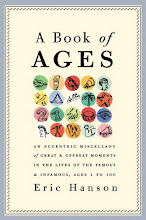
The Simpsons premiered on this day 20 years ago. The first episode, titled "Simpsons Roasting on an Open Fire", was about the family's Christmas being ruined because Homer didn't receive his Christmas bonus. Which is happening a lot this year, unless you work on Wall Street. I see people nodding their heads in recognition. The Simpsons is one of those cultural touchstones that everybody can relate to. Your life is not remotely like theirs, but then again it is. Partly because the program has been running underneath your experiences for the past twenty years, like the commentary track on a DVD. The Simpsons only appear once in A Book of Ages, and only parenthetically, when George Plimpton (age 75) does a guest shot on the program as a corrupt spelling bee judge. Appearances on the cover of Rolling Stone, or on the Tonight Show or in the Doonesbury comic strip are similarly noted in the book.

Monday, August 24, 2009
On the cover of Rolling Stone
Bruce Springsteen appeared on the August 24, 1978 cover of Rolling Stone magazine. He was 28, and had finally made it. Pop stars are routinely baptized as such on the iconic cover of the magazine. Britney Spears made her first appearance at the experienced age of 17. In 1971, 11 year-old Michael Jackson appeared under a provocative question about how late his bedtime was. As rock legends die of various excesses, the Rolling Stone cover treatment has become a valediction and validation. John Lennon appeared on the first cover in 1967 when he was 26, and posed for the famous Annie Liebovitz cover on the day he died at age 40.
Saturday, July 18, 2009
Hunter S. Thompson
Gonzo journalist, anti-hero and role model Hunter S. Thompson was born on July 18, 1937 in Louisville, Kentucky. He appears seven times in A Book of Ages. Jailed for robbery at 18; later turning up as a Caribbean correspondent for Time magazine and El Sportivo; purchasing a mail-order doctorate; running for sheriff in Aspen, Colorado; showing up as a recurring character in Doonesbury; being arrested for possession of various drugs and various weapons, including a Gatling gun; and, perhaps most significantly, inventing shotgun golf (Olympic certification pending.) Measured against his achievements, most of our lives seem tame and uninteresting, but we are still living. Happy Birthday Hunter.
Friday, May 8, 2009
Acknowledgments
I thought I'd take a day to thank some people.
Firstly, I owe a debt to the magazines I read. The critics who've taught me most of what I know about the authors and poets and artists and composers and performers who create the culture. The analysts who explain politics while events are still warm, before they become history, and the history in the background of those events.
In the book I thank the New Yorker, the Atlantic, Rolling Stone, Vanity Fair, the New York Times and their book review, the BBC and NPR and PBS. And Garrison Keillor's Writer's Almanac, which has influenced my voice, as his, I'm sure, was influenced by White and Thurber and Benchley and Leibling, and theirs by Addison and Steele and Hazlitt and Lamb.
I owe them all. They are the voices speaking in my head as I write. The New Yorker crowd especially. White and Thurber and Benchley are in A Book of Ages several times each, as are Dorothy Parker and J. D. Salinger and William Shawn and Harold Ross and Saul Steinberg and S. J. Perelman and John Updike and Calvin Trillin, all part of that miscellaneous genius that arrives here in Minneapolis once every week inside a brilliantly illustrated cover. With cartoons.
Keillor should have been in the book too, but somehow he seemed too contemporary. I'd met him and, like Groucho Marx, we tend to disparage clubs that allow us to be members. I'd have included Garrison's first visit to the Grand Ol' Opry, which gave him the idea he might be up to doing a weekly radio variety program. He'd already hosted a daily one, which I'd listened to mornings while getting ready for work.
Every day I read the paper. Every week the handful of magazines arrived full of new material. As I read I jotted. As I heard anecdotes I asked myself "When did that happen? How old was he, or she?" The jottings became a collection and the collection became a book.
What's interesting is how the many (over 700) different personalities I included––authors being the largest group, but also poets and painters, composers, rock stars, cooks, politicians, husbands and wives, film stars and film directors, generals and assassins and bank robbers, monarchs and revolutionaries, wits and fools, celebrities and journalists–-all of them began talking to each other, adjacent entries commenting on each other, presenting mute ironies and unexpected punning references back and forth. But all of it originated in, was heard or read, in other sources, who read or heard it in other sources themselves. That's the culture for you.
Firstly, I owe a debt to the magazines I read. The critics who've taught me most of what I know about the authors and poets and artists and composers and performers who create the culture. The analysts who explain politics while events are still warm, before they become history, and the history in the background of those events.
In the book I thank the New Yorker, the Atlantic, Rolling Stone, Vanity Fair, the New York Times and their book review, the BBC and NPR and PBS. And Garrison Keillor's Writer's Almanac, which has influenced my voice, as his, I'm sure, was influenced by White and Thurber and Benchley and Leibling, and theirs by Addison and Steele and Hazlitt and Lamb.
I owe them all. They are the voices speaking in my head as I write. The New Yorker crowd especially. White and Thurber and Benchley are in A Book of Ages several times each, as are Dorothy Parker and J. D. Salinger and William Shawn and Harold Ross and Saul Steinberg and S. J. Perelman and John Updike and Calvin Trillin, all part of that miscellaneous genius that arrives here in Minneapolis once every week inside a brilliantly illustrated cover. With cartoons.
Keillor should have been in the book too, but somehow he seemed too contemporary. I'd met him and, like Groucho Marx, we tend to disparage clubs that allow us to be members. I'd have included Garrison's first visit to the Grand Ol' Opry, which gave him the idea he might be up to doing a weekly radio variety program. He'd already hosted a daily one, which I'd listened to mornings while getting ready for work.
Every day I read the paper. Every week the handful of magazines arrived full of new material. As I read I jotted. As I heard anecdotes I asked myself "When did that happen? How old was he, or she?" The jottings became a collection and the collection became a book.
What's interesting is how the many (over 700) different personalities I included––authors being the largest group, but also poets and painters, composers, rock stars, cooks, politicians, husbands and wives, film stars and film directors, generals and assassins and bank robbers, monarchs and revolutionaries, wits and fools, celebrities and journalists–-all of them began talking to each other, adjacent entries commenting on each other, presenting mute ironies and unexpected punning references back and forth. But all of it originated in, was heard or read, in other sources, who read or heard it in other sources themselves. That's the culture for you.
Subscribe to:
Posts (Atom)

 Posts
Posts


