Today is the birthday of John O'Hara. Nobody had more stories published in the New Yorker magazine, and no one was better at describing 20th century American life.
He was born in 1905, the son of a Pottsville, Pennsylvania physician. When he was twelve years-old his father offered to pay him $10,000 if he would agree to become a doctor. The boy refused. Instead, when he was 14, he stole his father's Buick. This harum-scarum tendency lasted him all his life. He possessed a devout wish for approval but he was as likely to throw the approval directly back in someone's face. He was social, but volatile, a swell friend but sensitive to slights and prone to grudges. Everybody in New York literary circles had their own O'Hara story. His drunken behavior, his kindnesses, his feuds, his sulks and bragging.
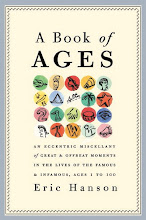
This alternately harsh and tender personality finds vivid expression in his stories. They may be the best picture we have about being alive in America at mid-century. What makes his writing so compelling is the transparency of the style. He is unfussy. Less blunt and mannered than Hemingway. Not elaborate like Faulkner, but detailed in his descriptions of place and time and relationships. Unlike Cheever or Fitzgerald, his sentences don't interpose a lovely style between the reader and the material described. The conversations sound spoken. It is all simply there and happening before you. His novels (except for Appointment in Samarra) tend to be baggy and undistinguished, but his stories deserve a much larger audience. John O'Hara appears five times in A Book of Ages. In 1970, the year he died, he was living in Princeton, New Jersey. He dressed in gentleman's tweeds and drove a Rolls Royce. It was also in this last year that he finally learned to swim. He was 65.
It's also the birthday of Norman Mailer, another writer with a chip on his shoulder, a product of New Jersey and Brooklyn, born in 1923. He wrote his first story when he was ten; it was 35,000 words long. He fought in the Pacific during World War II, and described the experience in his novel The Naked and the Dead. At the age of 44 he was arrested for participating in a march on the Pentagon, protesting the war in Vietnam. He wrote another book about that; The Armies of the Night won the Pulitzer Prize. Norman Mailer appears eight times in A Book of Ages.
Showing posts with label the New Yorker. Show all posts
Showing posts with label the New Yorker. Show all posts
Sunday, January 31, 2010

Monday, December 14, 2009
A Story Everybody Read in School
It's Shirley Jackson's birthday today. Born in 1916 in San Francisco, she wrote short stories for the New Yorker and other magazines. One of them made her famous. She was 28 and had recently moved to Vermont with her husband, who taught at Bennington. One morning while she was walking her children to school she thought of a story. By the time she arrived back home it was completed in her head, and she typed it out before the school day was over.
"The Lottery" appeared in the June 26th, 1948 issue of the New Yorker. Her life was never the same again. We all know what the story's about. If you don't I won't ruin it. It became a controversial part of the curriculum in thousands of high school English classes, where it provoked discussions about what human beings are capable of. Arriving as it did, in the aftermath of the war and its atrocities, it made perfect sense, still it floored the comfortable post-war readers who came upon it unawares. It upset their idea of American exceptionalism. "Nothing like that would ever happen in small town America forgodssake." People canceled their subscriptions and wrote angry letters aimed at the author. Many people thought the housewife in the story was going to win a washer-dryer. Imagine their surprise.
I first came across Shirley Jackson in the book catalogs we brought home from junior high. I gave two of her books to my mother for Christmas. "Life Among the Savages" and "Raising Demons" were about Jackson's disordered family life in Vermont. Individual chapters had run in women's magazines. I remember my mom reading them with tears running down her face, laughing. I read them next and they became my guidebook to family life from an adult point of view. She wrote another story I like to read at this time of year: "My Life with R. H. Macy" describes Jackson's short, comical career as a salesperson during the Christmas rush. Shirley Jackson appears one time in A Book of Ages.
Tuesday, December 8, 2009
Thurber
It's James Thurber's 115th birthday, which means I'll have to pick up one of my Thurber collections and find something to read before I go to bed. Or bed might be the best place. There is something reassuring about Thurber, almost soporific. His best material explains why you think and behave the way you do, why everybody is so foolish, and why that foolishness is so utterly predictable and repetitive. We work to a pattern and patterns are endlessly amusing.
Half blind from age seven, he was completely blind by the time the New Yorker assigned an eighteen year-old Truman Capote to help him around, which meant helping him visit his mistress during lunch hours. Blindness made him angry and being angry made him unpleasant, but his writing was always graceful and companionable. The reader was his intimate friend, his accomplice, sharing his grudges and mistakes. The interiorness of his world conjured stories to flesh out what he couldn't see.
He was a two way threat, a writer who also drew. Office-mate E. B. White would rescue his doodles out of the wastebasket and put them in the magazine. They were throw-away drawings, but that was their charm. They were transcribed thoughts.
James Thurber appears six times in A Book of Ages.
Saturday, July 4, 2009
Novelist and Car Thief
On July 4th, 1919, John O'Hara, the fourteen year-old future novelist and writer of New Yorker short stories, stole his father's Buick.
O'Hara was a complex mixture of conventionality and rebellion. A sensitive soul, but an irascible drunk and a nourisher of grudges. He never got the Ivy League education he'd craved (it was withdrawn after a drunken episode on the eve of his prep school valedictory). It was a loss for which the Rolls Royces he drove, the impeccable tweeds and the address and the burial plot in Princeton could never compensate. The Nobel Committee never phoned, perhaps because his novels were trashy and sold so well. It is his short stories which endure. They provide the best picture we have of America at mid-century; sensitive, nuanced, vividly detailed. This quintessentially American writer appears five times in A Book of Ages.
O'Hara was a complex mixture of conventionality and rebellion. A sensitive soul, but an irascible drunk and a nourisher of grudges. He never got the Ivy League education he'd craved (it was withdrawn after a drunken episode on the eve of his prep school valedictory). It was a loss for which the Rolls Royces he drove, the impeccable tweeds and the address and the burial plot in Princeton could never compensate. The Nobel Committee never phoned, perhaps because his novels were trashy and sold so well. It is his short stories which endure. They provide the best picture we have of America at mid-century; sensitive, nuanced, vividly detailed. This quintessentially American writer appears five times in A Book of Ages.
Friday, June 26, 2009
The Lottery
On June 26, 1948, the New Yorker magazine published a short story by a 28 year-old Vermont housewife. The Lottery is set in an ordinary New England village, much like the one Shirley Jackson lived in. The story is about a town ritual. It unfolds much like the Fourth of July, with the attendant excitement and gossip and speculation, and the town fathers giving speeches, culminating in a drawing of names. Many who read the story in the New Yorker expected the heroine to win a washer-dryer, and were upset by how the story turned out, and angry with Jackson for having the nerve to write it.
Shirley Jackson appears only once in A Book of Ages. Another anecdote was left out with some regret; it involved Jackson using a voodoo doll to break Alfred A. Knopf's leg while he was vacationing at Stowe.
Shirley Jackson appears only once in A Book of Ages. Another anecdote was left out with some regret; it involved Jackson using a voodoo doll to break Alfred A. Knopf's leg while he was vacationing at Stowe.
Friday, May 8, 2009
Acknowledgments
I thought I'd take a day to thank some people.
Firstly, I owe a debt to the magazines I read. The critics who've taught me most of what I know about the authors and poets and artists and composers and performers who create the culture. The analysts who explain politics while events are still warm, before they become history, and the history in the background of those events.
In the book I thank the New Yorker, the Atlantic, Rolling Stone, Vanity Fair, the New York Times and their book review, the BBC and NPR and PBS. And Garrison Keillor's Writer's Almanac, which has influenced my voice, as his, I'm sure, was influenced by White and Thurber and Benchley and Leibling, and theirs by Addison and Steele and Hazlitt and Lamb.
I owe them all. They are the voices speaking in my head as I write. The New Yorker crowd especially. White and Thurber and Benchley are in A Book of Ages several times each, as are Dorothy Parker and J. D. Salinger and William Shawn and Harold Ross and Saul Steinberg and S. J. Perelman and John Updike and Calvin Trillin, all part of that miscellaneous genius that arrives here in Minneapolis once every week inside a brilliantly illustrated cover. With cartoons.
Keillor should have been in the book too, but somehow he seemed too contemporary. I'd met him and, like Groucho Marx, we tend to disparage clubs that allow us to be members. I'd have included Garrison's first visit to the Grand Ol' Opry, which gave him the idea he might be up to doing a weekly radio variety program. He'd already hosted a daily one, which I'd listened to mornings while getting ready for work.
Every day I read the paper. Every week the handful of magazines arrived full of new material. As I read I jotted. As I heard anecdotes I asked myself "When did that happen? How old was he, or she?" The jottings became a collection and the collection became a book.
What's interesting is how the many (over 700) different personalities I included––authors being the largest group, but also poets and painters, composers, rock stars, cooks, politicians, husbands and wives, film stars and film directors, generals and assassins and bank robbers, monarchs and revolutionaries, wits and fools, celebrities and journalists–-all of them began talking to each other, adjacent entries commenting on each other, presenting mute ironies and unexpected punning references back and forth. But all of it originated in, was heard or read, in other sources, who read or heard it in other sources themselves. That's the culture for you.
Subscribe to:
Posts (Atom)

 Posts


