Showing posts with label Vanity Fair. Show all posts
Showing posts with label Vanity Fair. Show all posts
Thursday, July 30, 2009
Very Early Television
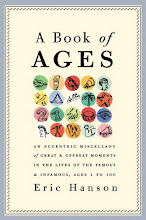
In July 1932, 29 year-old Clare Boothe was having an affair with married Wall Street moneybags Bernard Baruch and was invited over to his place to watch something his friend David Sarnoff called television. Not yet a playwright or married to Henry Luce of Time magazine, Boothe was an editor at Vanity Fair. She appears three times in A Book of Ages. Understudying Mary Pickford on Broadway, letting boyfriend Henry Luce "go all the way", and being nervous as her play "The Women" opens on Broadway in 1936. (Henry Luce appears twice.)

Friday, May 8, 2009
Acknowledgments
I thought I'd take a day to thank some people.
Firstly, I owe a debt to the magazines I read. The critics who've taught me most of what I know about the authors and poets and artists and composers and performers who create the culture. The analysts who explain politics while events are still warm, before they become history, and the history in the background of those events.
In the book I thank the New Yorker, the Atlantic, Rolling Stone, Vanity Fair, the New York Times and their book review, the BBC and NPR and PBS. And Garrison Keillor's Writer's Almanac, which has influenced my voice, as his, I'm sure, was influenced by White and Thurber and Benchley and Leibling, and theirs by Addison and Steele and Hazlitt and Lamb.
I owe them all. They are the voices speaking in my head as I write. The New Yorker crowd especially. White and Thurber and Benchley are in A Book of Ages several times each, as are Dorothy Parker and J. D. Salinger and William Shawn and Harold Ross and Saul Steinberg and S. J. Perelman and John Updike and Calvin Trillin, all part of that miscellaneous genius that arrives here in Minneapolis once every week inside a brilliantly illustrated cover. With cartoons.
Keillor should have been in the book too, but somehow he seemed too contemporary. I'd met him and, like Groucho Marx, we tend to disparage clubs that allow us to be members. I'd have included Garrison's first visit to the Grand Ol' Opry, which gave him the idea he might be up to doing a weekly radio variety program. He'd already hosted a daily one, which I'd listened to mornings while getting ready for work.
Every day I read the paper. Every week the handful of magazines arrived full of new material. As I read I jotted. As I heard anecdotes I asked myself "When did that happen? How old was he, or she?" The jottings became a collection and the collection became a book.
What's interesting is how the many (over 700) different personalities I included––authors being the largest group, but also poets and painters, composers, rock stars, cooks, politicians, husbands and wives, film stars and film directors, generals and assassins and bank robbers, monarchs and revolutionaries, wits and fools, celebrities and journalists–-all of them began talking to each other, adjacent entries commenting on each other, presenting mute ironies and unexpected punning references back and forth. But all of it originated in, was heard or read, in other sources, who read or heard it in other sources themselves. That's the culture for you.
Firstly, I owe a debt to the magazines I read. The critics who've taught me most of what I know about the authors and poets and artists and composers and performers who create the culture. The analysts who explain politics while events are still warm, before they become history, and the history in the background of those events.
In the book I thank the New Yorker, the Atlantic, Rolling Stone, Vanity Fair, the New York Times and their book review, the BBC and NPR and PBS. And Garrison Keillor's Writer's Almanac, which has influenced my voice, as his, I'm sure, was influenced by White and Thurber and Benchley and Leibling, and theirs by Addison and Steele and Hazlitt and Lamb.
I owe them all. They are the voices speaking in my head as I write. The New Yorker crowd especially. White and Thurber and Benchley are in A Book of Ages several times each, as are Dorothy Parker and J. D. Salinger and William Shawn and Harold Ross and Saul Steinberg and S. J. Perelman and John Updike and Calvin Trillin, all part of that miscellaneous genius that arrives here in Minneapolis once every week inside a brilliantly illustrated cover. With cartoons.
Keillor should have been in the book too, but somehow he seemed too contemporary. I'd met him and, like Groucho Marx, we tend to disparage clubs that allow us to be members. I'd have included Garrison's first visit to the Grand Ol' Opry, which gave him the idea he might be up to doing a weekly radio variety program. He'd already hosted a daily one, which I'd listened to mornings while getting ready for work.
Every day I read the paper. Every week the handful of magazines arrived full of new material. As I read I jotted. As I heard anecdotes I asked myself "When did that happen? How old was he, or she?" The jottings became a collection and the collection became a book.
What's interesting is how the many (over 700) different personalities I included––authors being the largest group, but also poets and painters, composers, rock stars, cooks, politicians, husbands and wives, film stars and film directors, generals and assassins and bank robbers, monarchs and revolutionaries, wits and fools, celebrities and journalists–-all of them began talking to each other, adjacent entries commenting on each other, presenting mute ironies and unexpected punning references back and forth. But all of it originated in, was heard or read, in other sources, who read or heard it in other sources themselves. That's the culture for you.
Friday, April 10, 2009
Mona Lisa, Gatsby, Theroux
The story about the 1911 theft of the Mona Lisa is detailed in the new Vanity Fair, but the most interesting anecdote, involving the poet Guillaume Apollinaire and a young painter named Pablo Picasso, appears on page 109 of A Book of Ages.
Today is author Paul Theroux's birthday; he's 68. He was thirty when he quit teaching to be a writer full time. He also was making enough, finally, to own his own telephone. Page 107, A Book of Ages.
The Great Gatsby was published on April 10, 1925. Fitzgerald wrote much of it the year before while living in France. While there he also took the time to recommend a young writer to his editor at Scribners, a writer he hadn't even met yet named Ernest Hemingway, who was also living in Paris. Fitzgerald is already drinking heavily but not disastrously, as his prose demonstrates, but the novel doesn't sell very well, nor will the next or the one following it, all of which leads Fitz to observe that there are no second acts in American life. F. Scott Fitzgerald appears on pages 69, 89, 103, 148, 153, 161 and 171 in A Book of Ages. There are second acts, by the way, you just have to survive to see them.
Today is author Paul Theroux's birthday; he's 68. He was thirty when he quit teaching to be a writer full time. He also was making enough, finally, to own his own telephone. Page 107, A Book of Ages.
The Great Gatsby was published on April 10, 1925. Fitzgerald wrote much of it the year before while living in France. While there he also took the time to recommend a young writer to his editor at Scribners, a writer he hadn't even met yet named Ernest Hemingway, who was also living in Paris. Fitzgerald is already drinking heavily but not disastrously, as his prose demonstrates, but the novel doesn't sell very well, nor will the next or the one following it, all of which leads Fitz to observe that there are no second acts in American life. F. Scott Fitzgerald appears on pages 69, 89, 103, 148, 153, 161 and 171 in A Book of Ages. There are second acts, by the way, you just have to survive to see them.
Subscribe to:
Posts (Atom)

 Posts
Posts


