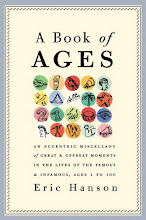
In October 1964, Guiseppe Bonanno, a.k.a. “Joe Bananas”, was allegedly kidnapped by alleged mob rivals Peter and Nino Magaddino, while allegedly walking down Park Avenue in New York City. Bonanno was allegedly released after he agreed to retire from the business he was engaged in. But according to Sam “The Plumber” Decavalcante, none of this ever happened. Mr. Bonanno was 59. He appears five times in A Book of Ages.
I leavened the mixture of sports heroes, rock stars, politicians, film actors, authors and artists with a selection of anti-heroes, rogues, bank robbers like Bonnie and Clyde, and a few murderers. It gave the book more flavor. Bonanno finally died of natural causes in Tucson, Arizona at age 97. Clean living and regular habits, I guess. After the boss's death, Joseph "Big Joey" Massino and Richard "Shellackhead" Cantarella immediately started singing to the Feds.
Wednesday, October 7, 2009

Howl
Allen Ginsberg was six years-old when his mother was committed to an insane asylum. He was 18 and a student at Columbia when he met Jack Kerouac. He was expelled from the university the next year and joined the Merchant Marine. In 1948 he was back in New York, sitting in his Harlem apartment, when he had a vision of the poet Blake. He described it as “a sense of cosmic consciousness, vibrations, understanding, awe, and wonder and surprise." But writing poetry didn't pay the rent, so he got a job at an advertising agency located in the Empire State Building, where he wrote ads for Ipana toothpaste.
On October 7, 1955 Ginsberg read Howl for the first time to an audience in San Francisco. He was living in North Berkeley then, Kerouac was staying with him. They rode the bus together across the Bay Bridge and then bummed a ride in Lawrence Ferlinghetti’s Aston Martin to the Six Gallery near Fillmore and Union. Ginsberg was the fifth poet on the program. He began with the famous line: “I saw the best minds of my generation destroyed by madness.” Afterwards, Ginsburg, Kerouac, and a few others went out for Chinese. He was 29 and had finally arrived. Allen Ginsberg appears five times in A Book of Ages.
On October 7, 1955 Ginsberg read Howl for the first time to an audience in San Francisco. He was living in North Berkeley then, Kerouac was staying with him. They rode the bus together across the Bay Bridge and then bummed a ride in Lawrence Ferlinghetti’s Aston Martin to the Six Gallery near Fillmore and Union. Ginsberg was the fifth poet on the program. He began with the famous line: “I saw the best minds of my generation destroyed by madness.” Afterwards, Ginsburg, Kerouac, and a few others went out for Chinese. He was 29 and had finally arrived. Allen Ginsberg appears five times in A Book of Ages.
Tuesday, October 6, 2009
Lumberjack, Parrot-Fancier, Geographer
Last week 66 year-old former Python and world traveler Michael Palin became the new president of the Royal Geographical Society, one of those clubbish, leather-armchaired institutions that maintains vague associations with the Royals and underwrites expeditions to save tropical butterflies. The RGS supported the expeditions of Edmund Hillary, Charles Darwin, Robert Falcon Scott, Stanley and Livingstone, and Richard Francis Burton, all of whom appear in A Book of Ages. Most of the Society's past presidents were named Viscount This or Earl That. They were Important People with ancestors and large houses in the shires, the sort of people Monty Python liked to lampoon by wearing balaclava helmets and acting inanely brave or bossy.
Michael Palin appears in A Book of Ages only once, in 1969, at age 26, when he and Terry Jones wrote and performed the famous song about a lumberjack with very secure self-esteem. That year they also collaborated on a sketch about a couple who try to order breakfast in a café but are constantly interrupted by Vikings singing about processed meat. The Spam obsessed Vikings later influenced the naming of the junk mail that relentlessly fills our email inboxes. In 66 years, Michael Palin has become an influential person without losing his charm or his ability to act silly.
Michael Palin appears in A Book of Ages only once, in 1969, at age 26, when he and Terry Jones wrote and performed the famous song about a lumberjack with very secure self-esteem. That year they also collaborated on a sketch about a couple who try to order breakfast in a café but are constantly interrupted by Vikings singing about processed meat. The Spam obsessed Vikings later influenced the naming of the junk mail that relentlessly fills our email inboxes. In 66 years, Michael Palin has become an influential person without losing his charm or his ability to act silly.
Monday, October 5, 2009
A Letter to 84 Charing Cross Road
Sixty years ago today, on October 5, 1949, Helene Hanff wrote a letter to a bookstore in London. Marks & Co. was located at 84 Charing Cross Road; Miss Hanff was located on East 95th Street in New York City. She'd read their ad in the Saturday Review (a magazine once influential and now dead) and asked if they could send her "clean secondhand copies" of books on a list she enclosed. Hazlitt, Stevenson, Leigh Hunt––she loved books of essays. Also English authors, mostly 19th century. (In the letter she disparages the "grimy, marked-up schoolboy copies" available at Barnes & Noble, which was where NYU students flogged their books.) This initial note began a twenty-year friendship.
Helene Hanff was a 33 year-old writer of radio and television scripts and unproduced stage plays. She never visited Marks & Co. Friends of hers who visited London stopped by the shop and described its details and its people to her; that's the closest she came. By the time she could afford the fare to London the store had closed and her book-dealer correspondent, Frank Doel, had died. Hanff didn't particularly like travel anyway. She traveled through books, and the books traveled to her. Despite her love of cigarettes and martinis, she lived to be 80. Helene Hanff appears once in A Book of Ages, writing that first of many letters. In 1970 the two-way correspondence was collected into a book of its own, which I still reread occasionally. It remains in print.
I remember reading 84 Charing Cross Road when it was first published. I was a 14 year-old book collector, and obtained most of my books not by catalog but by bicycle. I rode the ten or so miles from suburban Minneapolis to Nelson's Book Shop and Oudal's Used and Rare located downtown, bringing the books home in a backpack. Hanff and I had similar tastes, though I preferred Charles Lamb to Hazlitt and Hunt. I still have the books I bought then, the prices I paid remain unerased inside the endpapers. The 1900 Dent edition of The Last Essays of Elia (with illustrations by C. E. Brock) cost $2.
Helene Hanff was a 33 year-old writer of radio and television scripts and unproduced stage plays. She never visited Marks & Co. Friends of hers who visited London stopped by the shop and described its details and its people to her; that's the closest she came. By the time she could afford the fare to London the store had closed and her book-dealer correspondent, Frank Doel, had died. Hanff didn't particularly like travel anyway. She traveled through books, and the books traveled to her. Despite her love of cigarettes and martinis, she lived to be 80. Helene Hanff appears once in A Book of Ages, writing that first of many letters. In 1970 the two-way correspondence was collected into a book of its own, which I still reread occasionally. It remains in print.
I remember reading 84 Charing Cross Road when it was first published. I was a 14 year-old book collector, and obtained most of my books not by catalog but by bicycle. I rode the ten or so miles from suburban Minneapolis to Nelson's Book Shop and Oudal's Used and Rare located downtown, bringing the books home in a backpack. Hanff and I had similar tastes, though I preferred Charles Lamb to Hazlitt and Hunt. I still have the books I bought then, the prices I paid remain unerased inside the endpapers. The 1900 Dent edition of The Last Essays of Elia (with illustrations by C. E. Brock) cost $2.
Sunday, October 4, 2009
Apollo 11
On October 4, 1969, former German rocket scientist Wernher Von Braun watched the Apollo 11 moon landing with the other NASA scientists on the little TV’s at Mission Control. He was 57. Thirty years earlier he'd been designing rockets for Germany to use in the destruction of London. Wernher von Braun appears four times in A Book of Ages.
Saturday, October 3, 2009
Patriotic Gore
Gore Vidal first enjoyed the public gaze at age three when he became the first child to fly across the United States in a plane. He's enjoyed attention ever since. A preening, arrogant, articulate, intelligent, entertaining scold. A critic of almost everything Americans do or say or think, but a defender of our rights to be as stupid as we are, which makes him the most valuable kind of American: a troublesome patriot. I like Barbara Ehrenreich's line: "Dissent, rebellion, and all-around hell-raising remain the true duty of patriots." He and H. L. Mencken serve as bookends to the American sensibility, one left-wing, the other right, both discontented and contemptuous.
Gore Vidal was born on this day in 1925 in, of all places, West Point, New York. His mother was an actress and New York socialite. His father, a former West Point All-American quarterback, was the academy's first aeronautics instructor when Gore was born, and went on to direct FDR's bureau of air commerce in the Department of Commerce. Which is how the toddler wound up in a plane at such a tender age. At age 11 Gore was flying his own airplane in a Pathé newsreel. He fought in World War II and wrote a novel about it. His third novel, The City and the Pillar (provocative title) was daring enough to suggest that homosexuals were as normal as anybody else, which caused the New York Times to ban reviews of his next five novels. He was 22. He wrote the script for Ben Hur, became friends with Tennessee Williams and the Paul Newmans. In 1960 he ran for Congress––and lost. His most celebrated moment may have been his televised scuffle with William F. Buckley Jr. during ABC's coverage of the the 1968 Democratic Convention.
In the 1970s Vidal said this: "There is only one party in the United States, the Property Party...and it has two right wings: Republican and Democrat. Republicans are a bit stupider, more rigid, more doctrinaire in their laissez-faire capitalism than the Democrats, who are cuter, prettier, a bit more corrupt—until recently... and more willing than the Republicans to make small adjustments when the poor, the black, the anti-imperialists get out of hand. But, essentially, there is no difference between the two parties." Thus proving he could be very right and very wrong in one paragraph, but always provocative and intelligent. In spite of everything, he always considered himself a conservative. If conservative means preserving what works, for instance a functioning and fair-minded government to serve public needs, then he probably is one, and so am I. Gore Vidal appears six times in A Book of Ages.
Gore Vidal was born on this day in 1925 in, of all places, West Point, New York. His mother was an actress and New York socialite. His father, a former West Point All-American quarterback, was the academy's first aeronautics instructor when Gore was born, and went on to direct FDR's bureau of air commerce in the Department of Commerce. Which is how the toddler wound up in a plane at such a tender age. At age 11 Gore was flying his own airplane in a Pathé newsreel. He fought in World War II and wrote a novel about it. His third novel, The City and the Pillar (provocative title) was daring enough to suggest that homosexuals were as normal as anybody else, which caused the New York Times to ban reviews of his next five novels. He was 22. He wrote the script for Ben Hur, became friends with Tennessee Williams and the Paul Newmans. In 1960 he ran for Congress––and lost. His most celebrated moment may have been his televised scuffle with William F. Buckley Jr. during ABC's coverage of the the 1968 Democratic Convention.
In the 1970s Vidal said this: "There is only one party in the United States, the Property Party...and it has two right wings: Republican and Democrat. Republicans are a bit stupider, more rigid, more doctrinaire in their laissez-faire capitalism than the Democrats, who are cuter, prettier, a bit more corrupt—until recently... and more willing than the Republicans to make small adjustments when the poor, the black, the anti-imperialists get out of hand. But, essentially, there is no difference between the two parties." Thus proving he could be very right and very wrong in one paragraph, but always provocative and intelligent. In spite of everything, he always considered himself a conservative. If conservative means preserving what works, for instance a functioning and fair-minded government to serve public needs, then he probably is one, and so am I. Gore Vidal appears six times in A Book of Ages.
Friday, October 2, 2009
Peanuts
On October 2, 1950 Charles Schulz debuted his new comic strip in seven newspapers. The syndicate paid the 27 year-old cartoonist $90 a month. Peanuts. Schulz appears 13 times in A Book of Ages.
Career Tracks
Wallace Stevens was born on this day in 1879, in Reading, Pennsylvania. He always wanted to be a writer but then he studied law, as his father urged him to do, and spent his whole working life in the insurance business, eventually becoming an executive for the Hartford. Which is the story of everybody's life. Most of the novelists you read pay their mortgages by teaching. Poets write advertising copy. T. S. Eliot was an editor. Edgar Lee Masters wrote poems while sitting in a courtroom where he was defending a Chicago waitresses' union. For a while in his twenties Allen Ginsberg wrote ads for Ipana toothpaste. We live our lives on separate tracks. Wallace Stevens walked two miles to work every morning and two miles back home, composing his poems along the sidewalks of Hartford. An irreproachable life apart from the incident in Key West when he broke his hand on Ernest Hemingway's jaw. Stevens appears five times in A Book of Ages.
Wednesday, September 30, 2009
Live Fast, Die Young
On September 30, 1955, James Dean died in a head on collision while driving his Porsche Spyder to a race in Salinas, California. He was 24. He'd starred in three films, all made within the previous year, East Of Eden, Rebel Without A Cause, and Giant, for which he received two Oscar nominations. James Dean appears four times in A Book of Ages.
Tuesday, September 29, 2009
Irony and Safire
William Safire, who died the other day, was a master of ironic commentary. Every Sunday I was impressed at the way he was able to turn his column about language and words into a forum on the shortcomings of liberals. So it was a pleasure to include him in my book, winning a Pulitzer Prize in 1978, at age 48, for exposing the corruption in the Carter administration. Few knew corruption as intimately as Safire––he'd worked in the Nixon White House. The entry following the one about Safire is about Paul Newman, who at age 48, discovered his name was on President Nixon's enemies list.
Louis Armstrong speaks his mind
In September 1957 Louis Armstrong broke his long silence on the race issue in an interview to a young reporter for the Grand Forks Herald in North Dakota. He was 56. It came as a shock to most Americans who were used to the trumpeter’s ingratiating smile and comic manner, but he was angry, and had been angry for a long time. The interview came two weeks after black schoolchildren were barred from schools in Little Rock by National Guardsmen. Almost a century since Emancipation, Armstrong was the first black man to stay in Grand Forks’ finest hotel. Louis Armstrong appears five times in A Book of Ages.
Monday, September 28, 2009
Tom and Viv
In September 1932, T. S. Eliot moved out of the London apartment he shared with his wife, Vivien. The poet was 43. They'd been married for almost twenty years, but her mental illness had made her increasingly difficult to live with. She had begun biting visitors. The poet (who was never married to the novelist George Eliot) appears seven times in A Book of Ages.
Sunday, September 27, 2009
Picking Winners
In September 1945, German scientist Wernher von Braun, architect of the V-2 rocket program which had been blowing large holes in London, surrendered to the Americans instead of the Soviets. Which is why people on the moon speak English today instead of Russian. He was 33 at the time. He was 57 when he watched the American moon landing from mission control. Mr. von Braun appears four times in A Book of Ages.
Friday, September 25, 2009
Epiphanies
One evening in September 1931, C. S. Lewis had one of those late night discussions about Christianity with his usual Oxford chums J. R. R. Tolkien and Hugo Dyson. The next day he had an epiphany on his way to the zoo. He was on the back of his brother's motorcycle. Lewis later tells how when he started off for the zoo “I did not believe that Jesus Christ was the Son of God, and when we reached the zoo I did." Lewis was 32 and had always been a skeptic.
Life is full of journeys, long and short, with and without epiphanies. But there are discoveries of one kind or another waiting just outside our door. Even the minor ones are pretty interesting. Not everyone gets to discover the Pacific from a peak in Darien or the moons of Jupiter from a hillside near Florence. Sometimes, like Graham Greene, we come across something ordinary like a reasonably priced meal when that's exactly what we need. There are a lot of discoveries in A Book of Ages. They can happen at any age.
Life is full of journeys, long and short, with and without epiphanies. But there are discoveries of one kind or another waiting just outside our door. Even the minor ones are pretty interesting. Not everyone gets to discover the Pacific from a peak in Darien or the moons of Jupiter from a hillside near Florence. Sometimes, like Graham Greene, we come across something ordinary like a reasonably priced meal when that's exactly what we need. There are a lot of discoveries in A Book of Ages. They can happen at any age.
Thursday, September 24, 2009
A Wild and Crazy Guy
On September 24, 1977 Steve Martin told a live network television audience that he was a “wild and crazy guy." He may have been wearing an arrow through his head. He was 32. Steve Martin appears six times in A Book of Ages.
Wednesday, September 23, 2009
Martha Stewart
In September 1965, Martha Stewart quit her modeling career after the birth of her daughter Alexis. She was 24. She would eventually find other work. The homemaking doyenne appears five times in A Book of Ages.
Tuesday, September 22, 2009
Keats
In one year, between September 1818 and September 1819, John Keats wrote most of the poems that would ensure his immortality, including “Ode on a Grecian Urn,” “Ode to a Nightingale” and “To Autumn.” He was 23 years-old and would live another two years. Keats appears twice in A Book of Ages.
Monday, September 21, 2009
Gandhi
In September 1888, Gandhi sailed from Bombay to England, alone, to study law. He was eighteen years-old and a new father. Gandhi appears seven times in A Book of Ages.
Sunday, September 20, 2009
Frida Kahlo
On a rainy September day in 1925, Frida Kahlo was riding a Mexico City bus when it collided with a streetcar. She was treated for a broken pelvis, a dislocated shoulder, two broken ribs and shattered bones in her right leg and foot. A series of operations and painful convalescences were to follow. She put aside her plans to attend medical school and began to paint. She was eighteen. Frida Kahlo appears six times in A Book of Ages.
Saturday, September 19, 2009
Ian Fleming
In September 1925 Ian Fleming received seven blackballs when his brother Peter put him up for membership in Pop, the exclusive Eton social club. The future author of the James Bond novels was 17. It must have rankled to be found not up to standard, not the right sort. He got his own back via Bond's arrogant perfection.
Fleming's life reads like a good novel. He was a scoundrel, a lowlife among the uppercrust, a borrower of other men's wives. In 1939, his great coup as a spy went awry when he was caught smuggling condoms out of the Soviet Union; his cunning idea was to have them analyzed to learn the state of the Soviet rubber industry. He was 30 and a bit old for a spy, really. In his novels he could fantasize about how a competent spy might operate. He named his hero James Bond after an ornithologist, an expert on the subject of West Indian birds, something Fleming was an expert about too, in a manner of speaking. Ian Fleming appears seven times in A Book of Ages.
Fleming's life reads like a good novel. He was a scoundrel, a lowlife among the uppercrust, a borrower of other men's wives. In 1939, his great coup as a spy went awry when he was caught smuggling condoms out of the Soviet Union; his cunning idea was to have them analyzed to learn the state of the Soviet rubber industry. He was 30 and a bit old for a spy, really. In his novels he could fantasize about how a competent spy might operate. He named his hero James Bond after an ornithologist, an expert on the subject of West Indian birds, something Fleming was an expert about too, in a manner of speaking. Ian Fleming appears seven times in A Book of Ages.
Friday, September 18, 2009
Paul Meets George
In September 1954, 12 year-old Paul McCartney met 11 year-old George Harrison on a Liverpool bus. A Book of Ages is full of crossed paths and lucky meetings. John Lennon meeting Yoko Ono at a gallery opening when he was 26; Elvis meeting the Beatles when he was 30 (he didn't know their names and couldn't tell them apart). Elvis meeting President Nixon. Che Guevara meeting Castro, Gertrude Stein meeting Alice B. Toklas, Lillian Hellman meeting Dashiell Hammett, J. D. Salinger meeting Ernest Hemingway, Mark Twain meeting Sigmund Freud, Freud meeting Jung, Freud meeting Salvador Dali, Lincoln meeting Harriet Beecher Stowe, T. S. Eliot meeting Groucho Marx, Charles Lindbergh meeting Hitler. Sylvia Plath meeting Ted Hughes at a party in Cambridge; she bit his cheek till it bled. Rodgers meeting Hammerstein, Astaire meeting Rogers, Rolls meeting Royce. When partners meet there is an electric spark. It can happen anywhere, at any age.
Thursday, September 17, 2009
Judy Garland
In September 1935 Judy Garland had a personal audition with Louis B. Mayer at MGM and was signed to a contract for $100 a week. She was 13, bright-eyed, pudgy, adorable and enormously talented. The talent came paired with a trembling vulnerability, the eyes almost on the verge of tears, the tremble in the voice. She starred in nine movies opposite Mickey Rooney, usually playing the true-hearted best friend, then in 1939 she played Dorothy in The Wizard of Oz; she was 16.
Louis B. Mayer thought her plumpness unattractive and he and other MGM executives urged her to lose weight. She was given pills to accomplish this. She grew thinner but became addicted to the pills. Pills and alcohol made her an unreliable performer on set and she was fired from several pictures during production, she suffered nervous breakdowns and paralyzing episodes of self-doubt, but she remained a galvanizing presence on stage. Audiences sat mesmerized while she performed on that narrow space between perfection and collapse, an apt metaphor for stardom if there ever was one. Judy Garland appears six times in A Book of Ages.
Louis B. Mayer thought her plumpness unattractive and he and other MGM executives urged her to lose weight. She was given pills to accomplish this. She grew thinner but became addicted to the pills. Pills and alcohol made her an unreliable performer on set and she was fired from several pictures during production, she suffered nervous breakdowns and paralyzing episodes of self-doubt, but she remained a galvanizing presence on stage. Audiences sat mesmerized while she performed on that narrow space between perfection and collapse, an apt metaphor for stardom if there ever was one. Judy Garland appears six times in A Book of Ages.
Sunday, September 6, 2009
Heart of Darkness
On September 6, 1890, Joseph Conrad took command of a small steamship traveling down the Congo River from Stanley Falls to Leopoldville. He was 32. Twelve years later, the experience formed the germ of his novel Heart Of Darkness.
Saturday, September 5, 2009
Jesse James
Today is the birthday of Jesse James, born in 1847 in Clay County, Missouri. When he was 15 he rode with Quantrill's Raiders in a raid on the abolitionist settlement of Lawrence, Kansas, during which one hundred and fifty men, women and children were murdered. Shortly after the Civil War he and his brother Frank joined up with the four Younger brothers to form a gang. They robbed banks, businesses and trains across Texas, Missouri, Kansas, Iowa, Tennessee, Kentucky and West Virginia, shooting bank clerks, bystanders, children and horses who got in the way.
In September 1876 they rode north into Minnesota to rob the bank in Northfield, but the townspeople shot back, killing two of the bandits and wounding the rest. The robbers shot the bank clerk dead as they escaped. 1876 is considered the high water mark of the Wild West. That same summer, Wild Bill Hickock was gunned down in Deadwood, South Dakota and George Armstrong Custer died with all of his men at Little Big Horn.
Jesse James was shot to death by one of his criminal associates, Bob Ford, in 1882. He was 34. The Robin Hood image attached to James grew after his death, but there's no evidence he shared any of his loot with the poor or with anyone. Tyrone Power, Robert Wagner, Robert Duvall, Rob Lowe, Colin Farrell and Brad Pitt are among the movie idols who have played him in more than twenty five films. Jesse James appears three times in A Book of Ages.
In September 1876 they rode north into Minnesota to rob the bank in Northfield, but the townspeople shot back, killing two of the bandits and wounding the rest. The robbers shot the bank clerk dead as they escaped. 1876 is considered the high water mark of the Wild West. That same summer, Wild Bill Hickock was gunned down in Deadwood, South Dakota and George Armstrong Custer died with all of his men at Little Big Horn.
Jesse James was shot to death by one of his criminal associates, Bob Ford, in 1882. He was 34. The Robin Hood image attached to James grew after his death, but there's no evidence he shared any of his loot with the poor or with anyone. Tyrone Power, Robert Wagner, Robert Duvall, Rob Lowe, Colin Farrell and Brad Pitt are among the movie idols who have played him in more than twenty five films. Jesse James appears three times in A Book of Ages.
Friday, September 4, 2009
Buried Treasure
On September 4, 1666, diarist Samuel Pepys dug a hole in his back garden to bury his wine and his best cheese in, and hopefully save it from the Great Fire Of London, which was burning closer by the day. He was 33.
Snap
It was on this day in 1888 that George Eastman received a patent for the camera design he called a Kodak. It used film that unspooled like a strip of flypaper. It required chemicals and enlargers and skill and patience to convert the images to paper. Now we snap pictures with our phones. Thousands of them. Most of them we never develop or print at all. We look at them in miniature form on a tiny screen. We phone them to our friends who do the same before throwing them away. I expect most of the photography of our era will last no longer than the cheap ephemeral devices we carry them around in, devices which we replace every few years. I suppose that this is an improvement on the boxes and boxes of printed photos that sit unsorted in closets and under beds. Charles Eastman doesn't appear in A Book of Ages, but photographers Diane Arbus, Ansel Adams, Lewis Carroll, Henri Cartier-Bresson, Louis Daguerre, Alberto Korda, Alfred Stieglitz, Walker Evans, Mathew Brady, Annie Lebowitz and Abraham Zapruder do.
Thursday, September 3, 2009
"Earth hasn't anything to show more fair"
Garrison Keillor's Writer's Almanac reminds me that it was 207 years ago today that William Wordsworth composed his sonnet upon Westminster Bridge. Wordsworth appears five times in A Book of Ages.
Unity Mitford
On September 3, 1939, an hour after the declaration of war, attractive 25 year-old British upper-class Hitler-worshipper, Unity Mitford, sat down on a bench in Munich’s Englischer Garden and shot herself twice in the head. She didn’t die from it. She would live out the war in a vague, childlike state at her parents’ country house in Oxfordshire.
Tuesday, September 1, 2009
The Good War
Seventy years ago today Germany invaded Poland, assuming Britain and France wouldn't care about it any more than they had cared about Czechoslovakia. They did care this time. Neville Chamberlain was soon on his way out and Churchill, that irresponsible war-monger and back-number, was in Number 10 within the year. War would make him the man of the century.
But it's hard to call any war that killed 70 million people a good war. The heroes were heroic, mostly, and the villains were recognizable as monsters. The great novelists and artists of the 20th century set foot in this war. J.D. Salinger and Kurt Vonnegut fought in the Battle of the Bulge. Ernest Hemingway liberated the Ritz Bar in Paris. James Michener wrote some tales about the South Pacific and Rodgers and Hammerstein would make a musical about it. Norman Mailer was a rifleman in that same theater of the war. Graham Greene missed being killed by a German bomb because he was sleeping with his mistress at the time. Evelyn Waugh was an officer so hated by his men that he had to be reassigned for his own protection.
Joseph Heller flew combat missions. So did James Stewart. Afterwards he could no longer play wide eyed innocents. War added a layer of grit and cynicism and suppressed anger to his civilian roles. It was John Wayne, roughly the same age as Stewart, who stayed home to play war heroes on film. Heller's novel distilled war's insanity into a phrase: Catch 22. Vonnegut lived the firebombing of Dresden and wrote a novel around it. Salinger took a bullet out of the war and once everybody was home and safe he put it in the brain of Seymour Glass.
These personalities and their own particular versions of WWII are each included in A Book of Ages, as are Eisenhower and MacArthur and Patton and Roosevelt and Truman and Hirohito and Hitler, the people who made it happen. And Anne Frank, the quiet 14 year-old girl who died at Bergen Belsen.
But it's hard to call any war that killed 70 million people a good war. The heroes were heroic, mostly, and the villains were recognizable as monsters. The great novelists and artists of the 20th century set foot in this war. J.D. Salinger and Kurt Vonnegut fought in the Battle of the Bulge. Ernest Hemingway liberated the Ritz Bar in Paris. James Michener wrote some tales about the South Pacific and Rodgers and Hammerstein would make a musical about it. Norman Mailer was a rifleman in that same theater of the war. Graham Greene missed being killed by a German bomb because he was sleeping with his mistress at the time. Evelyn Waugh was an officer so hated by his men that he had to be reassigned for his own protection.
Joseph Heller flew combat missions. So did James Stewart. Afterwards he could no longer play wide eyed innocents. War added a layer of grit and cynicism and suppressed anger to his civilian roles. It was John Wayne, roughly the same age as Stewart, who stayed home to play war heroes on film. Heller's novel distilled war's insanity into a phrase: Catch 22. Vonnegut lived the firebombing of Dresden and wrote a novel around it. Salinger took a bullet out of the war and once everybody was home and safe he put it in the brain of Seymour Glass.
These personalities and their own particular versions of WWII are each included in A Book of Ages, as are Eisenhower and MacArthur and Patton and Roosevelt and Truman and Hirohito and Hitler, the people who made it happen. And Anne Frank, the quiet 14 year-old girl who died at Bergen Belsen.
The Merry Pranksters
In 1963, novelist Ken Kesey’s bungalow in the Bohemian neighborhood of Menlo Park, California, was torn down by developers so he moved to a place deep in the redwoods in nearby La Honda, where he'd heard "marijuana grows like a weed." On September 1, 1963, he formed “The Merry Pranksters.” He was 27. Ken Kesey appears twice in A Book of Ages.
Subscribe to:
Posts (Atom)

 Posts
Posts


